
What was the chief economic foundation of the triangular commerce between India, China and England ?
- (a)Silk
- (b)Opium
- (c)Black pepper
- (d)More than one of the above
Answer
Why
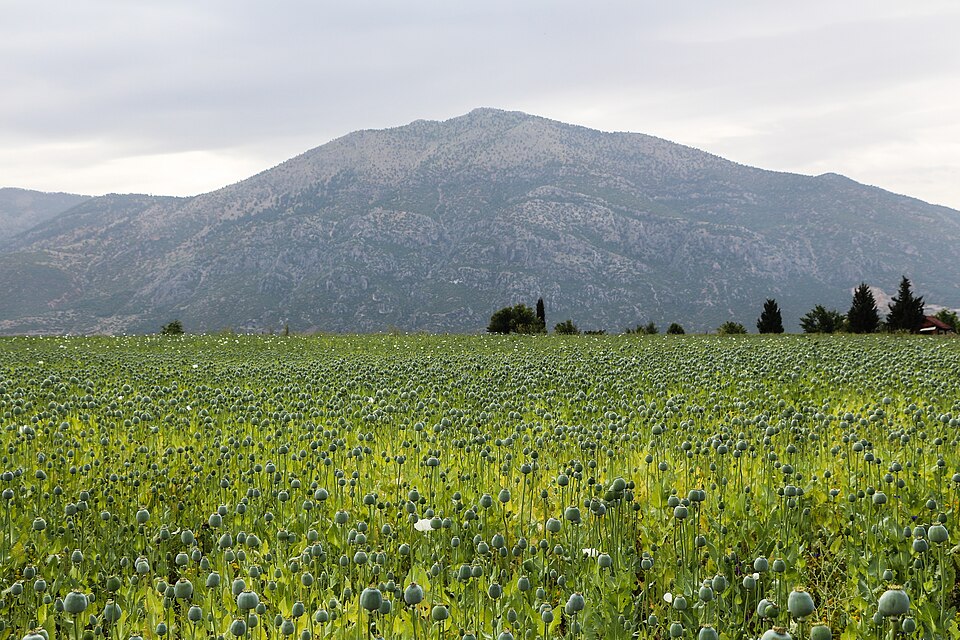
Correct: B, Opium. The triangle existed to solve a British payments problem. Britain had developed an enormous appetite for Chinese tea, but China wanted almost nothing British in return and would accept only silver, so bullion flowed steadily out of Britain into Canton. Opium reversed that flow. The East India Company held a monopoly over opium grown in the Bengal Presidency: the poppy districts of Bihar and eastern Uttar Pradesh, worked through the Company's Patna and Benares agencies: processed it, and auctioned it at Calcutta to private 'country traders'. Because the Company could not itself be seen smuggling a commodity the Qing state had banned, those private merchants carried the chests to the Chinese coast and sold them for silver; that silver went back into Canton to buy tea, and the tea sailed to England. India supplied the drug, China supplied the tea and absorbed the drug, England supplied the demand and the shipping. Every leg of the triangle was ultimately financed by opium, which is what 'chief economic foundation' means here. The scale of the dependence is proved by what Britain was prepared to do to protect it: when the Qing commissioner Lin Zexu seized and destroyed some 20,000 chests of opium at Humen in 1839, Britain went to war, and the First Opium War (1839–42) ended with the Treaty of Nanking. A second war (1856–60), closed by the Treaty of Tientsin and the Convention of Peking, made the trade legal outright.
Why the others are wrong
- (a)Silk: Silk genuinely moved in this trade: Chinese silk went to Britain alongside tea, and Bengal raw silk was one of the Company's staple exports. But silk was cargo, not the mechanism: it was another thing Britain had to pay China for, so it deepened the silver problem rather than solving it. The commodity that closed the payments gap was opium.
- (c)Black pepper: Pepper belongs to an earlier and different story: the Malabar spice trade that drew the Portuguese and the Dutch to India in the sixteenth and seventeenth centuries. It had no significant role in the nineteenth-century opium-tea-silver triangle, and China was not a market for it.
- (d)More than one of the above: This option is ruled out by a single word in the stem: 'chief'. A superlative admits exactly one answer, so even though silk was genuinely traded, it cannot share the title of the trade's chief economic foundation. Use this test whenever BPSC's fourth option appears: 'more than one' can only be right if two of the earlier options are simultaneously true of the thing asked, and a 'chief', 'largest' or 'first' question makes that impossible.
Concept
The India-China-Britain triangle was the financial engine of the Company's later empire. Bengal opium was a state monopoly: cultivators in Bihar and eastern UP were advanced money to grow the poppy and were bound to deliver the crude opium to Company agencies at fixed prices, where it was processed into chests for the China market. Malwa opium from the western princely states competed through Bombay. The revenue mattered enormously: opium was for decades among the largest single sources of Indian government income, ranking behind land revenue. On the British side, the Charter Act of 1813 ended the Company's monopoly of Indian trade but expressly preserved its monopoly of tea and of trade with China; that remaining monopoly went in 1833. The system also fed the drain-of-wealth argument that Indian nationalists such as Dadabhai Naoroji would later make: Indian land, Indian peasants and Indian revenue financed a commerce whose profits accumulated in London.
Read the stem for its superlative before you read the options. 'Chief economic foundation' asks for the one commodity without which the triangle collapses, not for a list of things that were traded. Silk and tea both moved in real quantity, but both moved in the direction that cost Britain silver; only opium moved in the direction that earned it. That asymmetry is the discriminating idea, and it also disposes of option (d), because a question with 'chief' in it cannot have two answers. The Bihar link is worth holding on to for a state paper: the poppy tracts around Patna were the heartland of the Bengal opium monopoly, so this is colonial economic history with a local address. If you need a memory hook, run the cycle in one line: Bihar poppy, Calcutta auction, Canton silver, London tea.
Key facts
- Direction of flow: Indian opium to China; Chinese silver to the traders; that silver spent on Chinese tea; tea to Britain: opium was the only leg that earned silver rather than spending it
- Bengal opium was an East India Company monopoly, grown in the Bihar and Benares tracts and auctioned at Calcutta to private country traders who ran it into China
- Lin Zexu destroyed about 20,000 chests of confiscated opium at Humen in 1839, the immediate trigger of the First Opium War
- First Opium War 1839–42, ended by the Treaty of Nanking (1842); Second Opium War 1856–60, ended by the Treaty of Tientsin (1858) and the Convention of Peking (1860), which legalised the trade
- The Charter Act of 1813 ended the Company's Indian trade monopoly but retained its monopoly over tea and the China trade; that too was abolished by the Charter Act of 1833
- Cotton, silk, saltpetre and opium were the Company's staple exports from Bengal in the mid-eighteenth century
Study next
Common traps
- Mistaking a commodity that was merely traded (silk, tea) for the commodity that financed the trade (opium)
- Reaching for 'More than one of the above' on a question whose stem contains a superlative such as 'chief', 'largest' or 'first'
- Placing black pepper in the nineteenth century: it belongs to the earlier Portuguese and Dutch spice trade on the Malabar coast
BPSC asks colonial economic history in one line and expects a single commodity, person or date, often with its house fourth option attached to see whether you will hedge. UPSC prefers to test the same material through institutions and legislation: the staple exports of a named period, what a particular Charter Act did to the Company's monopoly, or which funds made up the Home Charges.
Related PYQs
The staple commodities of export by the English East India Company from Bengal in the middle of the 18th century were
- (a) Raw cotton, oil-seeds and opium
- (b) Sugar, salt, zinc and lead
- (c) Copper, silver, gold, spices and tea
- (d) Cotton, silk, saltpetre and opium
Answer(d) Cotton, silk, saltpetre and opium
The same commerce seen from the Indian end: UPSC confirms opium among the Company's staple exports out of Bengal, which is precisely the leg of the triangle that earned the silver used to buy Chinese tea.
Consider the following statements about ‘the Charter Act of 1813’: 1. It ended the trade monopoly of the East India Company in India except for trade in tea and trade with China. 2. It asserted the sovereignty of the British Crown over the Indian territories held by the Company. 3. The revenues of India were now controlled by the British Parliament. Which of the statements given above are correct?
- (a) 1 and 2 only
- (b) 2 and 3 only
- (c) 1 and 3 only
- (d) 1, 2 and 3
Answer(a) 1 and 2 only
The legal scaffolding of the same triangle: Parliament kept the Company's monopoly over tea and the China trade alive in 1813 precisely because that leg was too valuable to open up, and only surrendered it in 1833.
Practice
- practice, not a real PYQ
The Treaty of Nanking, 1842, which ended the First Opium War, resulted in the cession to Britain of
- (a)Macau
- (b)Hong Kong
- (c)Formosa
- (d)Shanghai
Answer(b) Hong Kong: the treaty also opened five treaty ports to British trade and imposed an indemnity on China. Macau was Portuguese, and Shanghai became a treaty port rather than a cession. - practice, not a real PYQ
Under the East India Company's Bengal opium monopoly, the crude opium collected from cultivators was processed and auctioned chiefly at
- (a)Bombay
- (b)Madras
- (c)Calcutta
- (d)Surat
Answer(c) Calcutta: Bengal opium from the Bihar and Benares tracts was auctioned there to private traders who carried it to China; Malwa opium from the western states went out through Bombay instead.