
Indian National Flag was adopted by the Constituent Assembly on which date ?
- (a)24 January 1950
- (b)26 November 1950
- (c)22 July 1947
- (d)26 January 1950
Answer
Why
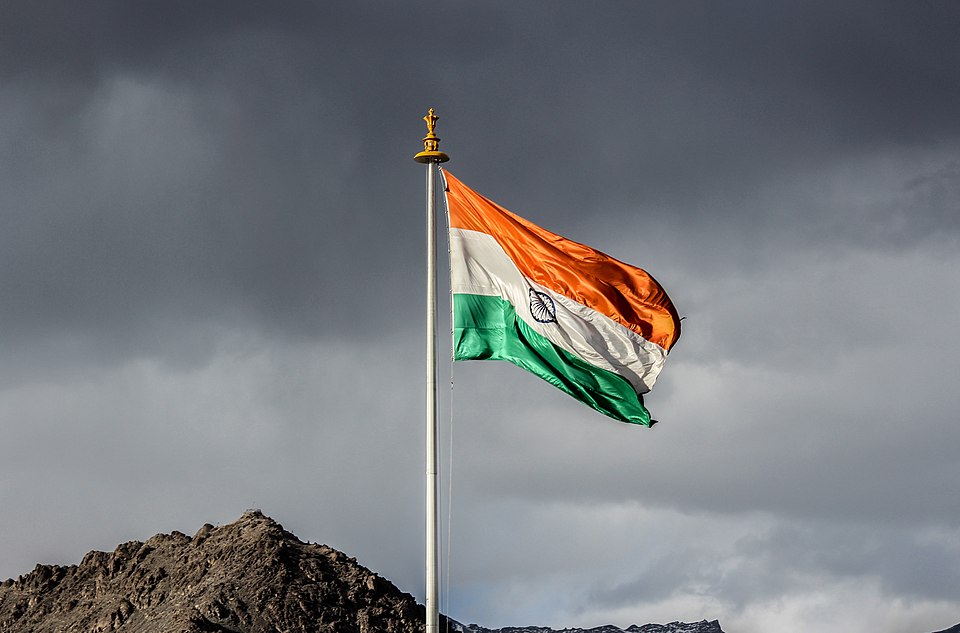
Correct: C, 22 July 1947. The Constituent Assembly adopted the national flag on 22 July 1947, twenty-four days before Independence, on a resolution moved by Jawaharlal Nehru. The resolution specified a horizontal tricolour of deep saffron, white and dark green in equal proportion, with a navy-blue wheel in the centre of the white band (the wheel of the Sarnath Lion Capital of Ashoka, whose diameter was to approximate the width of the white band) and a width-to-length ratio of 2:3. The design was worked out by an ad hoc Flag Committee set up in June 1947 under the chairmanship of Dr Rajendra Prasad, which took the Congress's own Swaraj flag and replaced the charkha at its centre with the Ashoka Chakra of twenty-four spokes, a change that made the flag the emblem of a state rather than of a party. The date matters because the flag had to exist before the state did: the Assembly was legislating for a Dominion that would come into being on 15 August 1947, and the flag was hoisted on that day. Every other option is drawn from the 1949-50 constitutional cluster, and the question is really testing whether a candidate keeps the flag date separate from those. Note also the wording of option (b): 26 November 1950 is not the date of anything: the Constitution was adopted on 26 November 1949, a year earlier.
Why the others are wrong
- (a)24 January 1950: The correct date for a different national symbol. On 24 January 1950, at its final session, the Constituent Assembly adopted 'Jana Gana Mana' as the national anthem and gave 'Vande Mataram' equal honour as the national song; the same day, members signed the copies of the Constitution. It is the single most commonly substituted wrong answer for a flag question.
- (b)26 November 1950: A doctored version of a real date. The Constitution was adopted by the Constituent Assembly on 26 November 1949 (the day recorded in the Preamble itself and now observed as Constitution Day) not in 1950. The option shifts the year by one, so it is wrong on two counts: it is the wrong event and the wrong year.
- (d)26 January 1950: The date the Constitution came into force and India became a Republic, chosen to honour the Purna Swaraj declaration of 26 January 1930. It marks the commencement of the Constitution, not the adoption of any national symbol, and the flag had already been in official use for two and a half years by then.
Concept
India's national symbols were settled by the Constituent Assembly at three separate moments, and confusing them is the most common source of error in this area. The flag came first, on 22 July 1947, because the Dominion needed one immediately. The Constitution itself was adopted on 26 November 1949 and commenced on 26 January 1950. The national anthem and national song were adopted on 24 January 1950, on a statement by President Rajendra Prasad rather than by a formal resolution. The flag's own lineage runs back through the Swaraj flag designed by Pingali Venkayya and presented to Gandhi at Bezwada in 1921, and the Congress tricolour with the charkha adopted in 1931; substituting the Ashoka Chakra for the spinning wheel in 1947 was the deliberate step that converted a movement's banner into a state's flag.
The reasoning route is to notice that three of the four options fall in the winter of 1949-50 and one falls in July 1947, and then to ask what was actually happening at each moment. Anything to do with the Constitution (adoption, commencement, the signing of copies, the anthem) belongs to the 1949-50 cluster. The flag, by contrast, had to be ready for the transfer of power, so it belongs to the summer of 1947. The single discriminating fact to carry is the sequence: flag (22 July 1947) → Independence (15 August 1947) → Constitution adopted (26 November 1949) → anthem and song (24 January 1950) → Republic (26 January 1950). Once that chain is memorised in order, the question answers itself, and so do the many variants that swap one symbol for another.
Key facts
- 22 July 1947: the Constituent Assembly adopted the national flag on Nehru's resolution: deep saffron, white and dark green in equal proportion, ratio 2:3, with a navy-blue Ashoka Chakra in the white band
- The Ashoka Chakra has 24 spokes and is taken from the abacus of the Sarnath Lion Capital of Ashoka, which is also the source of the State Emblem of India
- An ad hoc Flag Committee under Dr Rajendra Prasad, constituted in June 1947, recommended the Swaraj flag with the charkha replaced by the wheel
- Pingali Venkayya designed the earlier Swaraj flag presented to Gandhi at Bezwada in 1921; the Congress adopted a saffron-white-green tricolour with the charkha in 1931
- Use of the flag is governed by the Flag Code of India, 2002 (amended since, including to permit display at night in the open) and by the Prevention of Insults to National Honour Act, 1971
Study next
Common traps
- Answering 24 January 1950, that is the national anthem and national song, not the flag
- Writing 26 November 1950 for the adoption of the Constitution; the correct year is 1949, and the option here is deliberately shifted by a year
- Assuming the flag was adopted on Independence Day itself; it was adopted on 22 July 1947 and first hoisted as the national flag on 15 August 1947
BPSC asks national-symbol questions as bare date recall, packing the options with the neighbouring constitutional dates so that only exact sequencing saves you, and, as option (b) here shows, sometimes altering a real date by a year. UPSC prefers to test the same cluster through a statement set or a design detail: how many spokes the Dharmachakra has, what the Preamble's closing date is, or which statement about a national symbol is correct.
Related PYQs
What is the number of spokes in the Dharmachakra in the National Flag of India?
- (a) 16
- (b) 18
- (c) 22
- (d) 24
Answer(d) 24
The same flag, tested on its design instead of its date: the 24-spoke wheel is exactly what the Constituent Assembly's resolution of 22 July 1947 put in place of the charkha.
In the following quotation, “WE, THE PEOPLE OF INDIA, having solemnly resolved to constitute India into a Sovereign Socialist Secular Democratic Republic and to secure to all its citizens: JUSTICE, social, economic and political; LIBERTY of thought, expression, belief, faith and worship; EQUALITY of status and of opportunity; and to promote among them all; FRATERNITY assuring the dignity of the individual and the unity and integrity of the Nation; In our Constituent Assembly this ‘X’ ………. do hereby adopt, enact and give to ourselves this Constitution.” ‘X’ stands for
- (a) twenty-sixth day of January, 1950
- (b) twenty-sixth day of November, 1949
- (c) twenty-sixth day of January, 1949
- (d) None of the above
Answer(b) twenty-sixth day of November, 1949
The other half of the date cluster this BPSC question exploits: it fixes 26 November 1949 as the adoption of the Constitution, which is precisely the date option (b) here misstates as 1950.
Practice
- practice, not a real PYQ
The Ashoka Chakra in the centre of the Indian national flag is taken from
- (a)the Dhamek Stupa at Sarnath
- (b)the abacus of the Sarnath Lion Capital of Ashoka
- (c)the Great Stupa at Sanchi
- (d)the Ashokan pillar at Vaishali
Answer(b) the abacus of the Sarnath Lion Capital of Ashoka: the same capital that supplies the State Emblem of India; the wheel has 24 spokes. - practice, not a real PYQ
On which date did the Constituent Assembly adopt 'Jana Gana Mana' as the national anthem of India ?
- (a)22 July 1947
- (b)26 November 1949
- (c)24 January 1950
- (d)26 January 1950
Answer(c) 24 January 1950: at the Assembly's final session, when 'Vande Mataram' was also given equal honour as the national song.