
Which of the following corundum and cryolite are important ores ?
- (a)Silver
- (b)Aluminium
- (c)Iron
- (d)Tin
Answer
Why
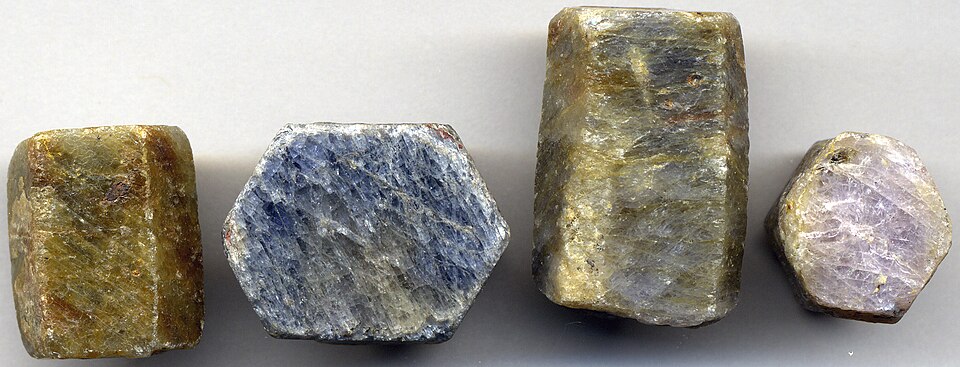
Correct: B, Aluminium. Read the stem as "of which of the following are corundum and cryolite important ores?": the English is inverted, but the chemistry is not in doubt. Corundum is crystalline aluminium oxide, Al2O3: the same compound as alumina, hardness 9 on the Mohs scale (second only to diamond), and the mineral whose coloured varieties are ruby, tinted red by traces of chromium, and sapphire, tinted blue by iron and titanium. Cryolite is sodium hexafluoroaluminate, Na3AlF6: again an aluminium compound, historically mined at Ivigtut in Greenland until that deposit was worked out, and now made synthetically because industry cannot do without it. Both minerals therefore contain aluminium and nothing else in the option list. Cryolite's role is the more interesting one: in the Hall-Héroult process, discovered independently in 1886 by Charles Martin Hall in the United States and Paul Héroult in France, purified alumina is dissolved in a bath of molten cryolite at roughly 950-980 degrees Celsius. Alumina on its own melts only above 2,000 degrees Celsius, which would make electrolysis impossible; dissolving it in cryolite drops the working temperature below 1,000 degrees and makes the melt electrically conducting, and molten aluminium collects at the carbon-lined cathode. Standard Indian textbook lists of aluminium ores name bauxite, cryolite, corundum, alunite and kaolinite together, which is the list this question is drawn from: though in commercial practice bauxite is the ore actually smelted, and cryolite is the electrolyte rather than a feedstock.
Why the others are wrong
- (a)Silver: Silver's ores are sulphides and halides (argentite/acanthite (Ag2S) and horn silver or chlorargyrite (AgCl)) and most of the world's silver is actually recovered as a by-product of lead, zinc and copper smelting. Neither an oxide like corundum nor a fluoride like cryolite has any silver in it.
- (c)Iron: Iron's ores are haematite (Fe2O3), magnetite (Fe3O4), limonite and siderite (FeCO3). Haematite is an oxide, which is the resemblance that traps candidates who half-remember that corundum is 'an oxide', but corundum's oxide is of aluminium, and iron in corundum appears only as a colouring impurity in sapphire.
- (d)Tin: Tin has effectively one commercial ore, cassiterite (SnO2), also called tinstone; in India it is worked mainly in the Bastar region of Chhattisgarh. Neither corundum nor cryolite is associated with tin, and tin metallurgy is a carbon-reduction smelt, not an electrolytic process requiring a fluoride bath.
Concept
An ore is a mineral from which a metal can be extracted profitably: every ore is a mineral, but not every mineral of a metal is its ore. Aluminium illustrates the distinction better than any other element. It is the most abundant metal in the Earth's crust at about 8 per cent, and the third most abundant element after oxygen and silicon, yet it was a precious curiosity until the 1880s because its oxide bond is so strong that carbon reduction, the route used for iron, will not break it. Two discoveries changed that: the Bayer process (Karl Josef Bayer, 1888), which digests bauxite in hot caustic soda to yield pure alumina, and the Hall-Héroult electrolytic process of 1886, which reduces that alumina in a cryolite bath. Bauxite itself is not a single mineral but a weathered lateritic mixture of gibbsite, boehmite and diaspore.
The reasoning route is simply to decode the two mineral names. Cryolite gives itself away to anyone who has learned its formula, Na3AlF6, and corundum to anyone who remembers that ruby and sapphire are aluminium oxide: a fact UPSC has itself asked directly. If neither formula comes, work from the other end: each remaining option has a signature ore that a candidate is likely to know (cassiterite for tin, haematite and magnetite for iron, argentite for silver) and none of those names resembles corundum or cryolite. The single discriminating fact worth carrying is that cryolite is the molten electrolyte of the aluminium cell; that one detail identifies the metal and explains why a fluoride mineral is remembered at all.
Key facts
- Corundum is Al2O3 with Mohs hardness 9; ruby is corundum coloured by chromium, sapphire by iron and titanium, and emery is a granular impure corundum used as an abrasive
- Cryolite is Na3AlF6 (sodium hexafluoroaluminate); the natural deposit at Ivigtut, Greenland was mined out and industrial cryolite is now synthetic
- Hall-Héroult process, 1886: alumina dissolved in molten cryolite at about 950-980 °C is electrolysed with carbon anodes, cutting the working temperature from over 2,000 °C for pure alumina
- Bauxite (a lateritic mix of gibbsite, boehmite and diaspore) is the commercial ore; the Bayer process (1888) converts it to alumina before smelting
- Aluminium is the most abundant metal in the Earth's crust (about 8%) and the third most abundant element overall, after oxygen and silicon
Study next
Common traps
- Assuming corundum is an iron mineral because haematite is also an oxide: the metal in corundum is aluminium; iron appears only as a colouring impurity
- Treating cryolite as the raw material of aluminium; it is the solvent and electrolyte of the smelting cell, while bauxite supplies the metal
- Confusing an ore with a mineral: corundum and cryolite are aluminium minerals, but bauxite is the mineral actually mined for the metal
BPSC asks this as a one-line mineral-to-metal recall, sometimes with the syntax scrambled as it is here, so the first task is reconstructing what is being asked. UPSC prefers the same fact wrapped in an application: asking what rubies and sapphires are chemically, or matching a naturally occurring substance to its element, or asking why an aluminium smelter is sited where power, not ore, is cheap.
Related PYQs
What are Rubies and Sapphires chemically known as?
- (a) Silicon dioxide
- (b) Aluminium oxide
- (c) Lead tetroxide
- (d) Boron nitride
Answer(b) Aluminium oxide
The identical fact from the gemstone side: ruby and sapphire are corundum, and corundum is aluminium oxide. Anyone who has met this UPSC question can answer the BPSC one without knowing what cryolite is.
Match List I (Naturally occurring substances) with List II (Elements) and select the correct answer using the codes given below the Lists: List I I. Diamond II. Marble III. Sand IV. Ruby List II A) Calcium B) Silicon C) Aluminium D) Carbon Codes:
- (a) I-C, II-A, III-B, IV-D
- (b) I-D, II-B, III-A, IV-C
- (c) I-B, II-A, III-C, IV-D
- (d) I-D, II-A, III-B, IV-C
Answer(d) I-D, II-A, III-B, IV-C
The same mineral-to-element mapping asked as a match list, with ruby paired to aluminium: exactly the corundum-aluminium link the BPSC stem depends on.
Practice
- practice, not a real PYQ
In the Hall-Héroult process for the extraction of aluminium, cryolite is used mainly to
- (a)act as the reducing agent for alumina
- (b)lower the melting point of alumina and make the melt conducting
- (c)protect the carbon anodes from oxidation
- (d)remove silica impurities from bauxite
Answer(b) lower the melting point of alumina and make the melt conducting: dissolved in molten cryolite, alumina can be electrolysed near 950-980 °C instead of above 2,000 °C. - practice, not a real PYQ
Cassiterite is an important ore of which one of the following metals ?
- (a)Tin
- (b)Zinc
- (c)Lead
- (d)Nickel
Answer(a) Tin: cassiterite (SnO2), also called tinstone, is effectively the only commercial ore of tin.