
In which organisms does spore formation occur as a mode of reproduction ?
- (a)Algae
- (b)Fungi
- (c)Fern
- (d)Yeast
Answer
Why
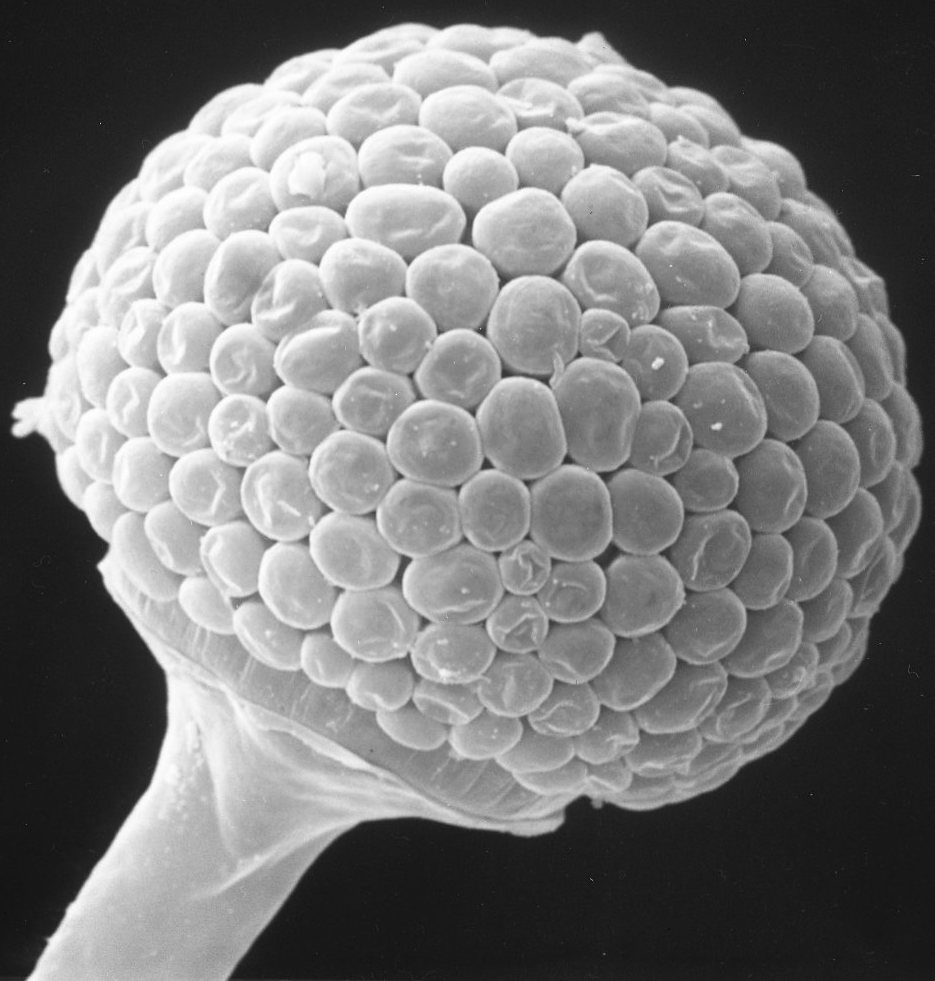
Correct: B, Fungi. In school biology, 'spore formation' is the name of a specific mode of asexual reproduction, and the organism used to teach it is a fungus. The standard illustration is Rhizopus, the black bread mould: the fungal thread sends up an upright hypha tipped with a swollen sporangium, the sporangium matures and bursts, and the spores it scatters germinate into new mycelia wherever they meet moisture and food. The spores carry thick protective walls, which is why they survive drying and heat and travel on air currents, and it is why bread left uncovered develops mould without anyone introducing it. Two features of this option set point firmly at fungi. First, yeast is listed separately even though yeast is itself a fungus, and it is listed separately precisely because school texts teach yeast under budding, in which a small outgrowth swells on the parent cell and pinches off. Setting yeast against fungi in the same list is the setter signalling the budding-versus-spore-formation contrast, and it makes little sense unless the intended answer is fungi. Second, none of the other options is presented with its own characteristic mode; only fungi is. Honesty requires the caveat, though, because this question is loosely framed and the derivation carried only medium confidence. Ferns genuinely reproduce by spores, borne in sporangia clustered into sori on the underside of the frond, and many algae release motile zoospores. In strict biology more than one option can form spores, and a candidate who marked ferns has a real argument. The card argues fungi because that is where the syllabus places 'spore formation as a mode of reproduction' and because the deliberate pairing with yeast shows what the setter was contrasting.
Why the others are wrong
- (a)Algae: Not wrong in biology, but wrong for this question. Many algae do produce motile zoospores, yet the mode school texts attach to algae is fragmentation (Spirogyra breaking into pieces that each grow into a new filament) and it is fragmentation, not spore formation, that algae are used to illustrate.
- (c)Fern: The most defensible of the wrong options, and the reason this item is loosely framed. Ferns are pteridophytes and really do reproduce by spores, produced in sporangia grouped into sori on the underside of the fronds. But that is taught under plant classification and alternation of generations, not under the chapter on modes of reproduction, where the spore-forming example is a fungus.
- (d)Yeast: A fungus, but the one fungus that is the exception. Yeast is the textbook example of budding, in which a bud appears on the parent cell, grows, and separates. Its separate appearance in this list, alongside 'Fungi', is the strongest clue in the question about what the setter intended.
Concept
Asexual reproduction produces offspring from a single parent without the fusion of gametes, and school biology teaches it as a set of named modes, each attached to a standard organism. Binary fission is Amoeba and Paramecium, where the parent cell divides into two. Multiple fission is Plasmodium. Budding is Hydra and yeast, where an outgrowth forms on the parent and detaches. Fragmentation is Spirogyra, where the filament breaks and each piece grows. Regeneration is Planaria. Vegetative propagation covers runners, tubers, bulbs and leaf buds in plants: Bryophyllum being the standard case. And spore formation is Rhizopus, the bread mould. Spores are single reproductive units enclosed in a resistant wall; because they are light, numerous and protected, they let an organism survive conditions that would kill the parent and colonise new ground when conditions improve. It is worth keeping two senses of the word apart: in fungi spores are the vehicle of asexual multiplication, while in ferns and mosses spores are one stage of an alternating life cycle in which a spore-producing generation succeeds a gamete-producing one.
The way into this question is to notice what is odd about the option list rather than to rank the four organisms biologically. Yeast is a fungus, so putting 'Fungi' and 'Yeast' side by side as separate choices would be incoherent unless the examiner wanted a specific contrast, and the only contrast that makes both options meaningful is the one the syllabus draws, spore formation in moulds against budding in yeast. Reading the option set as a piece of evidence about the setter's intention is a real exam skill, and it is often more reliable than trying to decide which of two biologically true statements is truer. What the skill cannot do is make the question rigorous. Ferns reproduce by spores as a matter of plain fact, and no reading of the stem excludes them, so this is an item where a well-prepared candidate can lose a mark for knowing more rather than less. Where that happens, the practical response in the hall is to weigh the one-third negative mark against your confidence; the response afterwards is to note the syllabus placement, since the examiner is testing recall of a textbook pairing rather than the biology itself.
Key facts
- Spore formation is the asexual mode illustrated in school texts by Rhizopus, the black bread mould, whose sporangia burst to release spores that germinate into new mycelia
- Fungal spores are enclosed in thick protective walls, which lets them survive drought and heat and disperse on air currents
- Yeast is a fungus but reproduces mainly by budding (a bud forms on the parent cell, enlarges and separates) which is why it appears as a distinct option here
- Ferns are pteridophytes whose spores form in sporangia clustered into sori on the underside of the frond, within a life cycle that alternates a spore-producing sporophyte with a gamete-producing prothallus
- The other standard asexual modes are binary fission in Amoeba, multiple fission in Plasmodium, budding in Hydra, fragmentation in Spirogyra, regeneration in Planaria, and vegetative propagation in plants such as Bryophyllum
Study next
Common traps
- Reading the option set before deciding: ferns and algae do reproduce by spores, so the question is loosely framed, and the reason Fungi wins is that yeast is listed separately: the contrast the examiner has built into the options is fungal
- Treating yeast as a plant or a bacterium: it is a fungus, and its distinctness here lies in its mode of reproduction, not in its kingdom
- Confusing spores with seeds: spores are single cells with no embryo and no stored food, while a seed contains an embryo and a food reserve
BPSC asks school-level biology as a one-line recall question and often builds the option list so that the odd item out reveals the intended contrast, as the separate listing of yeast does here. UPSC does not ask which organism reproduces by which mode; it prefers the applied and ecological side of the same content: what lichens are made of, which organisms decompose or act as biopesticides, or whether a general claim about unicellular organisms holds.
Related PYQs
Assertion (A): Amoeba reproduces by fission. Reason (R): All unicellular organisms reproduce by asexual methods.
- (a) Both A and R are individually true and R is the correct explanation of A
- (b) Both A and R are individually true but R is not the correct explanation of A
- (c) A is true but R is false
- (d) A is false but R is true
Answer(c) A is true but R is false
The same table of asexual modes, with the organism-to-mode pairing tested directly: Amoeba with fission, as Rhizopus goes with spore formation. It also warns against exactly the over-generalisation this area invites, since many unicellular organisms have sexual cycles too.
Lichens, which are capable of initiating ecological succession even on a bare rock, are actually a symbiotic association of
- (a) algae and bacteria
- (b) algae and fungi
- (c) bacteria and fungi
- (d) fungi and mosses
Answer(b) algae and fungi
Two of the four organisms in the BPSC option list, and a reminder that algae and fungi are separate kingdoms with separate biology despite living together in a lichen. Keeping them apart is what stops the algae option looking as good as the fungi one.
In mycorrhizal association, the advantage of plant is :
- (a) Protection
- (b) Food
- (c) (A) and (B) both
- (d) Increased mineral absorption and diseases protection
Answer(d) Increased mineral absorption and diseases protection
The Commission returned to fungal biology one edition later, this time on the mycorrhizal partnership between a fungus and plant roots. Fungi appear in this paper's biology slot in consecutive cycles, so the group is worth learning beyond the single reproduction fact.
Practice
- practice, not a real PYQ
Which one of the following organisms reproduces mainly by budding ?
- (a)Rhizopus
- (b)Yeast
- (c)Spirogyra
- (d)Planaria
Answer(b) Yeast: a bud forms on the parent cell, enlarges and detaches; Rhizopus illustrates spore formation, Spirogyra fragmentation and Planaria regeneration. - practice, not a real PYQ
In ferns, the spores are produced in sporangia that are clustered into structures called
- (a)Sori
- (b)Rhizoids
- (c)Stomata
- (d)Prothalli
Answer(a) Sori: the brown clusters on the underside of a fern frond; the prothallus of option (d) is the gamete-producing stage that grows from a germinating spore.