
Which of the following minerals occurs in the Minas Gerais province of Brazil ?
- (a)Iron ore
- (b)Bauxite
- (c)Coal
- (d)Mica
Answer
Why
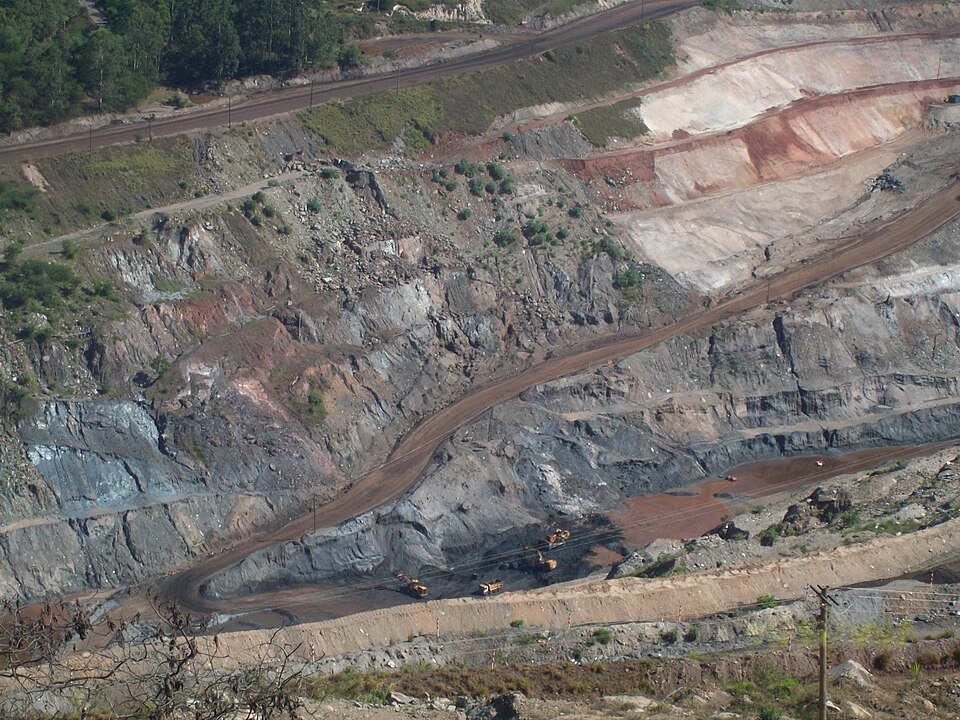
Correct: A, Iron ore. Minas Gerais is Brazil's classic iron-ore state, and its name says so: in Portuguese it means 'General Mines', a legacy of the eighteenth-century gold rush around Ouro Preto that first drew miners inland. Its iron comes from the Quadrilátero Ferrífero, the Iron Quadrangle, a mineralised belt around Belo Horizonte taking in Itabira, Congonhas, Mariana and Ouro Preto, where high-grade haematite is worked along with the banded iron formation known as itabirite: a rock named after Itabira itself. Vale, today one of the world's largest iron-ore producers, began there: it was created in 1942 as Companhia Vale do Rio Doce and built its first operations around Itabira. Brazil is the world's second-largest producer and exporter of iron ore after Australia, and it has two great provinces: this one in the south-east, and Carajás in Pará in the Amazon north, which is the newer and the higher-grade of the two. The scale of Minas Gerais mining is also why the state's name recurs in disaster reporting: the tailings-dam failures at Mariana in November 2015 and at Brumadinho in January 2019 were both at iron-ore operations there. None of the other three minerals defines the state. Brazil's bauxite industry sits in Pará, its very limited coal in the far south, and mica is not a Brazilian speciality at all: it is India's, and above all the Koderma belt's.
Why the others are wrong
- (b)Bauxite: Brazil is a major bauxite producer, so this is the most defensible wrong answer, but the industry is concentrated in Pará in the Amazon, at Trombetas and Paragominas; Minas Gerais mines bauxite too, but on a far smaller scale. If you were asked to name the mineral that defines Minas Gerais, no geographer would say bauxite.
- (c)Coal: Brazil is poor in coal. What it has lies in the far south, in Rio Grande do Sul and Santa Catarina, and it is largely low-grade; the country imports coking coal for its steel industry. That import dependence is itself the point: Brazil pairs its own abundant ore with somebody else's coal.
- (d)Mica: Mica's classic producing region is India, historically the Koderma belt of what was then Bihar and is now Jharkhand, along with Nellore in Andhra Pradesh, and Madagascar. Brazil has no comparable mica industry, and the option is on the list mainly because Indian candidates associate mica strongly with mining.
Concept
World economic geography is examined through a small set of place-to-mineral pairs that recur across papers, and the reliable way to hold them is by region rather than by country. Brazil's mineral map has three parts: iron ore in the Iron Quadrangle of Minas Gerais in the south-east and at Carajás in Pará in the north, bauxite in Pará along the Trombetas and at Paragominas, and only marginal coal in the southern states of Rio Grande do Sul and Santa Catarina. That combination shapes the country's trade: Brazil exports ore in bulk and imports the coking coal its steel mills need. Minas Gerais itself is a mining state in a much older sense (the eighteenth-century gold of Ouro Preto gave it its name, and it still yields gold, manganese and gemstones alongside iron) but iron is what it is known for and what its rocks are named after, the itabirite of Itabira. The comparable pairs worth learning alongside it are Pilbara and Mount Whaleback in Western Australia, the Mesabi Range in the United States, Kiruna in Sweden and Krivoy Rog in Ukraine.
The fastest route is the name. Minas Gerais means 'General Mines', and the ore whose type-locality lies inside the state (itabirite, from Itabira) is an iron formation, so iron is the answer the name itself points at. If the name does not help, eliminate by country rather than by state. Brazil is coal-poor, which removes option (c) without any knowledge of Minas Gerais at all. Mica is an Indian and Malagasy speciality, which removes option (d) on the same basis. That leaves iron ore against bauxite, and the discriminator is that Brazil's bauxite is an Amazonian industry in Pará while its south-eastern mining heartland is iron. Be precise about what the question is asking, though: a state as large and as mineralised as Minas Gerais contains many minerals, so 'occurs' is looser wording than the setter intends. Read it as 'is characteristically associated with', which is how every such question in this format works, and then only one answer survives.
Key facts
- Minas Gerais means 'General Mines' in Portuguese, a name from the eighteenth-century gold rush centred on Ouro Preto
- Its Quadrilátero Ferrífero (Iron Quadrangle), around Belo Horizonte, Itabira, Congonhas and Mariana, is Brazil's classic iron-ore province, worked for high-grade haematite and itabirite
- Vale, created in 1942 as Companhia Vale do Rio Doce, built its first iron-ore operations around Itabira in Minas Gerais
- Brazil is the world's second-largest producer and exporter of iron ore after Australia; its other great province is Carajás in the state of Pará
- Brazil's bauxite is concentrated in Pará (Trombetas and Paragominas) while its limited coal lies in Rio Grande do Sul and Santa Catarina in the far south
- The Mariana tailings-dam failure of November 2015 and the Brumadinho collapse of January 2019 both occurred at iron-ore operations in Minas Gerais
Study next
Common traps
- Picking bauxite because Brazil is a big bauxite producer; the deposits are in Pará, not Minas Gerais
- Assuming a large industrial economy must be coal-rich: Brazil is not, and imports coking coal for its steel plants
- Reading 'occurs' literally in a question that means 'is characteristically associated with'; a large mineralised state will contain many minerals in quantity, not merely traces
BPSC asks world economic geography as one-line place-to-mineral or place-to-crop identifications and reuses the same short list of famous regions, so a compact table of world mining regions pays for itself. UPSC prefers the matching format for the same material (minerals against producing countries, or minerals against Indian mining towns) and increasingly wraps it in trade or supply-chain framing rather than asking for the pairing bare.
Related PYQs
Match List I with List II and select the correct answer using the codes given below the Lists: List I (Minerals) I. Mineral oil II. Copper III. Manganese IV. Bauxite List II (Major producer) A) Zambia B) Guyana C) Venezuela D) Gabon Codes:
- (a) I-C, II-A, III-D, IV-B
- (b) I-C, II-A, III-B, IV-D
- (c) I-A, II-C, III-B, IV-D
- (d) I-A, II-C, III-D, IV-B
Answer(a) I-C, II-A, III-D, IV-B
The same body of knowledge (which mineral a named place in the world is known for) set out as a four-way match, and it includes bauxite, this question's most tempting distractor.
Match List I with List II and select the correct answer by using the codes given below the lists: List I (Minerals) I. Coal II. Gold III. Mica IV. Manganese List II (Typical areas of Occurrence) A) Bhandara B) Karanpura C) Hutti D) Nellore Codes:
- (a) I-A, II-C, III-B, IV-D
- (b) I-B, II-C, III-D, IV-A
- (c) I-C, II-D, III-B, IV-A
- (d) I-B, II-A, III-D, IV-C
Answer(b) I-B, II-C, III-D, IV-A
The Indian version of the same skill, and it fixes the mica pairing directly: mica belongs with Nellore, not with Brazil, which is why option (d) here fails.
Which of the following statements is correct?
- (a) Natural gas is found in Dharwar rock formation.
- (b) Mica is found in Kodarma.
- (c) Cuddapah series is famous for diamonds.
- (d) Petroleum reserves are found in Aravalli hills.
Answer(b) Mica is found in Kodarma.
The Commission asked the mineral-to-place pairing one edition earlier, and the same pairing settles this question's fourth option: mica belongs to Koderma in the old Bihar mica belt, not to Brazil.
Practice
- practice, not a real PYQ
The Carajás mining region, one of the world's largest iron ore deposits, is located in which Brazilian state ?
- (a)Minas Gerais
- (b)Pará
- (c)Bahia
- (d)São Paulo
Answer(b) Pará: Carajás lies in the Amazonian north; Minas Gerais holds Brazil's other great iron province, the Iron Quadrangle. - practice, not a real PYQ
Which country is the world's largest producer of iron ore ?
- (a)Brazil
- (b)China
- (c)Australia
- (d)India
Answer(c) Australia: chiefly from the Pilbara region of Western Australia, with Brazil second; China is the largest consumer and steel producer but depends on imported ore.