
Consider the following about Ajivika sect : a. Makhali Gosala was its most important leader. b. Central idea of the philosophy was “NIYATI” that is fate. c. The discrimination on the basis of caste and class. d. The Ajivikas had regular sabhas for meetings.
- (a)b, c and d are correct
- (b)a, b and d are correct
- (c)a and d are correct
- (d)More than one of the above
Answer
Why
Correct: B, a, b and d are correct. Statement a is the best-attested fact about the sect: Makkhali Gosala is generally treated as the founder, and certainly the most important leader, of the Ajivikas, and he is named in the Buddhist Samannaphala Sutta among the six rival teachers of the Buddha's day, while the Jain Bhagavati Sutra records his long and finally bitter association with Mahavira. Statement b names the sect's defining doctrine: niyati, absolute determinism, the teaching that everything that has happened, is happening and will happen is preordained by cosmic principle, so that moral effort cannot alter destiny. It is exactly this that set the Ajivikas against both Buddhists and Jains, who made karma and effort the engine of liberation. Statement d is consistent with what is known of Ajivika organisation: they were organised renunciates who formed discrete communities with shared ascetic practice, so regular assemblies fit; and the option set itself corroborates it, since d appears in two of the three combinations offered and cannot be the statement the setter planted as false. That leaves statement c, and it is the one that fails. The Ajivikas are not recorded as practising discrimination by caste or class: their appeal ran across the warrior, industrial and mercantile classes, and they were patronised at the highest level by the Mauryas. Remove c, keep a, b and d, and only option (b) matches.
Why the others are wrong
- (a)b, c and d are correct: Includes statement c, the one claim about the Ajivikas that is not attested, and simultaneously drops statement a: Makkhali Gosala's leadership, which is the single most secure fact in the whole question. A combination that discards the most certain statement and admits the least certain one is almost always the planted wrong answer.
- (c)a and d are correct: Correctly rejects c but also throws out b, and niyati is the doctrine the Ajivikas are actually remembered for: without it the sect has no identity distinct from other shramana orders. Read in the ordinary exam convention, 'a and d are correct' means only a and d are correct, and that is false because b is correct too.
- (d)More than one of the above: This would hold only if two or more of the listed combinations were each a complete and exclusive account of which statements are true. Since statement c is false and statement b is true, combination (a) fails and combination (c) is incomplete, leaving (b) as the single accurate one.
Concept
The Ajivikas were one of the shramana orders that grew up in Magadha in the sixth and fifth centuries BCE alongside Buddhism and Jainism, rejecting Vedic authority and sacrifice. Their leader Makkhali Gosala taught niyati (fate) in its strongest possible form: the universe runs on a fixed and impersonal order, every soul must pass through a set quantity of transmigration, and neither ritual nor moral striving can shorten or lengthen the passage. That is a denial of karma as the Buddhists and Jains understood it, and it made the Ajivikas the standing target of both. Almost everything we know about them comes from those hostile accounts (the Samannaphala and Sandaka Suttas on the Buddhist side, the Bhagavati Sutra on the Jain side) which is why A. L. Basham's 1951 reconstruction argued they had been systematically misrepresented by their competitors. The sect peaked under Bindusara, declined by the Shunga period, and survived in south India as late as an inscription of 1346 CE.
Two things decide this question, and one of them is a reading problem rather than a history problem. Statement (c) as printed in the English column: 'The discrimination on the basis of caste and class.': is a noun phrase with no verb, so on the English page alone you cannot tell whether it says the Ajivikas practised such discrimination or opposed it. The facing हिन्दी column supplies the verb the English dropped: जाति और वर्ग के आधार पर भेदभाव किया जाता है: 'discrimination is practised on the basis of caste and class', an affirmative claim. On a bilingual booklet the two columns are independent transcriptions of one question, so when one is ambiguous the other is a legitimate tool to read it with. Once (c) is read as affirmative it is the odd one out, because caste-and-class discrimination is nowhere attested as an Ajivika practice, while leadership by Gosala, the niyati doctrine and organised community life all are. The residual doubt on this question sits in two places and is worth naming: statement (d) rests on general descriptions of Ajivika communal organisation rather than on a text that says 'sabha', and if a reader insisted on treating (c) as a rejection of discrimination, all four statements would become true and the question would collapse towards the 'More than one of the above' option instead.
Key facts
- Makkhali Gosala is generally regarded as the founder and chief teacher of the Ajivikas; the Buddhist Samannaphala Sutta lists him among the six heterodox teachers, and the Jain Bhagavati Sutra records his association with Mahavira
- Niyati (absolute determinism) is the Ajivika core doctrine: all events are preordained by cosmic principle and moral effort cannot change destiny, which is a direct rejection of karma as the Buddhists and Jains taught it
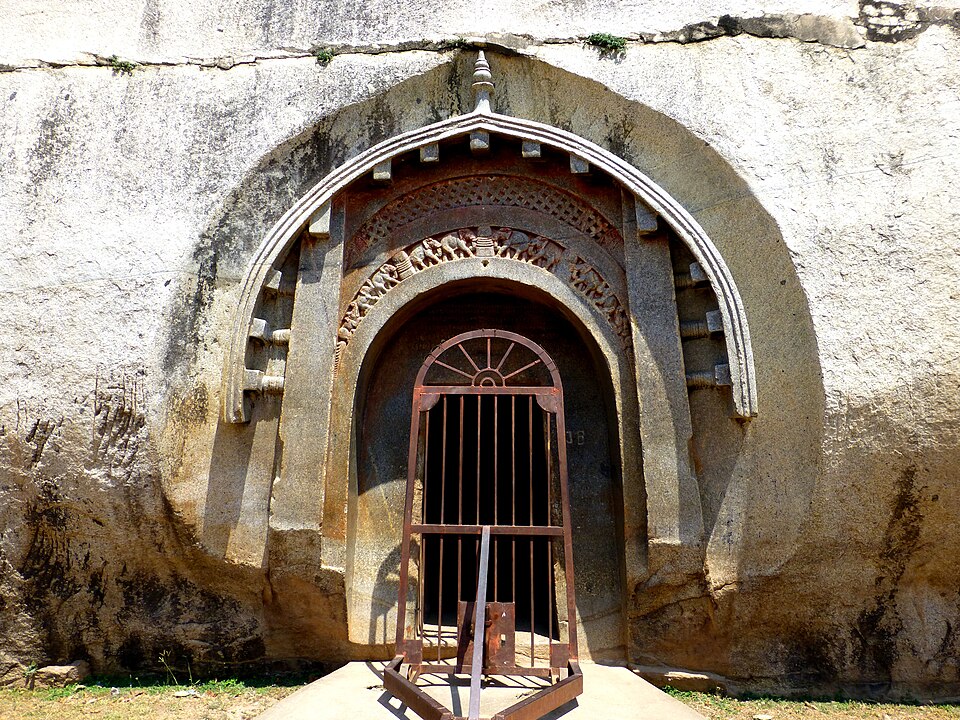
- Ashoka dedicated caves in the Barabar hills of Jehanabad district, Bihar to the Ajivikas: the Sudama and Visvakarma caves in his 12th regnal year and Karan Chaupar in his 19th; these are the oldest surviving rock-cut caves in India
- Dasharatha Maurya, Ashoka's grandson, dedicated three further caves on the adjoining Nagarjuni hill (Gopika, Vadathika and Vapiyaka) to the Ajivikas around 230 BCE
- The sect's high point was under Bindusara; it faded in the north by the Shunga period but survived in south India, with inscriptional traces as late as 1346 CE
- A. L. Basham's History and Doctrines of the Ajivikas (1951) remains the standard scholarly reconstruction of the sect
Study next
Common traps
- Reading statement (c) as a claim that the Ajivikas opposed caste discrimination: the हिन्दी column shows it is an affirmative statement about discrimination being practised
- Attributing the Barabar caves to Chandragupta Maurya; the Ajivika dedications there are by Ashoka and, on the Nagarjuni hill, by Dasharatha
- Confusing the Ajivika denial of karma with the Buddhist middle path: the Ajivikas held that effort is futile, which is the opposite of the Buddha's teaching
BPSC builds these as an unnumbered a-b-c-d statement block with combination options and, increasingly, a 'More than one of the above' fourth option, so you must judge each statement independently before you look at the combinations. UPSC asks the Ajivikas obliquely: as one option among sect names, or inside a rock-cut architecture question about who the Barabar caves were made for and by which ruler. Both papers reward the same two anchors: Makkhali Gosala and niyati for the doctrine, Barabar and Ashoka for the archaeology.
Related PYQs
With reference to the history of Indian rock-cut architecture, consider the following statements: 1. The caves at Badami are the oldest surviving rock-cut caves in India. 2. The Barabar rock-cut caves were originally made for Ajivikas by Emperor Chandragupta Maurya. 3. At Ellora, caves were made for different faiths. Which of the statements given above is/are correct?
- (a) 1 only
- (b) 2 and 3 only
- (c) 3 only
- (d) 1, 2 and 3
Answer(c) 3 only
The Ajivikas from the archaeological side: the Barabar caves in Bihar were made for them, and the statement fails only because it names Chandragupta instead of Ashoka. The same sect, tested through its Mauryan patronage rather than its doctrine.
Which one of the following was a Saiva sect in ancient India?
- (a) Ajivika
- (b) Mattamayura
- (c) Mayamata
- (d) Isanasivagurudevapaddhati
Answer(b) Mattamayura
Turns on knowing what the Ajivikas were not (a Shaiva order) which is only possible if you can place them correctly as a heterodox shramana sect, the same classification this BPSC question tests from the inside.
In Indian art, the construction of ‘Stupa’, ‘Chaitya’ and ‘Vihara’ is related to which of the following?
- (a) Ajivika sect
- (b) Vaishnava sect
- (c) Buddhism
- (d) Shaiva sect
Answer(c) Buddhism
The 69th CCE put the Ajivika sect on the option list one year earlier, as the distractor against Buddhism: proof that BPSC expects a Bihar candidate to be able to place this sect precisely, which the 70th then tested head-on.
Practice
- practice, not a real PYQ
The doctrine of 'Niyati', which holds that all events are predetermined and human effort cannot alter destiny, was central to which of the following sects ?
- (a)Ajivika
- (b)Charvaka
- (c)Sautrantika
- (d)Pashupata
Answer(a) Ajivika: niyati, absolute determinism taught by Makkhali Gosala, is the doctrine that defines the Ajivikas against both Buddhism and Jainism. - practice, not a real PYQ
The Barabar hill caves in Bihar were dedicated to the Ajivika sect by which ruler ?
- (a)Chandragupta Maurya
- (b)Bindusara
- (c)Ashoka
- (d)Kanishka
Answer(c) Ashoka: the Sudama and Visvakarma caves carry his dedication in his 12th regnal year and Karan Chaupar in his 19th; his grandson Dasharatha later dedicated the Nagarjuni hill caves to the same sect.