
In Indian art, the construction of ‘Stupa’, ‘Chaitya’ and ‘Vihara’ is related to which of the following?
- (a)Ajivika sect
- (b)Vaishnava sect
- (c)Buddhism
- (d)Shaiva sect
Answer
Why
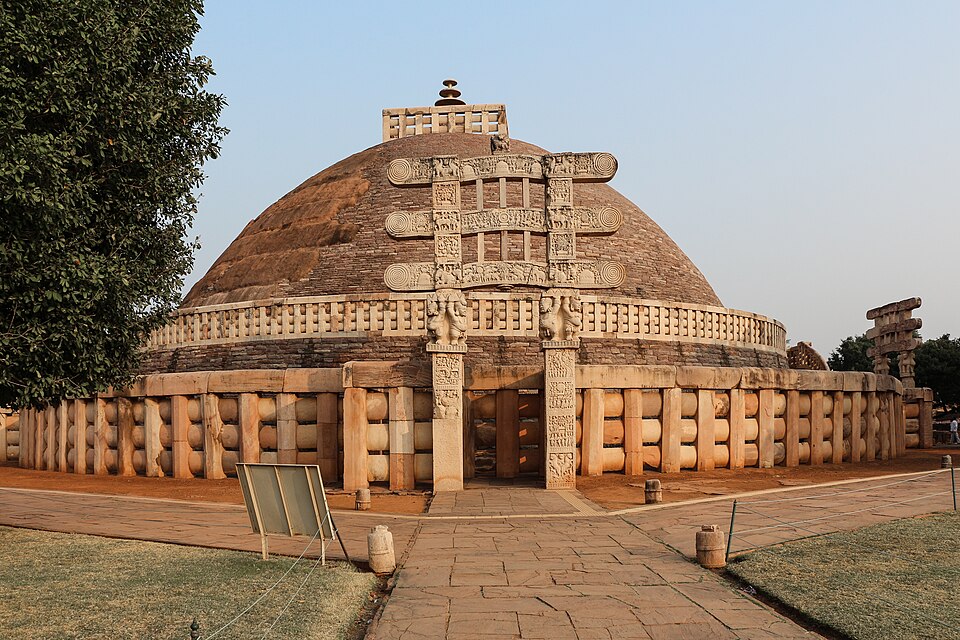
Correct: C, Buddhism. The three words name the three functional buildings of a Buddhist monastic establishment, and they only make sense together. A stupa is a solid hemispherical mound raised over relics: the anda or dome sits on a medhi or drum with a pradakshina patha for circumambulation, crowned by a harmika enclosing the yashti and its tiers of chhatra, the whole ringed by a vedika and entered through toranas at the cardinal points. The Great Stupa at Sanchi: protected by the Archaeological Survey of India as 'Buddhist monuments, Sanchi' in Raisen district of Madhya Pradesh: is the type specimen: a brick core of Ashoka's time in the third century BCE, doubled in size and faced in stone under the Shungas in the second century BCE, with the four carved gateways added around the first century BCE. A chaitya-griha is the congregational prayer hall: apsidal in plan, barrel-vaulted, divided by two rows of pillars into a nave and side aisles, with a votive stupa standing at the rounded far end so that worshippers can walk around it indoors. ASI protects the classic rock-cut examples as 'Cave temples and inscriptions' at Bhaja and at Karla in Pune district; Ajanta's Caves 9, 10, 19 and 26 are chaityas. A vihara is where the monks actually lived: a pillared central hall or open courtyard with small cells cut into three sides, a refectory, and in later examples a shrine chamber set opposite the door; Ajanta's Caves 1, 2, 16 and 17 are viharas. In eastern India the vihara scaled up into the walled mahavihara campus, which is what ASI's Bihar list records at Nalanda and at the 'Ancient site of Vikramasila Monastery' at Antichak in Bhagalpur. Relic mound, prayer hall, residence: that is the complete grammar of a Buddhist site, and no other Indian sect built to this three-part plan.
Why the others are wrong
- (a)Ajivika sect: The Ajivikas of Makkhali Gosala were a real renouncer order with real royal patronage in Magadha, which is what makes this the sharpest of the four distractors. But their surviving architecture is something quite different: the mirror-polished rock-cut chambers of the Barabar and Nagarjuni hills, dedicated by Ashoka and his grandson Dasharatha. ASI's Bihar list carries seven of them in Jehanabad district: the Gopi, Karan Chaupar, Vadathika, Lomas Rishi, Sudama, Vapiyaka and Visva Jhopa caves. They are plain excavated halls with a barrel-vaulted inner cell and a famous imitation-timber facade at Lomas Rishi, not stupas, chaityas or viharas.
- (b)Vaishnava sect: Vaishnava building vocabulary is temple vocabulary: garbhagriha, antarala, mandapa, shikhara or vimana, gopuram and the surrounding prakara wall. A Vaishnava shrine houses an image of the deity for darshan and its worship is conducted for a householder congregation by hereditary priests. It does not enshrine bodily relics in a solid mound, and it has no residential cell-block for a celibate order at its core, so two of the three terms in the question could never attach to it.
- (d)Shaiva sect: Shaiva architecture is likewise temple architecture, built around a linga in the garbhagriha with a Nandi mandapa in front: the Kailasa at Ellora and the Brihadeeswara at Thanjavur are its scale models. Ellora is the trap here, because ASI protects it as a single group of 'Ellora Caves' in Aurangabad district in which Buddhist, Hindu and Jain excavations stand side by side; but its Shaiva caves, including the monolithic Kailasa, are temples, while the chaityas and viharas at the site belong to the Buddhist group of caves at the southern end.
Concept
Buddhist monasticism produced India's first large body of permanent religious architecture, and it did so in three linked forms. The stupa began as a funerary tumulus and, after the Buddha's parinirvana, became the object of worship itself: the relics were divided among eight claimants and Ashoka is said to have redistributed them into a great many stupas across his empire. Once a community formed around a stupa it needed a covered hall for congregational worship, which produced the apsidal chaitya-griha with its own votive stupa at the far end; and it needed somewhere to sleep, which produced the vihara. From about the second century BCE these were cut into the Deccan trap rock of the Western Ghats at Bhaja, Kondane, Pitalkhora, Bedsa, Karla, Nasik, Kanheri and Ajanta, faithfully copying in stone the wooden rafters, ribs and railings of the free-standing buildings that have not survived: a chaitya's stone roof still carries carved beams that hold nothing up. Bihar is unusually rich in every one of the three forms: ASI's protected list for the state records the Relic Stupa at Harpur Basant in Vaishali, the Buddhist Stupa at Tajpur Deur in East Champaran, the mound known as Sujata garh at Bakraur in Gaya, the Chhoti Pahari stupa and the five stupa mounds at Paharidih in Patna district, and the mahavihara complexes at Nalanda and Antichak.
The discriminating fact is that all three terms belong to one system, not one term to each faith. A candidate who knows only that 'stupa is Buddhist' can still be shaken by 'chaitya', because chaitya in its older and wider sense simply meant a sacred spot or shrine, and Jain rock-cut halls exist at Udayagiri and Khandagiri too. Test the set rather than the word: a religion needs stupas only if it venerates bodily relics, and needs viharas only if it maintains a celibate resident sangha that lives on alms and studies together. Buddhism does both. Vaishnavism and Shaivism do neither, because a temple is a house for a deity's image and its priests are householders, which is why their vocabulary is shikhara and mandapa, not medhi and torana. The Ajivika option is the one that costs marks, because Ajivikas really were an organised renouncer order patronised by Mauryan kings in this very region; but what Ashoka gave them at Barabar were polished cave-chambers, and there is no Ajivika stupa, chaitya or vihara anywhere. One nuance BPSC does not test but UPSC does: the mound-over-remains idea is older than Buddhism, so the bare statement 'the concept of stupa is Buddhist in origin' is itself false. What is Buddhist is the three-part architectural programme this question names.
Key facts
- Stupa anatomy: anda (hemispherical dome) on a medhi (drum) with pradakshina patha, topped by harmika, yashti and chhatravali, enclosed by a vedika with four toranas at the cardinal points
- Sanchi Stupa No. 1: brick core built under Ashoka in the 3rd century BCE, enlarged to roughly double in stone under the Shungas in the 2nd century BCE, the four carved gateways added about the 1st century BCE; ASI protects the group as 'Buddhist monuments, Sanchi', Raisen district, Madhya Pradesh
- Chaitya-griha = apsidal, barrel-vaulted hall with nave, two aisles and a votive stupa at the apse; Vihara = residential monastery with cells around a central hall. At Ajanta, Caves 9, 10, 19 and 26 are chaityas while Caves 1, 2, 16 and 17 are viharas
- ASI protects the earliest rock-cut chaitya sites as 'Cave temples and inscriptions' at Bhaja and Karla in Pune district, and Ajanta and Ellora as cave groups in Aurangabad district
- The Ajivikas' architecture is the Barabar and Nagarjuni caves in Jehanabad district, Bihar: Gopi, Karan Chaupar, Vadathika, Lomas Rishi, Sudama, Vapiyaka and Visva Jhopa, all on ASI's protected list for the Patna Circle
- Bihar's protected Buddhist remains span all three forms: the Relic Stupa at Harpur Basant (Vaishali), the Buddhist Stupa at Tajpur Deur (East Champaran), Sujata garh at Bakraur (Gaya), and the mahaviharas at Nalanda and at Antichak in Bhagalpur
- The rock-cut caves imitate carpentry: stone ribs, purlins and railing patterns reproduce a timber original, which is how art historians date the earliest excavations to the century after Ashoka
Study next
Common traps
- Reversing chaitya and vihara: the chaitya is the prayer hall, the vihara is the dwelling; UPSC asked exactly this reversal in 2013
- Assuming the stupa as a form is Buddhist in origin: burial mounds over remains predate Buddhism, which is why UPSC 2023 marked that statement wrong; what is Buddhist is the three-part stupa-chaitya-vihara complex
- Awarding Barabar to Buddhism. The Barabar and Nagarjuni caves in Bihar were dedicated to the AJIVIKAS by Ashoka and Dasharatha, and their form is a polished chamber, not a chaitya
BPSC keeps this at recognition level (name the sect, name the site, name the district) because the state syllabus wants Bihar's Buddhist heritage secured before anything else, and because a one-line identification can be set on any of the dozens of protected Buddhist sites in the state. UPSC almost never asks 'which religion'. It asks the internal distinction (chaitya versus vihara, 2013), the origin claim (is the stupa Buddhist in origin, 2023), the chronology of rock-cut caves (Badami versus Barabar, 2013), or a place-and-attribute matching set. Preparing only the label therefore clears BPSC and fails UPSC; preparing the anatomy, the sequence and the site list clears both.
Related PYQs
Some Buddhist rock-cut caves are called Chaityas, while the others are called Viharas. What is the difference between the two?
- (a) Vihara is a place of worship, while Chaitya is the dwelling place of the monks
- (b) Chaitya is a place of worship, while Vihara is the dwelling place of the monks
- (c) Chaitya is the stupa at the far end of the cave, while Vihara is the hall axial to it
- (d) There is no material difference between the two
Answer(b) Chaitya is a place of worship, while Vihara is the dwelling place of the monks
The same three terms, one level deeper. BPSC is satisfied that you attach them to Buddhism; UPSC assumes that and asks you to separate the prayer hall from the dormitory, which is the distinction a candidate who has only memorised the word list cannot make.
With reference to ancient India, consider the following statements: 1. The concept of Stupa is Buddhist in origin. 2. Stupa was generally a repository of relics. 3. Stupa was a votive and commemorative structure in Buddhist tradition. How many of the above statements are correct?
- (a) Only one
- (b) Only two
- (c) All three
- (d) None
Answer(b) Only two
The precise limit of the answer argued here, and asked in the same examination season. Stupas are a Buddhist architectural programme and they do hold relics, but the idea of a mound over human remains is older than Buddhism, so 'the concept of Stupa is Buddhist in origin' is the one statement UPSC struck down.
Which Buddhist council was not held in Bihar?
- (a) First
- (b) Second
- (c) Third
- (d) Fourth
Answer(d) Fourth
BPSC returning to Buddhism two years later from the institutional side rather than the architectural one. Both questions reward the same reading, that the sangha's history, its councils at Rajgir and Vaishali and its buildings are one syllabus block, and that Bihar is where most of it happened.
Practice
- practice, not a real PYQ
The Barabar and Nagarjuni hill caves of Bihar, the earliest surviving rock-cut caves in India, were dedicated to which religious order?
- (a)Ajivikas
- (b)Theravada Buddhists
- (c)Digambara Jains
- (d)Pashupata Shaivas
Answer(a) Ajivikas: dedicated by Ashoka and his grandson Dasharatha; the caves lie in Jehanabad district and are protected by ASI as the Gopi, Karan Chaupar, Vadathika, Lomas Rishi, Sudama, Vapiyaka and Visva Jhopa caves. - practice, not a real PYQ
In Buddhist rock-cut architecture, an apsidal hall with a barrel-vaulted roof, a nave flanked by two aisles and a votive stupa standing at the far rounded end is called a
- (a)Vihara
- (b)Chaitya-griha
- (c)Medhi
- (d)Harmika
Answer(b) Chaitya-griha: the congregational prayer hall, as at Karla and Bhaja; a vihara is the monks' residence, while medhi and harmika are parts of a stupa.