
Bihula Festival is celebrated especially in which one of the following districts in Bihar usually in the month of August each year ?
- (a)Patna
- (b)Bhagalpur
- (c)Darbhanga
- (d)Sitamarhi
Answer
Why
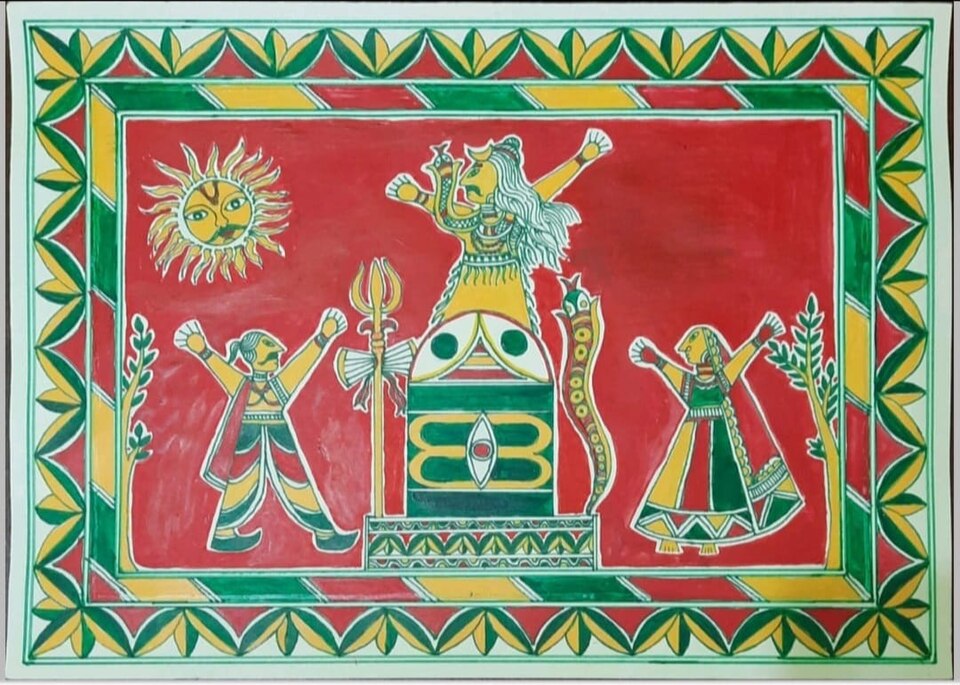
Correct: B, Bhagalpur. The Union Ministry of Tourism's national events portal carries a page for the Bihula Festival and gives it exactly one location, Bhagalpur in Bihar, with the Department of Tourism, Government of Bihar named as the organiser. The festival, written variously as Bihula, Bihula-Bishari or Bihula-Vishahari, is the great annual observance of the Anga region of eastern Bihar, of which Bhagalpur is the historic centre. It rests on a folk epic rather than a pan-Indian myth: Bihula, newly married, loses her husband Bala Lakhindar to a snakebite, refuses to accept the death, and undertakes a journey that ends in his restoration, and in the serpent goddess Manasa, called Mansa and locally Bishari or Vishahari, finally winning the human worship she had been denied. The Ministry's own text makes the same points: the story "is about the dedication of a woman to her husband and goddess at the same time", the serpent goddess Mansa is at its centre, and "special Ashtanag rituals are offered to Devi during the Asaahad, Shravan month of the traditional Hindu calendar", months that run across July and August and explain the stem's timing. It adds that Bhagalpur district holds a large fair around it, "dominated by arts crafts, plays and shows that showcase snakes as their centres". The decisive cultural marker, and the one worth memorising, is the art: the same source records that "the splendid Manjusha craftsmanship has always been a big part of this festival". Manjusha painting and Bihula belong to one cultural complex, and that complex is Bhagalpur's.
Why the others are wrong
- (a)Patna: Patna: the state capital, and the reflexive answer whenever a question says 'which district in Bihar'. Patna sits in the Magadh region, whose religious calendar and cultural markers are different ones; the Bihula-Bishari complex, with its Manasa legend, its Ashtanag rituals and its Manjusha painting, belongs to Anga in the east of the state. Being the capital makes Patna the likeliest guess and, for that very reason, a standard decoy on district questions.
- (c)Darbhanga: Darbhanga: the strongest wrong option, because it is a genuine centre of Bihar folk tradition and a candidate who knows that Bihar has powerful regional cultures may simply attach this festival to the wrong one. Darbhanga lies in Mithila, whose signature art is Madhubani painting and whose observances are its own. Telling Mithila and Anga apart, and knowing that Manjusha and Bihula are Anga's rather than Mithila's, is the actual skill this question is testing.
- (d)Sitamarhi: Sitamarhi: a north Bihar district on the Nepal border, known in tradition for its association with Sita rather than for anything in the Manasa cycle. It has no particular link to the Bihula legend, to the Bishari fair or to Manjusha art, and appears here to fill the fourth slot with a district name that is familiar without being plausible on the facts.
Concept
Bihar's folk culture is organised not by its thirty-eight administrative districts but by four older cultural regions that cut across them, and almost every Bihar art-and-festival question in a state paper turns on knowing which region a thing belongs to. Magadh, around Patna, Gaya and Nalanda, is the old imperial heartland. Mithila, in the north-east around Darbhanga and Madhubani, speaks Maithili and gave the world Madhubani painting. Bhojpur, in the west, speaks Bhojpuri. Anga, in the east around Bhagalpur and Munger, speaks Angika and holds the Bihula-Bishari festival and Manjusha painting. Manjusha is a narrative art (the word means a box or casket, after the containers the paintings were traditionally made for) and its subject is the Bihula and Bishari story itself, which is why the art and the festival are impossible to separate and why either one identifies the other's district. A candidate who carries the four regions and one cultural marker for each can answer a whole family of questions that otherwise require separate memorisation, because the examiner's wrong options are almost always drawn from the neighbouring region rather than from outside the state.
The four options are not equally serious and should not be given equal time. Patna is the capital and is on this list as the default guess; Sitamarhi is filler. The question is really Bhagalpur against Darbhanga, which is Anga against Mithila, and that is a region question dressed as a district question. Two independent routes reach Bhagalpur. The first is the art: if you know that Manjusha painting comes from Bhagalpur and that Manjusha depicts the Bihula story, the festival's home follows without any separate memorisation. The second is the deity: Manasa, the serpent goddess, is worshipped across a belt that runs from eastern Bihar into Bengal, and eastern Bihar means Anga and Bhagalpur, not Mithila. On timing, note that the stem says 'usually in the month of August', which is deliberately soft: the rituals fall in the lunar months of Asadha and Shravan, so the Gregorian date drifts, and the Ministry of Tourism's own listing for one recent year put the event in early September. Do not reject Bhagalpur because a calendar you remember puts the fair a few weeks later than August.
Key facts
- The Ministry of Tourism's national events portal lists the Bihula Festival at Bhagalpur, Bihar, with the Department of Tourism, Government of Bihar as the organiser and 'Spiritual, Puja, Art and Crafts' as its activities.
- The festival honours the serpent goddess Manasa (Mansa, and locally Bishari or Vishahari) through the folk epic of Bihula and her husband Bala Lakhindar, who dies of snakebite and is restored; hence its alternative name, Bihula-Bishari.
- The Ministry records that 'special Ashtanag rituals are offered to Devi during the Asaahad, Shravan month of the traditional Hindu calendar', lunar months that fall across July and August, which is why the stem places the festival in August.
- Manjusha painting, the narrative folk art of the Bhagalpur region whose name means a box or casket, is bound to the festival: the same source calls Manjusha craftsmanship 'a big part of this festival'.
- Bhagalpur is the historic centre of Anga, one of Bihar's four cultural regions along with Magadh around Patna, Mithila around Darbhanga and Madhubani, and Bhojpur in the west; the wrong options are drawn from the other two eastern-facing regions.
- Bhagalpur is also long known as Bihar's silk centre, the origin of the Bhagalpuri tussar silk that carries the city's name.
Study next
Common traps
- Answering Patna by reflex. On Bihar district questions the capital is almost always present as a decoy, and folk traditions are usually anchored somewhere else.
- Swapping Mithila and Anga. Madhubani painting and Maithili belong to the Darbhanga–Madhubani belt; Manjusha painting, Angika and Bihula-Bishari belong to Bhagalpur.
- Reading the stem's 'usually in the month of August' as a fixed date. The festival follows the lunar months of Asadha and Shravan, so its Gregorian date shifts from year to year and can slip into September.
BPSC asks Bihar culture as a direct district-mapping drill (name the festival, the craft, the mineral or the project and identify the district) and fills the wrong options with districts from a neighbouring cultural region, so the capital and the best-known cultural district are almost always among them. UPSC asks the same material as a matched-pairs statement set spanning several states, where a Bihar item such as Madhubani painting is one line among three and the mark depends on evaluating each pairing independently rather than recognising one famous name.
Related PYQs
Chapchar Kut is a festival celebrated in the state of
- (a) Arunachal Pradesh
- (b) Assam
- (c) Mizoram
- (d) Sikkim
Answer(c) Mizoram
The identical question shape at the national level: name a regional festival and place it. Chapchar Kut is to Mizoram what Bihula is to Bhagalpur, and both are answered by attaching a festival to a cultural region rather than by recognising the word itself.
Consider the following pairs: Tradition — State 1. Gatka, a traditional martial art : Kerala 2. Madhubani, a traditional painting : Bihar 3. Singhye Khababs Sindhu Darshan Festival : Jammu and Kashmir Which of the pairs given above is/are correctly matched?
- (a) 1 and 2 only
- (b) 3 only
- (c) 2 and 3 only
- (d) 1, 2 and 3
Answer(c) 2 and 3 only
The Bihar item in a UPSC matched-pairs set: Madhubani painting is correctly paired with Bihar here. That is the very art form a candidate is likeliest to confuse with Manjusha, and holding the two apart (Madhubani for Mithila, Manjusha for Anga and Bhagalpur) is what decides the 70th's question.
In the context of Indian handicrafts, what is ‘Sujini’ in Bihar?
- (a) A type of glassware
- (b) A metal craft
- (c) A type of embroidery
- (d) A type of clay pottery
Answer(c) A type of embroidery
The 69th asked the same kind of Bihar folk-craft identification a year earlier, on Sujini rather than Manjusha. Both papers expect a candidate to know Bihar's crafts by name and by the tradition each belongs to, not merely to recognise that they are Bihari.
Gold is found in which district of Bihar?
- (a) Gaya District
- (b) Jamui District
- (c) Nalanda District
- (d) Bhagalpur District
Answer(b) Jamui District
The 71st ran the same district-mapping drill in the year after this paper, and Bhagalpur appears there as one of the wrong options. Read together, the two questions show how consistently BPSC tests Bihar by district and how freely it recycles the same district names between the answer slot and the decoy slots.
Practice
- practice, not a real PYQ
Manjusha art, associated with the Bihula-Bishari legend, belongs to which region of Bihar ?
- (a)Mithila
- (b)Magadh
- (c)Anga
- (d)Bhojpur
Answer(c) Anga: the eastern Bihar region centred on Bhagalpur. Mithila's signature art is Madhubani painting; Magadh is the Patna–Gaya–Nalanda belt; Bhojpur lies in the west of the state. - practice, not a real PYQ
The Bihula-Bishari festival of Bihar is dedicated to which deity ?
- (a)Surya, the sun god
- (b)Manasa, the serpent goddess
- (c)Shitala, the goddess of pox
- (d)Ganga, the river goddess
Answer(b) Manasa, the serpent goddess: known locally as Bishari or Vishahari. Surya is the deity of Chhath, the festival most identified with Bihar as a whole, which makes option (a) the natural trap.