
Which of the following pairs will give displacement reactions ?
- (a)NaCl solution and copper metal
- (b)AgNO3 solution and copper metal
- (c)MgCl2 solution and aluminium metal
- (d)FeSO4 solution and silver metal
Answer
Why
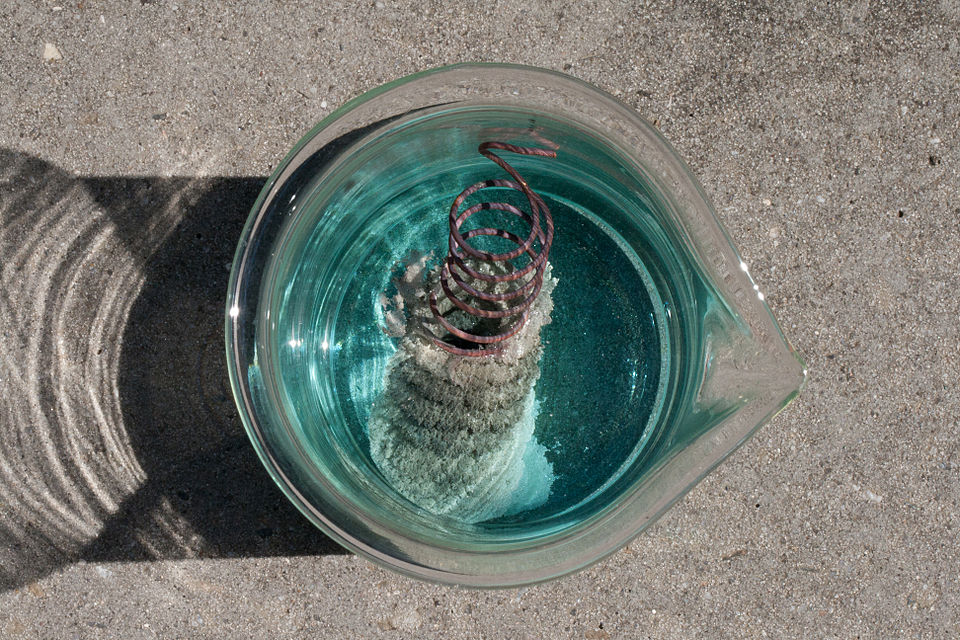
Correct: B, AgNO3 solution and copper metal. A metal displaces another metal from its salt solution only when the free metal is the more reactive of the two, that is, higher in the reactivity series. Taking the standard order (potassium, sodium, calcium, magnesium, aluminium, zinc, iron, lead, (hydrogen), copper, mercury, silver, gold) copper stands above silver, so copper can push silver out of its salt and take its place: Cu + 2AgNO3 gives Cu(NO3)2 + 2Ag. This is the textbook demonstration of the idea precisely because you can watch it happen. Suspend a clean copper wire in colourless silver nitrate solution and within minutes the solution turns blue as copper(II) nitrate forms, while glittering grey needles of metallic silver build up along the wire. Underneath, it is a redox change: each copper atom is oxidised from 0 to +2 and gives up two electrons, and each silver ion is reduced from +1 to 0 by taking one, which is why reactions of this shape are also called single-displacement or single-replacement redox reactions. Test the other three the same way, by writing the free metal against the metal already in the salt: copper against sodium, aluminium against magnesium, silver against iron. In every one of those the free metal is the lower of the pair, so no reaction occurs. The plural 'pairs' in the stem is loose phrasing, not a signal that more than one option works: exactly one of the four combinations has the free metal above the salt's metal.
Why the others are wrong
- (a)NaCl solution and copper metal: NaCl solution and copper metal: copper sits near the bottom of the reactivity series and sodium near the very top, so copper cannot displace sodium from sodium chloride and nothing happens. There is a subtler trap buried here: silver nitrate and sodium chloride do react with each other, by double displacement, giving a white curdy precipitate of silver chloride. But this option pairs sodium chloride with copper metal, not with a silver salt, and a metal-plus-salt pairing is judged by the reactivity series alone.
- (c)MgCl2 solution and aluminium metal: MgCl2 solution and aluminium metal: the option that separates candidates who have memorised the series from those who have not. Magnesium is above aluminium, not below it, so aluminium cannot displace magnesium from magnesium chloride. Reverse the pair and it works: magnesium metal dropped into aluminium chloride solution would displace aluminium. Anyone who reasons only that 'aluminium is a reactive metal' will pick this and lose the mark on an adjacent-pair ordering.
- (d)FeSO4 solution and silver metal: FeSO4 solution and silver metal: silver is one of the least reactive metals of all and lies well below iron, so it cannot displace iron from ferrous sulphate. That inertness is exactly why silver, like gold, is found in nature in the native metallic state and does not corrode away, and it is the same property that makes it the metal being displaced, rather than the displacer, in the correct option.
Concept
The reactivity series, also called the activity series, ranks metals by how readily they give up electrons and form positive ions. Potassium, sodium and calcium do so most easily; gold and silver most reluctantly. That single ordering answers four different kinds of examination question, which is why it repays memorising rather than deriving. First, displacement: a metal higher in the series displaces one lower down from its salt solution. Second, reaction with water and acids: metals above hydrogen release hydrogen gas from dilute acids, which is why zinc fizzes in dilute hydrochloric acid while copper and silver, both below hydrogen, sit unchanged. Third, extraction: the most reactive metals, from potassium down to aluminium, cannot be reduced by carbon and must be won by electrolysis of their molten compounds; the middle group, zinc, iron and lead, are obtained by reducing their oxides with carbon or coke in a furnace; and the least reactive, silver and gold, occur native or need only gentle treatment. Fourth, corrosion control: galvanising coats iron with zinc, and sacrificial anodes protect buried pipelines, both because a more reactive metal placed alongside a less reactive one corrodes first and spares it.
Do not read the four options as chemistry to be recalled; convert each into a two-name comparison and check its direction against the series. Option (a) is copper against sodium. Option (b) is copper against silver. Option (c) is aluminium against magnesium. Option (d) is silver against iron. The rule is one line long: the reaction runs only if the first name is higher than the second. Copper against sodium fails badly and silver against iron fails badly, so both can be discarded almost without thought: a bottom-of-the-series metal is being asked to displace a metal far above it. That leaves (b) and (c), and the two are not equally hard. Copper above silver is at the far, unreactive end of the series where the order is easy to hold, since silver and gold are famously the metals that do not corrode. Aluminium against magnesium is the genuinely testable pair, because both are commonly described as reactive metals and their relative order has to be remembered rather than felt. Carry the sequence as a fixed string (potassium, sodium, calcium, magnesium, aluminium, zinc, iron, lead, hydrogen, copper, mercury, silver, gold) and read the two letters off it instead of reasoning about which metal 'seems' more reactive.
Key facts
- Reactivity series in descending order: potassium, sodium, calcium, magnesium, aluminium, zinc, iron, lead, hydrogen, copper, mercury, silver, gold. A metal displaces from a salt solution only those metals below it.
- The reaction in option (b): Cu + 2AgNO3 gives Cu(NO3)2 + 2Ag. The colourless solution turns blue from copper(II) ions and grey crystalline silver deposits on the copper.
- Displacement is a redox change (copper is oxidised from oxidation state 0 to +2 and silver is reduced from +1 to 0) which is why the reaction is classed as single displacement rather than double displacement.
- Only metals above hydrogen in the series release hydrogen gas from dilute acids. Zinc and iron do; copper and silver do not, which is why copper is unaffected by dilute hydrochloric acid.
- Position in the series decides how a metal is extracted: electrolysis of molten compounds for potassium through aluminium, reduction of the oxide with carbon or coke for zinc, iron and lead, and native occurrence for silver and gold.
- The same ordering explains galvanising. Iron is coated with zinc because zinc is above iron and corrodes in its place, and the coating protects even where it has been scratched through.
Study next
Common traps
- Placing aluminium above magnesium. Magnesium is the more reactive of the two, which is exactly what option (c) is built to catch.
- Reading the plural 'pairs' in the stem as an invitation to find more than one working combination. Only one pairing has the free metal above the salt's metal.
- Confusing displacement with double displacement. Silver nitrate and sodium chloride do react with each other and give a white precipitate of silver chloride, but option (a) offers sodium chloride with copper metal, and a metal against a salt is decided by the reactivity series alone.
BPSC asks school chemistry as a direct one-line application drawn straight from the Class 9 and 10 syllabus (pick the pair that reacts, name the acid, name the model) and expects the reactivity series to have been memorised as a list rather than reasoned out from data, with the discriminating option always an adjacent pair such as aluminium and magnesium. UPSC now rarely asks the series in that bare form. When it goes near metals it asks the industrial or environmental application instead (what coke actually does inside a blast furnace, or why copper smelting plants attract regulatory concern) so the same chemistry arrives wrapped in a process question.
Related PYQs
Assertion (A): Sodium metal is stored under kerosene. Reason (R): Metallic sodium melts when exposed to air.
- (a) Both A and R are true, and R is the correct explanation of A
- (b) Both A and R are true, but R is NOT a correct explanation of A
- (c) A is true, but R is false
- (d) A is false, but R is true
Answer(c) A is true, but R is false
The top end of the same series. Sodium has to be stored under kerosene because it is so far up the reactivity ranking that it attacks air and moisture on contact: the very property that makes option (a) here impossible, since copper sits near the bottom and cannot displace sodium from any of its salts.
Consider the following statements: Coke is one of the materials of the charge added to blast furnace for the production of steel/iron. Its function is to I. Act as a reducing agent. II. Remove silica associated with the iron ore. III. Function as fuel, to supply heat. IV. Act as an oxidizing agent. Of these statements:
- (a) I and II are correct
- (b) II and IV are correct
- (c) I and III are correct
- (d) III and IV are correct
Answer(c) I and III are correct
The reactivity series put to industrial work. Iron can be won by reducing its oxide with coke inside a blast furnace only because iron sits in the middle of the series; metals higher up, from aluminium to potassium, resist carbon reduction and have to be electrolysed instead. Same ranking, applied to extraction rather than to a test tube.
Practice
- practice, not a real PYQ
Which one of the following metals will displace hydrogen gas from dilute hydrochloric acid ?
- (a)Copper
- (b)Silver
- (c)Zinc
- (d)Gold
Answer(c) Zinc: only metals above hydrogen in the reactivity series liberate hydrogen from dilute acids. Copper, silver and gold all lie below hydrogen and are unaffected by dilute hydrochloric acid. - practice, not a real PYQ
When an iron nail is left standing in a blue copper sulphate solution, the blue colour fades. The reason is that
- (a)iron displaces copper from the solution
- (b)copper displaces iron from the solution
- (c)copper sulphate decomposes on contact with iron
- (d)iron sulphate is insoluble and settles at the bottom
Answer(a) iron displaces copper from the solution: iron is above copper in the reactivity series, so Fe + CuSO4 gives FeSO4 + Cu. The blue copper(II) ions leave the solution as a reddish-brown copper coating on the nail, and the pale green of ferrous sulphate replaces the blue.