
Which one of the following is the world’s richest region from a marine biodiversity perspective, comprising twenty-one islands with estuaries, beaches, forests of the nearshore environment, sea grasses, coral reefs, salt marshes and mangroves?
- (a)Gulf of Mannar Biosphere Reserve
- (b)Nanda Devi Biosphere Reserve
- (c)Sunderbans Biosphere Reserve
- (d)Nilgiri Biosphere Reserve
Answer
Why
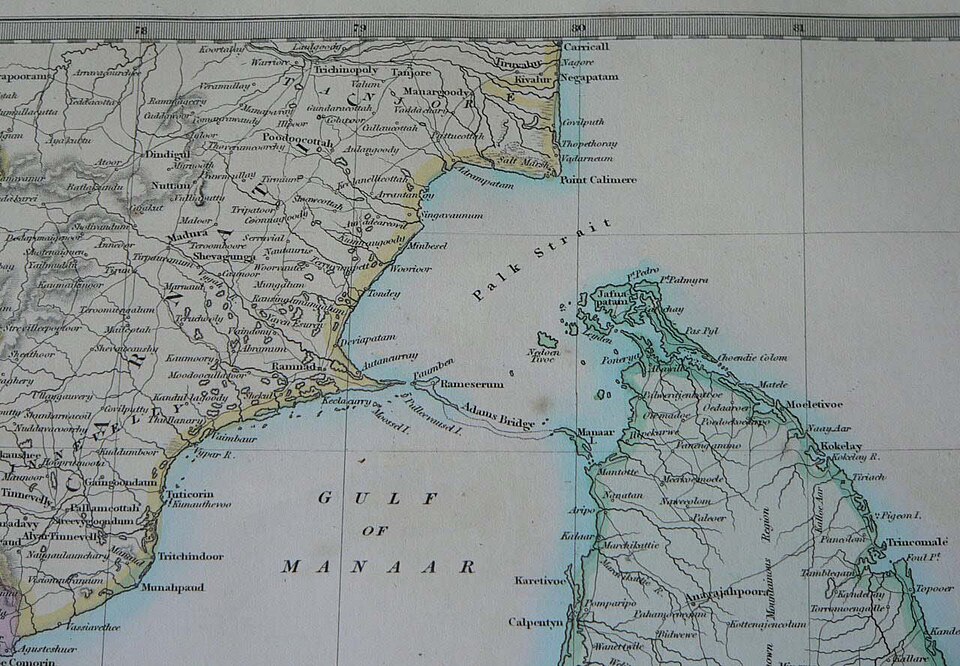
Correct: A, Gulf of Mannar Biosphere Reserve. Every clause of the stem describes this one reserve and no other, and two of them are near-quotations. UNESCO's Man and the Biosphere entry for Gulf of Mannar (on the World Network of Biosphere Reserves since 2001) calls it "one of the world's richest regions from a marine biodiversity perspective" and records 4,223 species of plants and animals across about 10,500 sq km, which is where the stem's superlative comes from. The "twenty-one islands" is the harder half of the clue and it is exact: the Gulf of Mannar Biosphere Reserve Trust, a registered trust of the Government of Tamil Nadu, states that the area of 560 sq km "encompassing 21 uninhabited islands, surrounding coral reef areas and shallow water habitat" was declared a Marine National Park in 1986. Those 21 islands form a chain along the coast between Rameswaram and Tuticorin (Thoothukudi) in four groups: Mandapam (7 islands: Musal, Manoli, Manoliputti, Poomarichan, Pullivasal, Krusadai, Shingle), Keezhakkarai (7), Vembar (3) and Thoothukudi (4: Vaan, Koswari, Kariyachalli, Vilanguchalli), and their combined land area is only about 6 sq km, so the reserve is overwhelmingly sea. The seven habitats the stem lists occur together only here among the four options, because only the Gulf of Mannar has true coral reefs and extensive seagrass meadows alongside estuaries, beaches, salt marshes and mangroves. India notified the reserve in 1989, and it was the first marine biosphere reserve not merely in India but in all of South and South-East Asia. Its standing has since been reinforced: MoEFCC's official list of Ramsar Sites of India records "Gulf of Mannar Marine Biosphere Reserve", Tamil Nadu, as designated on 08-04-2022 over 52,672 hectares. One honest caveat on wording: UNESCO writes "one of the world's richest" where the stem hardens it to "the world's richest". The superlative is exam shorthand; the identification it points to is not in doubt.
Why the others are wrong
- (b)Nanda Devi Biosphere Reserve: Nanda Devi is a high-Himalayan, wholly land-locked reserve in Chamoli district of Uttarakhand: notified in 1988, on UNESCO's World Network since 2004, about 5,860 sq km, built around the 7,816 m Nanda Devi peak and the Nanda Devi National Park and Valley of Flowers World Heritage Site. It has glaciers, alpine meadows and temperate forest; it has no coast, no islands, no coral and no mangrove. Candidates pick it only because it is the most famous name on the list.
- (c)Sunderbans Biosphere Reserve: The most tempting wrong answer, because the Sundarbans genuinely is an island-studded coastal reserve with estuaries, mudflats, salt marsh and the world's largest mangrove forest, notified in 1989 and on UNESCO's network since 2001. Two things break the match. Its deltaic islands number far more than twenty-one, and its heavy freshwater discharge and silt load make the water too turbid for coral reefs or seagrass meadows, which is why UPSC's own 2014 coral-reef question excludes the Sundarbans while including the Gulf of Mannar.
- (d)Nilgiri Biosphere Reserve: The Nilgiri Biosphere Reserve was India's first biosphere reserve, notified in 1986 and inscribed on UNESCO's World Network in 2000, covering about 5,520 sq km across Tamil Nadu, Kerala and Karnataka and taking in Mudumalai, Bandipur, Nagarhole, Wayanad, Silent Valley and Mukurthi. It is entirely an inland Western Ghats montane and moist-deciduous forest complex. Its claim to biodiversity fame is terrestrial and floral, not marine, and it contains no island, reef or estuary.
Concept
A biosphere reserve is not a stricter national park; it is a UNESCO Man and the Biosphere (MAB) category (the programme was launched in 1971) built for people and nature together, and it is zoned in three rings: a legally protected core where only research is allowed, a buffer where regulated ecological activity is permitted, and a transition zone of farms, fishing villages and settlements. That is why biosphere reserves are so much larger than the national parks inside them. At Gulf of Mannar the core is the 560 sq km Marine National Park of 1986, while the reserve as a whole runs to about 10,500 sq km and holds roughly 2.5 million people in some 47 coastal villages, many of them Marakeyars whose livelihood is fishing: a population that a park notification could never have excluded, and the reason the biosphere category was used at all. Day-to-day management sits with the Gulf of Mannar Biosphere Reserve Trust, a registered trust of the Government of Tamil Nadu set up specifically to run the reserve with its fisher communities rather than against them. India runs 18 biosphere reserves, of which 13 are on UNESCO's World Network; Gulf of Mannar, notified in 1989 and internationally recognised in 2001, is the only one whose core is water: India's first marine biosphere reserve and the first in South and South-East Asia.
Two clues in the stem do all the work, and both are quantitative rather than atmospheric. The first is the number: twenty-one islands. Only one Indian protected area is defined by exactly twenty-one islands, and it is the Gulf of Mannar chain between Rameswaram and Thoothukudi; the Sundarbans has many times that number and neither Nanda Devi nor the Nilgiris has any. The second is the habitat list, and the discriminating entries in it are coral reefs and sea grasses, not mangroves. Mangroves and estuaries are shared with the Sundarbans and would leave the question ambiguous, but coral needs clear, warm, low-silt water: precisely what a river delta cannot offer. The moment you read "coral reefs" next to "mangroves" in the same list, the answer must be a shallow tropical gulf rather than a delta, and only option (a) is a gulf. A student who never learnt the island count can still get there on the reef clue alone, which is the more transferable habit. There is also a structural tell worth training: two of the four options, Nanda Devi and Nilgiri, are Western Ghats or Himalayan reserves that no amount of doubt can push towards the sea, so the real question is only ever gulf versus delta. Narrowing a four-option question to a two-option one before you start reasoning is worth more marks over a paper than any single fact on this card.
Key facts
- Gulf of Mannar Biosphere Reserve: notified by India in 1989; added to UNESCO's World Network of Biosphere Reserves in 2001; area about 10,500 sq km; 4,223 recorded species of plants and animals (UNESCO MAB entry)
- Gulf of Mannar Marine National Park, declared 1986, is the reserve's core: 560 sq km enclosing 21 uninhabited islands whose own land area is only about 6.23 sq km
- The 21 islands lie between Rameswaram and Thoothukudi in four groups: Mandapam (7), Keezhakkarai (7), Vembar (3) and Thoothukudi (4), in Ramanathapuram and Thoothukudi districts of Tamil Nadu
- It is the first marine biosphere reserve in India and in all of South and South-East Asia (Gulf of Mannar Biosphere Reserve Trust, Government of Tamil Nadu)
- MoEFCC's official Ramsar list records Gulf of Mannar Marine Biosphere Reserve as Ramsar-designated on 08-04-2022, area 52,672 hectares
- The dugong (sea cow) is the reserve's flagship mammal and is protected under Schedule I of the Wild Life (Protection) Act, 1972
- India has 18 biosphere reserves; 13 are on UNESCO's World Network. Nilgiri was the first notified (1986) and the first Indian entry on the World Network (2000)
- A biosphere reserve is zoned core / buffer / transition; only the core carries full legal protection, which is why local fishing continues legally in the Gulf of Mannar's outer zones
- The Gulf of Mannar Biosphere Reserve Trust records nearly 3,600 species of marine organisms in the Gulf, many endemic to it; the IUCN Commission on National Parks and Protected Areas, with UNEP, UNESCO and WWF, identified the reserve as an area of 'particular concern'
- Tamil Nadu's coast runs about 1,000 km, roughly 13% of India's coastline; of this the Gulf of Mannar accounts for about 360 km and the Palk Strait about 625 km
- The Gulf of Mannar, the Gulf of Kachchh and the Gulf of Khambhat are the three gulfs on India's coastline: only the first two carry coral reefs
Study next
Common traps
- Assuming the Sundarbans because the stem mentions mangroves and estuaries: the reef and seagrass entries in the same list rule a silty delta out
- Confusing the Gulf of Mannar Marine National Park (560 sq km, 1986, the core) with the Gulf of Mannar Biosphere Reserve (about 10,500 sq km, 1989) and quoting one figure for the other
- Mixing up 'India's first biosphere reserve' (Nilgiri, 1986) with 'India's first marine biosphere reserve' (Gulf of Mannar) and with 'India's first marine national park' (Gulf of Kachchh)
BPSC and UPSC ask this area very differently. BPSC gives a descriptive paragraph (a habitat list, an island count, a superlative) and asks you to name the site, so the winning skill is spotting the one detail that only one place can satisfy. UPSC almost never names the site outright; it asks which reserves have coral reefs, whether a biosphere reserve permits local resource use, or which Indian reserves are on the UNESCO network, so it tests the category and its rules rather than the name.
Related PYQs
Which of the following have coral reefs? 1. Andaman and Nicobar Islands 2. Gulf of Kachchh 3. Gulf of Mannar 4. Sunderbans Select the correct answer using the code given below.
- (a) 1, 2 and 3 only
- (b) 2 and 4 only
- (c) 1 and 3 only
- (d) 1, 2, 3 and 4
Answer(a) 1, 2 and 3 only
The exact discriminator this BPSC question turns on: the Gulf of Mannar has coral reefs and the Sundarbans does not, because a silt-laden delta cannot support reef growth.
Out of all the Biosphere Reserves in India, four have been recognized on the World Network by UNESCO. Which one of the following is not one of them?
- (a) Gulf of Mannar
- (b) Kanchenjunga
- (c) Nanda Devi
- (d) Sunderbans
Answer(b) Kanchenjunga
Same three reserves, tested on their UNESCO status rather than their habitats: by 2008 the Indian entries on the World Network were Nilgiri (2000), Gulf of Mannar (2001), Sundarbans (2001) and Nanda Devi (2004); Khangchendzonga joined only in 2018.
Which of the following parks/sanctuaries come under the project tiger in Bihar?
- (a) Valmiki National Park
- (b) Udaypur Wildlife Sanctuary
- (c) Bhimbandh Wildlife Sanctuary
- (d) None of these
Answer(a) Valmiki National Park
The same discrimination task two years later: four named protected areas, only one of which carries the specific conservation designation the stem describes.
Practice
- practice, not a real PYQ
The Gulf of Mannar Marine National Park, declared in 1986, encompasses how many uninhabited islands?
- (a)14
- (b)21
- (c)27
- (d)36
Answer(b) 21: 21 uninhabited islands over about 560 sq km, grouped as Mandapam (7), Keezhakkarai (7), Vembar (3) and Thoothukudi (4). - practice, not a real PYQ
Which of the following is India's first marine biosphere reserve?
- (a)Gulf of Kachchh
- (b)Gulf of Mannar
- (c)Sunderbans
- (d)Great Nicobar
Answer(b) Gulf of Mannar: notified in 1989, it is the first marine biosphere reserve in India and in all of South and South-East Asia; the Gulf of Kachchh has India's first marine national park but is not a biosphere reserve at all.