
Which of the following are not the tastes of the tongue? 1. Sweet 2. Bitter 3. Salty 4. Spicy 5. Umami 6. Sour 7. Pungent Select the correct answer using the codes given below.
- (a)2, 5 and 7
- (b)1, 3 and 4
- (c)4 and 7
- (d)3 and 6
Answer
Why
Correct: C, 4 and 7. Sensory physiology recognises exactly five basic tastes (sweet, sour, salty, bitter and umami) and the word 'basic' has a precise meaning: each has its own dedicated receptor on the taste-receptor cells inside a taste bud, and its own labelled pathway to the brain. Sweet is detected by the T1R2–T1R3 receptor pair and umami by T1R1–T1R3, both G-protein-coupled receptors; bitter by the T2R family, of which humans carry about twenty-five working genes; sour by the proton channel OTOP1, which senses hydrogen ions; and salty largely by the epithelial sodium channel ENaC responding to Na+ ions. That accounts for five of the seven items in the list: 1 Sweet, 2 Bitter, 3 Salty, 5 Umami and 6 Sour. What is left is 4 Spicy and 7 Pungent, and they are not tastes at all; they are the same single sensation named twice, which is precisely the examiner's design. The burn of a chilli comes from capsaicin binding TRPV1, a receptor whose ordinary job is to report temperatures above roughly 43 °C and physical pain; black pepper's piperine and mustard oil's allyl isothiocyanate act on the same receptor family. Crucially, these receptors sit on the free nerve endings of the trigeminal nerve, not on taste buds. That is why the sensation is classed as chemesthesis rather than gustation, why you can feel it on your lips, your eyes and broken skin where there is not a single taste bud, and why cold milk, whose fat dissolves capsaicin, relieves it while water merely spreads it. The split is therefore clean and anatomical: five entries are tastes carried from taste buds by cranial nerves VII, IX and X, and two entries (spicy and pungent) are irritation carried by cranial nerve V along ordinary pain fibres.
Why the others are wrong
- (a)2, 5 and 7: Gets item 7 right and then discards two genuine tastes. Bitter (2) is the most protective of the five: the T2R family exists largely to make plant alkaloids and spoiled food unpalatable. Umami (5) is the real trap: it was named by Kikunae Ikeda at Tokyo Imperial University in 1908 from kombu seaweed broth, but only became textbook-standard after its receptor was identified around 2000, so candidates drilled on the old four-taste list still treat it as a marketing word rather than a basic taste.
- (b)1, 3 and 4: Correctly spots Spicy (4) and then throws out Sweet (1) and Salty (3), the two least disputable tastes on any classification anywhere. A candidate lands here by finding one non-taste, assuming the answer must have three items because two of the four options do, and filling the rest at random, or by inverting the stem and answering 'which of these ARE tastes'.
- (d)3 and 6: Names Salty (3) and Sour (6), both of which are basic tastes with well-characterised transduction machinery: sour through OTOP1 proton channels in type III taste cells, salty through amiloride-sensitive ENaC sodium channels. This option contains no non-taste at all, so it fails on both items rather than one, and it is chosen mainly by candidates who confuse a taste with the chemical that produces it.
Concept
Taste, or gustation, is a chemical sense mediated by taste buds: clusters of 50 to 100 receptor cells buried in the fungiform papillae at the front of the tongue, the foliate papillae along its sides and the large circumvallate papillae arranged in a V at the back. The filiform papillae that give the tongue its rough texture carry no taste buds at all. Only five stimulus classes have dedicated receptors there, and those five are the basic tastes. Everything else we loosely call taste is either smell: retronasal olfaction, which supplies most of what we experience as 'flavour', and whose loss during a cold is why food goes bland, or chemesthesis, the chemical irritation of ordinary pain, touch and temperature fibres of the trigeminal nerve. Capsaicin, piperine, menthol and mustard oil all work this last way, on TRP-family ion channels that also respond to heat and cold. The distinction is not pedantry: it explains why chilli hurts the eye, why menthol feels cold without lowering temperature, and why a person who has lost their sense of smell can still detect salt and sugar perfectly well.
Two things decide this question, and the first is simply reading the stem correctly: it asks which items are NOT tastes, so every option must be read as a list of impostors. The second is recognising that the setter has hidden the answer in plain sight by listing the same sensation twice: 'Spicy' at 4 and 'Pungent' at 7 are one and the same chilli-and-pepper burn, so any correct option must contain both. That single observation eliminates (b) and (d) immediately, since neither contains 4 and 7 together, and it eliminates (a) as well, since (a) picks 7 but not 4 while dropping two real tastes. Option (c) is the only one that names exactly the pair. Reaching it positively requires knowing that umami is a basic taste and not a Japanese food-industry invention, which is where most candidates fail; a student working from the old four-taste school textbook will suspect item 5 and be drawn to (a). It also helps to know why 'pungent' feels like a taste to an Indian candidate: classical Ayurveda counts six rasas (madhura (sweet), amla (sour), lavana (salty), katu (pungent), tikta (bitter) and kashaya (astringent)) so both pungency and astringency are tastes in that older scheme. The stem is asking about the tongue's receptor physiology, not about that classification.
Key facts
- The five basic tastes and their receptors: sweet (T1R2–T1R3), umami (T1R1–T1R3), bitter (the T2R family, about 25 functional human genes), sour (the OTOP1 proton channel) and salty (chiefly the epithelial sodium channel ENaC).
- Umami was identified in 1908 by Kikunae Ikeda of Tokyo Imperial University, who isolated glutamate from kombu seaweed broth and went on to patent monosodium glutamate; the umami receptor was characterised only around 2000, which is why older textbooks list four tastes.
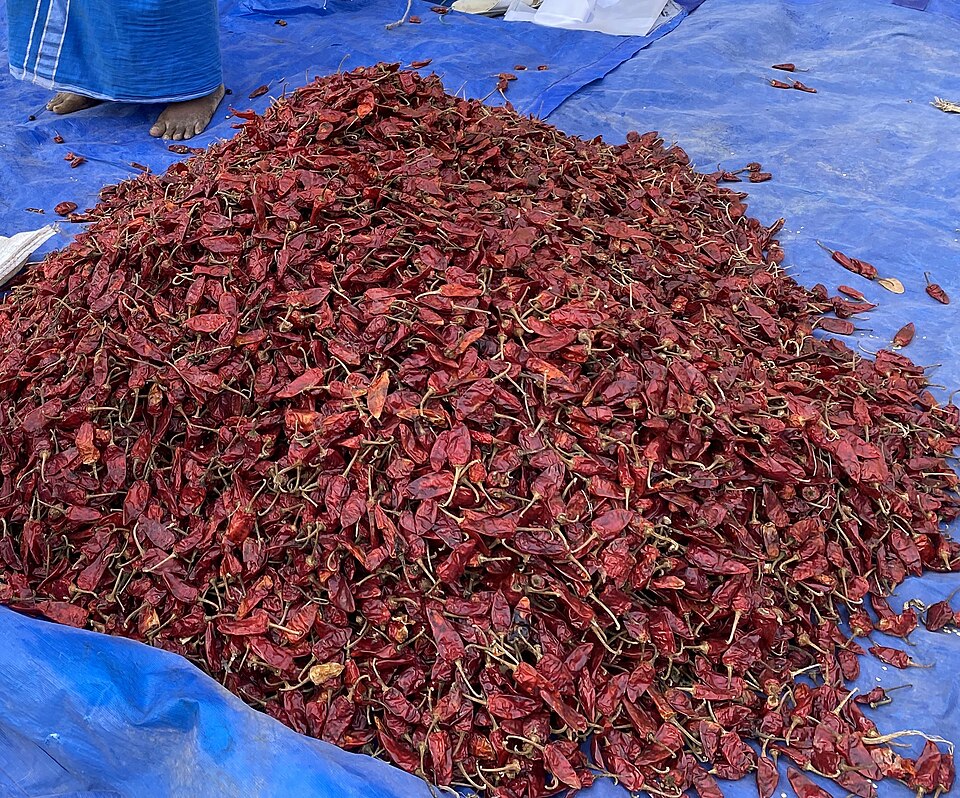
- 'Spicy' is not a taste but chemesthesis: capsaicin from Capsicum activates TRPV1, the same receptor that fires above about 43 °C and reports pain. Chilli heat is quantified on the Scoville scale, devised by Wilbur Scoville in 1912.
- Different cranial nerves carry the two sensations. Taste travels from the anterior two-thirds of the tongue in the chorda tympani branch of the facial nerve (VII), from the posterior one-third in the glossopharyngeal (IX) and from the epiglottis in the vagus (X); the burn of chilli travels in the lingual branch of the trigeminal (V).
- The 'tongue map' (sweet at the tip, bitter at the back) is a myth, traceable to Edwin Boring's 1942 misreading of D. P. Hänig's 1901 German study; all five basic tastes can be detected across the whole tongue surface.
Study next
Common traps
- Reading the stem as 'which ARE tastes': it asks the opposite, and options (b) and (d) reward exactly that misreading
- Rejecting umami because the school textbook listed four tastes; it has a dedicated receptor (T1R1–T1R3) and is a basic taste on every current classification
- Treating 'spicy' and 'pungent' as two separate items and settling for an option that contains only one of them: they are the same sensation, so the correct option must carry both
BPSC asks basic physiology as a numbered-list-and-code item where nearly all the difficulty sits in one inverted word: 'are NOT the tastes', and then pads the list with two entries that name the same thing, so a candidate who finds one impostor and stops still gets it wrong. UPSC rarely asks a definition list like this; it prefers the mechanism or the pairing, either matching objects to descriptions or setting a statement block on receptors, deficiency diseases and food chemistry, as with its 2017 pairing of monosodium glutamate with Chinese fast food.
Related PYQs
Consider the following pairs: Commonly used / consumed materials — Unwanted or controversial chemicals likely to be found in them 1. Lipstick — Lead 2. Soft drinks — Brominated vegetable oils 3. Chinese fast food — Monosodium glutamate Which of the pairs given above is/are correctly matched?
- (a) 1 only
- (b) 2 and 3 only
- (c) 1 and 3 only
- (d) 1, 2 and 3
Answer(d) 1, 2 and 3
Monosodium glutamate is the compound behind umami: item 5 in this list. Recognising MSG as the flavour enhancer of Chinese fast food and recognising umami as a basic taste are the same piece of knowledge approached from opposite ends.
Aspartame is an artificial sweetener sold in the market. It consists of amino acids and provides calories like other amino acids. Yet, it is used as a low-calorie sweetening agent in food items. What is the basis of this use?
- (a) Aspartame is as sweet as table sugar, but unlike table sugar, it is not readily oxidized in human body due to lack of requisite enzymes
- (b) When aspartame is used in food processing, the sweet taste remains, but it becomes resistant to oxidation
- (c) Aspartame is as sweet as sugar, but after ingestion into the body, it is converted into metabolites that yield no calories
- (d) Aspartame is several times sweeter than table sugar, hence food items made with small quantities of aspartame yield fewer calories on oxidation
Answer(d) Aspartame is several times sweeter than table sugar, hence food items made with small quantities of aspartame yield fewer calories on oxidation
Turns on the same physiology from the sweet side: the T1R2–T1R3 receptor responds to molecular shape, not to food value, so a compound roughly 200 times sweeter than sucrose delivers the full sensation of sweetness at a negligible calorie cost.
Practice
- practice, not a real PYQ
Which of the following is the fifth basic taste, identified by the Japanese chemist Kikunae Ikeda in 1908?
- (a)Astringent
- (b)Umami
- (c)Pungent
- (d)Metallic
Answer(b) Umami: Ikeda isolated glutamate from kombu seaweed broth at Tokyo Imperial University and named the savoury taste umami; monosodium glutamate is its commercial form. - practice, not a real PYQ
The burning sensation produced by capsaicin present in chillies is detected by:
- (a)Taste buds in the circumvallate papillae
- (b)Olfactory receptors in the nasal cavity
- (c)TRPV1 heat-and-pain receptors on trigeminal nerve endings
- (d)ENaC sodium channels of the taste-receptor cells
Answer(c) TRPV1 heat-and-pain receptors on trigeminal nerve endings: capsaicin activates the same receptor that responds to temperatures above about 43 °C, which is why chilli heat is a pain sensation and not a taste.