
The G20 members represent 1. around 85% of the global GDP 2. about 50% of the global trade 3. about two-thirds of the world population Which of the above statistics is/are correct?
- (a)Only 1
- (b)Only 1 and 3
- (c)1, 2 and 3
- (d)Only 1 and 2
Answer
Why
Correct: B, Only 1 and 3. This item is not testing an estimate; it is testing whether the candidate read the G20 presidency's own one-line description of the grouping. Through India's presidency (1 December 2022 to 30 November 2023) the official website g20.org carried this sentence under 'G20 Members': 'The G20 members represent around 85% of the global GDP, over 75% of the global trade, and about two-thirds of the world population.' Statements 1 and 3 of the stem reproduce that sentence almost word for word: 'around 85% of the global GDP' and 'about two-thirds of the world population'. Statement 2 is the one the setter altered. The official figure for trade is over 75 per cent; the stem offers 'about 50%', which understates it by a third and is therefore wrong. So exactly two of the three statistics stand, and the answer is (b). Two supporting checks make this safe rather than merely memorised. On output, the nineteen G20 countries together account for roughly 85 per cent of gross world product, so statement 1 survives independent verification. On trade, the same nineteen handle about three-quarters of world merchandise trade: a figure repeated by the OECD and by member governments' own G20 pages, so a 50 per cent claim is not a rounding difference but a different order of magnitude. The one honest caveat is on statement 3: a strict head-count of the nineteen member countries comes to roughly 56 per cent of humanity, and the 'two-thirds' figure depends on counting the European Union's other member states alongside them. It is nevertheless the official phrasing, it is what the presidency published, and after the African Union was admitted at the New Delhi summit the grouping's share of world population rose to close to four-fifths, so the statement errs, if at all, on the low side.
Why the others are wrong
- (a)Only 1: Right to reject statement 2, but wrong to reject statement 3 as well. This is the answer of a candidate who remembers the 85 per cent GDP figure (much the most quoted of the three) and then treats the population claim as an exaggeration because the G20 is 'only twenty countries'. The arithmetic defeats that instinct: China and India alone are about 2.8 billion people, and adding the United States, Indonesia, Brazil, Russia, Japan, Mexico and the rest brings the group past half the planet before the European Union's other members are counted at all.
- (c)1, 2 and 3: The commonest wrong answer, because 'about 50% of the global trade' sounds like the cautious, defensible claim in a list of large numbers: a candidate reading quickly assumes the modest figure must be the safe one. The setter has inverted the usual trap. Here the understated statistic is the false one: the G20's share of world trade is above 75 per cent, not around half. Whenever an all-of-the-above option is on offer, the discipline is to check the least dramatic statement as carefully as the most dramatic one.
- (d)Only 1 and 2: This keeps the single false statement and discards a true one, so it is wrong twice over. It is chosen by candidates who accept the trade figure at face value and then baulk at 'two-thirds of the world population', reasoning that the G20 excludes most of Africa. That reasoning was already weak in 2023 and became weaker three weeks before this paper was written, when the African Union (55 member states, some 1.4 billion people) was admitted to the G20 as a permanent member at the New Delhi summit.
Concept
The G20, or Group of Twenty, is the premier forum for international economic cooperation. It was created in 1999, in the wake of the East Asian financial crisis, as a table at which the finance ministers and central bank governors of systemically important economies could talk to one another; the global financial crisis pushed it up to the level of heads of state and government at the Washington summit of November 2008, and in 2009 it was formally designated the premier forum for international economic cooperation. Its membership is nineteen countries: Argentina, Australia, Brazil, Canada, China, France, Germany, India, Indonesia, Italy, Japan, the Republic of Korea, Mexico, Russia, Saudi Arabia, South Africa, Türkiye, the United Kingdom and the United States: plus the European Union, and since the New Delhi summit of September 2023 the African Union as well. It has no charter, no treaty and no permanent secretariat: the presidency rotates annually and the host country runs the agenda, supported by a troika of the previous, current and next presidencies. Work is split between a Finance Track of finance ministries and central banks and a Sherpa Track covering everything else, from trade and health to digital public infrastructure and climate. Because it issues no binding law, the G20's authority is entirely a function of the weight of its members, which is why every presidency puts the same three ratios (share of world output, share of world trade, share of world population) at the head of its own literature. Those ratios are the grouping's claim to speak for the world economy, and they are what this question is checking.
The route to the answer is to notice what kind of statement each of the three actually is. All three are lifted from the same publicity sentence, so the question reduces to: which one has been tampered with? Fix the official trio in memory as a descending ladder (85 per cent of GDP, 75 per cent of trade, two-thirds of population) and any altered figure jumps out. The stem keeps 85 and two-thirds untouched and moves 75 down to 50, so statement 2 is the planted error and (b) follows. The reason candidates get this wrong is that the tampered figure was made smaller rather than larger. Exam instinct says inflated claims are the traps, so a modest-sounding 'about 50%' slides past unchecked and the candidate ticks 1, 2 and 3. There is also a genuine conceptual point buried here: the G20's share of trade is bound to be higher than its share of population, because rich, industrialised economies trade far more per head than the world average, while its share of population is the weakest of the three claims precisely because it depends on counting the European Union's non-G20 members. If you can rank the three ratios by economic logic before you look at the numbers, the question answers itself.
Key facts
- The official self-description carried on the G20 India presidency website read: 'The G20 members represent around 85% of the global GDP, over 75% of the global trade, and about two-thirds of the world population': statements 1 and 3 of this stem quote it; statement 2 halves the trade figure.
- The G20 was founded in 1999 as a forum of finance ministers and central bank governors after the East Asian financial crisis, was raised to leaders' level at Washington in November 2008 during the global financial crisis, and was designated the premier forum for international economic cooperation in 2009.
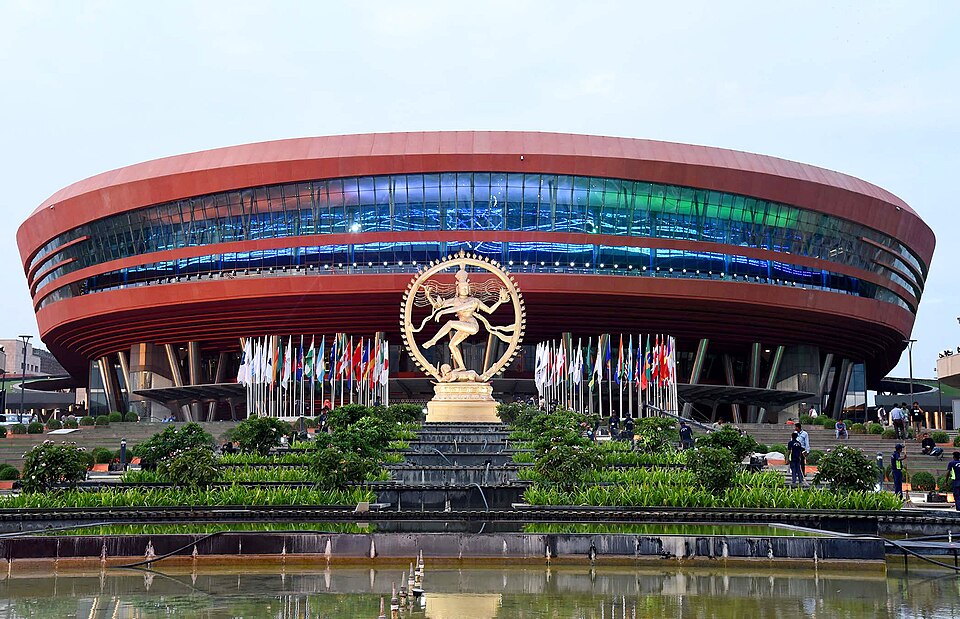
- India held the G20 presidency from 1 December 2022 to 30 November 2023; the 18th summit was held at Bharat Mandapam, Pragati Maidan, New Delhi on 9–10 September 2023 under the theme 'Vasudhaiva Kutumbakam: One Earth, One Family, One Future', and adopted the New Delhi Leaders' Declaration by consensus.
- The African Union was admitted as a permanent member at the New Delhi summit on 9 September 2023, taking the grouping from 19 countries plus the European Union to 21 members and lifting its share of world population towards four-fifths.
- The G20 has no charter, no treaty and no permanent secretariat; the annually rotating presidency is supported by a troika of the previous, present and next chairs: Indonesia, India and Brazil in India's year, and the work runs on two parallel tracks, Finance and Sherpa.
- Two initiatives were launched on the margins of the New Delhi summit and are the most examinable outcomes of India's presidency: the India–Middle East–Europe Economic Corridor (IMEC), a rail-and-shipping corridor backed by India, the UAE, Saudi Arabia, the European Union and the United States, and the Global Biofuels Alliance, whose founding members included India, Brazil and the United States.
Study next
Common traps
- Accepting an understated figure because it sounds cautious: the G20's trade share is above 75 per cent, not about 50 per cent
- Confusing the G20's share of world GDP (about 85 per cent) with its share of world trade (about 75 per cent) or of world population (about two-thirds on the official phrasing)
- Describing the G20 as a treaty organisation with a secretariat, or forgetting that the European Union (and since September 2023 the African Union) are members in their own right alongside the nineteen countries
BPSC asks the G20 as headline arithmetic (three publicity statistics, one of them quietly altered) so the marks go to a candidate who has read the presidency's own factsheet rather than a summary of it. UPSC works the same grouping from the institutional side: what the G20 was set up to do and at what level (2023), which specific countries are members (2020), and what a named G20 instrument such as the Common Framework actually does (2022). Prepare both faces of it: the numbers and the year for BPSC, the architecture and the initiatives for UPSC.
Related PYQs
Consider the following statements about G-20 : 1. The G-20 group was originally established as a platform for the Finance Ministers and Central Bank Governors to discuss the international economic and financial issues. 2. Digital public infrastructure is one of India's G-20 priorities. Which of the statements given above is/are correct?
- (a) 1 only
- (b) 2 only
- (c) Both 1 and 2
- (d) Neither 1 nor 2
Answer(c) Both 1 and 2
The same grouping in the same exam season, tested as a statement-validation item: UPSC checks what the G20 was founded to be and what India put on its agenda, where BPSC checks the presidency's published statistics; a candidate who read the g20.org factsheet once had both.
Which of the following sets of countries are all members of the G20?
- (a) Argentina, Mexico, South Africa and Turkey
- (b) Australia, Canada, Malaysia and New Zealand
- (c) Brazil, Iran, Saudi Arabia and Vietnam
- (d) Indonesia, Japan, Singapore and South Korea
Answer(a) Argentina, Mexico, South Africa and Turkey
Membership is the fact underneath the statistics: the shares of GDP, trade and population only make sense once you know exactly which nineteen countries, plus the European Union, are being counted, and this item shows how easily Malaysia, Singapore, Iran, Vietnam or New Zealand can be mistaken for members.
What is true of the 18th G20 Summit?
- (a) It was held in Rio de Janeiro
- (b) Its theme was : Building a Just World and a Sustainable Planet
- (c) The Rio de Janeiro Declaration emphasised the taxation of billionaires
- (d) None of the above
Answer(d) None of the above
BPSC came back to the G20 two years later and made the trap harder in exactly the same way: every option there describes the 19th summit at Rio de Janeiro rather than the 18th at New Delhi, just as statement 2 here quietly swaps the real trade share for a wrong one. The grouping recurs; what changes is which detail has been altered.
Practice
- practice, not a real PYQ
Which body was admitted as a permanent member of the G20 at the 18th G20 Summit in New Delhi in September 2023?
- (a)The Association of Southeast Asian Nations
- (b)The African Union
- (c)The Organisation of Islamic Cooperation
- (d)The Commonwealth of Independent States
Answer(b) The African Union: admitted on 9 September 2023 at Bharat Mandapam, taking the grouping to 21 members. ASEAN's chair, along with the AU and AUDA-NEPAD, had until then attended only as an invited regional organisation. - practice, not a real PYQ
The G20 was originally set up in 1999 as a forum of which of the following?
- (a)Heads of State and Government
- (b)Foreign Ministers and Permanent Representatives to the United Nations
- (c)Finance Ministers and Central Bank Governors
- (d)Trade Ministers and heads of national competition authorities
Answer(c) Finance Ministers and Central Bank Governors: the G20 was created in 1999 after the East Asian financial crisis at that level, and was raised to leaders' level only at the Washington summit of November 2008.