
Two objects of different masses falling freely near the surface of the Moon would
- (a)have different accelerations
- (b)undergo a change in their inertia
- (c)have same velocity at any instant
- (d)experience forces of same magnitude
Answer
Why
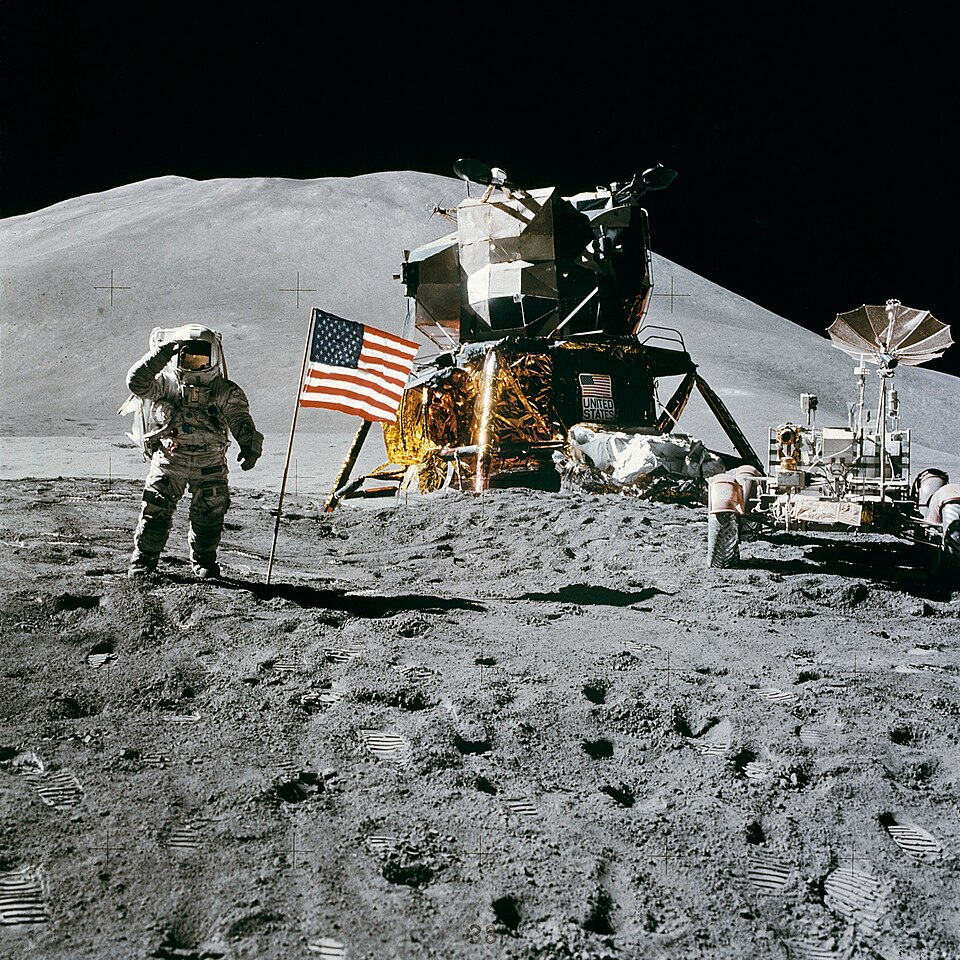
Correct: C, have same velocity at any instant. "Falling freely" means the only force acting is gravity. Newton's law of gravitation puts the pull on a body of mass m sitting at the Moon's surface at F = GMm/R², where M is the Moon's mass (7.35 × 10²² kg) and R its radius (1,737 km). Newton's second law then gives that body's acceleration as a = F/m = GM/R², and the falling body's own mass m has cancelled out of the expression entirely. Every object near the lunar surface therefore falls with one and the same acceleration, g on the Moon = 1.62 m/s², roughly one-sixth of Earth's 9.8 m/s². Two objects released together from rest thus satisfy v = u + at with the same u = 0 and the same a, so their speeds are equal at every instant, and by s = ½at² they have also fallen through the same distance. This is not a blackboard argument: it was actually done on the Moon. On 2 August 1971, on Apollo 15's third moonwalk, David Scott held out an aluminium geology hammer of about 1.32 kg in one hand and a falcon feather of about 30 g in the other, released them together in front of the television camera, and they struck the lunar dust at the same moment. On Earth the feather loses that race not because gravity treats it differently but because air drag does, and the Moon has effectively no air, its exosphere sitting near 10⁻¹⁵ of Earth's surface pressure, so free fall there is literally free. One condition the stem leaves implicit is worth naming: equal velocity at any instant follows because the two are falling together from rest; had they been released at different moments they would still share the acceleration but not the speed.
Why the others are wrong
- (a)have different accelerations: The intuitive answer, and the one Aristotle taught for nearly two thousand years: heavier things must fall faster. Galileo's insight, confirmed by Newton's algebra, is that the gravitational pull grows in exact proportion to the mass while the resistance to being accelerated (the inertia) grows in exactly the same proportion, so the two scalings cancel and every body accelerates at 1.62 m/s² on the Moon. Different accelerations appear only when a second force such as air drag enters, and on the Moon there is essentially none.
- (b)undergo a change in their inertia: Inertia is measured by mass, and mass is an intrinsic property of a body: it does not change because the body has been moved to the Moon or because it is falling. A 60 kg person carries 60 kg of mass on Earth, on the Moon and in deep space; what changes is weight, the force mg, which drops from about 588 N on Earth to about 97 N on the Moon. Candidates pick this option by silently swapping the word 'weight' for 'inertia'.
- (d)experience forces of same magnitude: The over-correction trap: a candidate who has just remembered that the accelerations are equal assumes the forces must be equal too. They are not. The gravitational force is F = mg, so a 10 kg rock is pulled with 16.2 N while a 1 kg rock is pulled with 1.62 N: a tenfold difference. The accelerations come out equal precisely because the larger force is applied to a proportionately larger inertia, not because the forces are the same.
Concept
Free fall is motion under gravity alone, with every other force (air resistance above all) absent or negligible. Its defining property is that the acceleration it produces is the same for all bodies at a given place, because the gravitational force on a body is proportional to its mass while its resistance to acceleration is measured by that same mass. Formally, the gravitational mass appearing in F = GMm/R² and the inertial mass appearing in F = ma are numerically identical: the weak equivalence principle, tested today to better than one part in 10¹⁵ and later generalised by Einstein into the foundation of general relativity. The consequence is a value of g that belongs to the attracting body, not to the falling one: 9.8 m/s² at Earth's surface, 1.62 m/s² at the Moon's, 3.72 m/s² on Mars, about 24.8 m/s² on Jupiter. Mass, weight and inertia must be kept apart in this topic: mass (kg) is intrinsic, weight (newtons) is the force mg and varies from place to place, and inertia is simply another name for the body's mass in its role of resisting a change of motion.
Reason by elimination and the item collapses in seconds. Option (a) fails because m cancels out of a = GM/R², which is the whole content of Galileo's result. Option (b) fails on a definition: inertia is mass, and mass does not vary with location or with the state of motion. Option (d) is the one that catches the half-prepared candidate, because it is superficially the same statement as 'equal acceleration' and is in fact its opposite: F = mg differs between the two bodies exactly as their masses differ, and it is the ratio F/m, not F itself, that is common to them. That leaves (c), which is the correct consequence of a shared acceleration acting from the same starting instant and the same rest condition. The single discriminating idea is therefore the difference between a force and an acceleration. The Moon is not decoration in this stem: BPSC set the question there so that no candidate could smuggle in air resistance, and so that 'g = 9.8' could not be applied by reflex. Note also that the answer would be unchanged on Mars or on Earth in a vacuum chamber: only the numerical value of g would move.
Key facts
- The Moon's surface gravity is 1.622 m/s², about 0.1654 of Earth's g: the familiar 'one-sixth' figure. A 60 kg astronaut weighs about 588 N on Earth and about 97 N on the Moon, while their mass stays 60 kg in both places.
- Acceleration in free fall is a = GM/R², obtained by equating GMm/R² with ma: the falling body's own mass cancels, which is why it never appears in the answer. For the Moon, M = 7.35 × 10²² kg and R = 1,737 km.
- Apollo 15, 2 August 1971: commander David Scott dropped a 1.32 kg aluminium geology hammer and a 0.03 kg falcon feather from the same height on live television, and they landed together. The feather was carried because the lunar module was named Falcon.
- The demonstration works on the Moon because it has no appreciable atmosphere (surface pressure of the order of 10⁻¹⁰ pascal at night, rising to about 10⁻⁷ pascal in sunlight as the surface outgasses) roughly 10⁻¹⁵ and 10⁻¹² of Earth's sea-level pressure respectively, so there is no drag, no terminal velocity and no dependence of fall on shape or density.
- Fall times scale as √(2h/g): a stone dropped 2 m takes about 0.64 s on Earth but about 1.57 s on the Moon, a ratio of √6. Chandrayaan-3's Vikram lander had to brake against exactly this 1.62 m/s² during its soft landing near the lunar south pole on 23 August 2023, now observed as National Space Day.
Study next
Common traps
- Reading 'same acceleration' as 'same force': the forces are mg and differ with mass; this is exactly what option (d) is built to catch
- Believing a heavier body falls faster, which is true only where air drag is present and is precisely why the experiment is worth doing on the Moon or in a vacuum
- Swapping weight for inertia: a body's weight drops to one-sixth on the Moon while its mass and therefore its inertia are unchanged, which is where option (b) comes from
BPSC keeps this in a single line with four one-clause options and no arithmetic, so the whole item turns on separating acceleration from force and mass from weight: the same style it used on the 71st CCE, where a bare statement about a freely falling body's potential energy had to be reconciled with conservation of energy. UPSC has taken the identical physics numerically and obliquely instead: asking what the MASS of a 100 kg body becomes on the Moon (2001), and why an orbiting satellite does not fall down (2011), which is free fall dressed up as orbital motion.
Related PYQs
The mass of a body on Earth is 100 kg (acceleration due to gravity, gₑ = 10 m/s²). If acceleration due to gravity on the Moon = gₑ/6, then the mass of the body on the moon is
- (a) 100/6 kg
- (b) 60 kg
- (c) 100 kg
- (d) 600 kg
Answer(c) 100 kg
The same mass-versus-weight discrimination, set on the same Moon and with the same one-sixth figure planted as bait: UPSC wants the candidate to notice that dividing g by six does nothing to the mass, which is exactly why option (b) of the BPSC item (a change in inertia) is wrong.
An artificial satellite orbiting around the Earth does not fall down. This is so because the attraction of Earth
- (a) does not exist at such distance
- (b) is neutralized by the attraction of the moon
- (c) provides the necessary speed for its steady motion
- (d) provides the necessary acceleration for its motion
Answer(d) provides the necessary acceleration for its motion
Free fall in disguise, and the same force-versus-acceleration distinction: a satellite is permanently falling, and UPSC's key turns on gravity supplying the acceleration rather than the speed: the very distinction that separates option (c) from option (d) on this BPSC question.
The potential energy of a freely falling body continuously decreases.
- (a) The principle of conservation of energy is violated
- (b) The principle of conservation of energy is not violated
- (c) Gravitational force is violated
- (d) Gravitational force is not violated
Answer(b) The principle of conservation of energy is not violated
BPSC returned to the freely falling body two years later and again tested it conceptually rather than numerically: there the point was that lost potential energy reappears as kinetic energy, here that the acceleration producing that kinetic energy is the same for every mass.
Practice
- practice, not a real PYQ
A body weighs 60 N on the surface of the Earth. What will it weigh on the surface of the Moon, where the acceleration due to gravity is about one-sixth of the Earth's value?
- (a)10 N
- (b)60 N
- (c)360 N
- (d)Zero
Answer(a) 10 N: weight is the force mg, so it falls to one-sixth of 60 N when g falls to one-sixth; the body's mass, and hence its inertia, is unchanged. - practice, not a real PYQ
A stone is dropped from rest near the surface of the Moon, where g = 1.6 m/s², and there is no air resistance. What is its speed 5 seconds later?
- (a)3.2 m/s
- (b)8 m/s
- (c)32 m/s
- (d)80 m/s
Answer(b) 8 m/s: v = u + at = 0 + 1.6 × 5 = 8 m/s, a result that does not involve the mass of the stone at all.