
Which of the following liquids is a bad conductor of electricity?
- (a)Salted water
- (b)Orange juice
- (c)Lemon juice
- (d)None of the above
Answer
Why
Correct: D, None of the above. All three named liquids conduct, so no bad conductor is on the list. A liquid conducts electricity only if it contains ions free to move, and NCERT's rule of thumb is that 'most liquids that conduct electricity are solutions of acids, bases and salts', which is precisely what each of these three is. Salted water is the textbook case: dissolve common salt in distilled water and the sodium chloride separates into Na⁺ and Cl⁻ ions, and NCERT Class VIII states flatly that the resulting salt solution 'is a conductor of electricity'. It is the same chemistry that makes tap water conducting, since water from taps, hand pumps and wells carries dissolved mineral salts, and the same reason the chapter opens by warning against touching an electrical appliance with wet hands. Lemon juice is not a matter of inference at all: NCERT's Table 11.1, 'Good/Poor Conducting Liquids', is printed with its first row already filled in: lemon juice, compass needle deflects, GOOD CONDUCTOR. Lemon juice is roughly five per cent citric acid, and an acid in water releases H⁺ ions, which is exactly how current is carried through it. Orange juice is the same class of liquid (citric and ascorbic acid plus dissolved potassium and other mineral salts) and it is what the familiar fruit-battery demonstration runs on. With (a), (b) and (c) all conducting, the fourth option is not a fallback but the only answer that survives. One thing to hold honestly: this answer is ours, derived rather than taken from any published key, and its weakest link is orange juice, which NCERT never classifies by name: its status rests on its composition and on the fruit-battery evidence, not on a printed line.
Why the others are wrong
- (a)Salted water: The strongest conductor on the list, not the weakest. Sodium chloride is an ionic compound: in the solid state its ions are locked in a lattice and it does not conduct, but dissolved in water the Na⁺ and Cl⁻ ions become free to migrate, carrying charge between the electrodes. NCERT builds the whole chapter on this contrast: distilled water is free of salts and is a poor conductor, and adding a pinch of common salt to it turns it into a good one. Candidates who pick this are usually thinking of pure water rather than salt water.
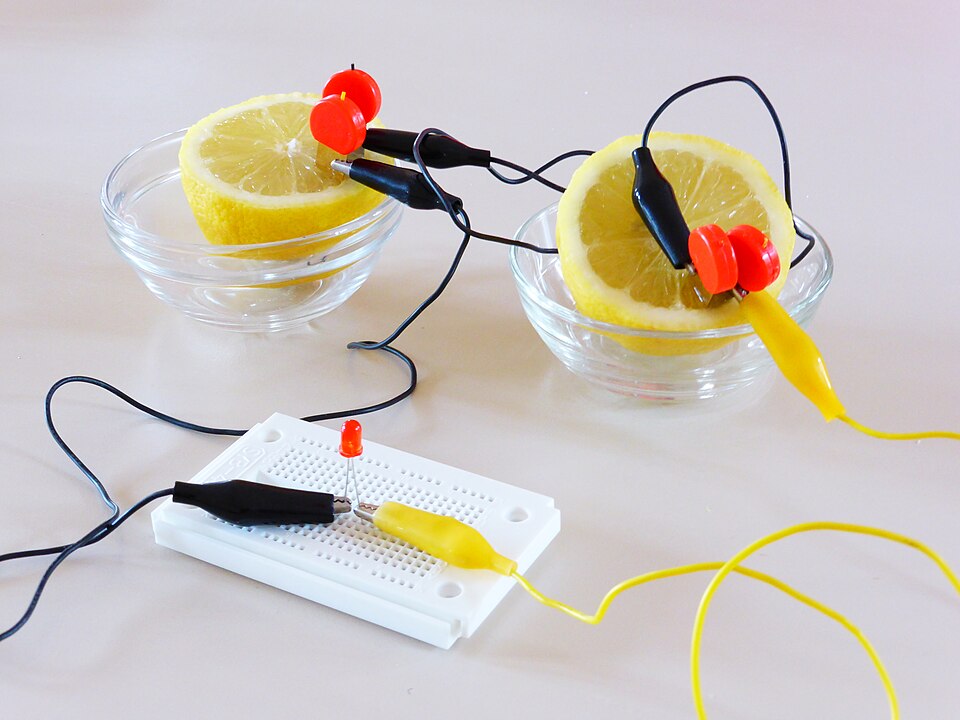
- (b)Orange juice: Orange juice conducts, though less strongly than brine. It carries citric acid and ascorbic acid, both of which release hydrogen ions in water, together with dissolved potassium and other mineral salts: the same ingredients that make a citrus fruit work as the electrolyte in a fruit battery, where two dissimilar metal electrodes pushed into an orange or a lemon will drive a small current. The trap is a relative reading: because a torch bulb may not visibly glow in juice, candidates conclude it is not conducting.
- (c)Lemon juice: The one option NCERT rules out in print. Its Class VIII table of good and poor conducting liquids has lemon juice entered as the worked example: the compass needle deflects, and the classification given is 'Good Conductor'. Lemon juice is about five per cent citric acid by volume with a pH near 2, and NCERT Class X demonstrates separately that an acid solution conducts because the current is carried through it by ions. Choosing this option means contradicting the textbook line the question is drawn from.
Concept
Conduction in a metal and conduction in a liquid are different mechanisms. In a metal, current is carried by free electrons drifting through a fixed lattice of positive ions. In a liquid, there are no free electrons to speak of; current is carried by ions (charged atoms or groups of atoms) physically moving through the fluid, positive ions towards the negative electrode and negative ions towards the positive. A liquid therefore conducts only if something in it has dissociated into ions, which is why acids, bases and salts dissolved in water conduct while covalent substances that dissolve without ionising do not. NCERT demonstrates the contrast directly: dilute hydrochloric and sulphuric acid make the bulb glow, but 'glucose and alcohol solutions do not conduct electricity', because they release no ions. NCERT also cautions against treating the categories as absolute: 'under certain conditions most materials can conduct', which is why it prefers 'good conductor' and 'poor conductor' to 'conductor' and 'insulator'. Passing a current through a conducting solution is not passive, either: it drives chemical change at the electrodes, which is what electrolysis is.
Read the stem's word 'bad' as absolute and the question resolves quickly: three electrolyte solutions are listed and none of them is a non-conductor, so the answer is the fourth option. Reasoning to that takes one test applied three times: does this liquid contain ions free to move? Salted water, yes, from a dissolved salt. Lemon juice, yes, from citric acid. Orange juice, yes, from citric and ascorbic acid plus potassium salts. What a genuine bad-conductor liquid looks like is worth fixing in memory as the contrast set: distilled water, sugar or glucose solution, alcohol, kerosene and vegetable oil: liquids with no free ions. Here is where this card names its own soft spot, because the reasoning is finely balanced in one place. A candidate can read 'bad conductor' comparatively instead, note that brine is a strong electrolyte while the two juices are weak ones, and argue that a juice is therefore the 'bad' conductor of the three. NCERT closes that door for lemon juice by classifying it, in print, as a good conductor, and orange juice is chemically its near-twin, but orange juice itself is nowhere classified by name in the textbook, so that last step is inference from composition rather than a citation. That is the residual doubt on this item, and it is worth knowing that it exists. Two further points steady the answer. NCERT warns explicitly that a bulb which fails to glow does not prove non-conduction: the current may simply be too weak to heat the filament, which is why the chapter switches to an LED or a magnetic-compass tester. And on this paper the fourth option is repeatedly a real answer rather than filler, so it cannot be discounted on sight.
Key facts
- NCERT Class VIII Science, 'Chemical Effects of Electric Current', Table 11.1 'Good/Poor Conducting Liquids' is printed with its first row completed as a worked example: lemon juice (compass needle shows deflection, Yes) Good Conductor.
- The same chapter states that dissolving common salt in distilled water gives a salt solution that 'is a conductor of electricity', while 'distilled water is free of salts and is a poor conductor'; tap, hand-pump and well water conduct because they carry naturally dissolved mineral salts.
- NCERT Class X Science, 'Acids, Bases and Salts', Activity 2.8: dilute hydrochloric and sulphuric acid make the bulb glow, but 'glucose and alcohol solutions do not conduct electricity': 'the electric current is carried through the acidic solution by ions'.
- A bulb that does not light is not proof that a liquid is non-conducting. NCERT notes that a material may conduct without conducting as easily as a metal, and if the current is too weak the filament never heats enough to glow, which is why the chapter uses an LED or a compass needle as the detector instead.
- The chemical effect follows from the conduction: William Nicholson showed in 1800 that when electrodes are immersed in water and a current is passed, oxygen bubbles form at the electrode joined to the positive terminal of the battery and hydrogen bubbles at the other: the basis of electrolysis, electroplating and electrorefining.
Study next
Common traps
- Assuming that if the bulb does not glow the liquid does not conduct: a weakly conducting liquid passes a current too small to heat a filament, which is exactly why NCERT switches to an LED or magnetic-needle tester
- Confusing pure water with ordinary water: distilled water is a poor conductor, while tap, well and hand-pump water conducts because of its dissolved mineral salts
- Reading 'bad conductor' as 'the weakest of those listed'; the question asks for a liquid that is a poor conductor in absolute terms, and none of the three named is
- Dismissing 'None of the above' as a filler option: on this paper it is a genuine answer more than once
BPSC asks conduction in liquids as a one-line pick-the-odd-liquid item drawn almost straight from the Class VIII chapter, often with 'None of the above' sitting in the fourth slot as a live answer rather than a decoy. UPSC does not ask the classification itself; it goes after the mechanism instead (whether an ionic compound conducts in the solid state or only when its ions are mobile, which electrolyte a dry cell uses, or why water dissolves so many substances) so the marks turn on knowing that liquids conduct by ion movement rather than on remembering a list.
Related PYQs
With reference to ionic compounds, consider the following statements: 1. Ionic compounds are insoluble in alcohol. 2. Ionic compounds in the solid state are good conductors of electricity. Which of these statements is/are correct?
- (a) Only 1
- (b) Only 2
- (c) Both 1 and 2
- (d) Neither 1 nor 2
Answer(a) Only 1
The mechanism behind this BPSC item, examined head-on: an ionic compound conducts only when its ions are free to move, so solid salt does not conduct while salt dissolved in water does. Statement 2 is wrong for exactly the reason salted water is a good conductor.
In a dry cell (battery), which of the following are used as electrolytes?
- (a) Ammonium chloride and Zinc chloride
- (b) Sodium chloride and Calcium chloride
- (c) Magnesium chloride and Zinc chloride
- (d) Ammonium chloride and Calcium chloride
Answer(a) Ammonium chloride and Zinc chloride
The same idea put to work: a cell needs an electrolyte (a salt paste whose ions can move) to carry charge internally, which is why the zinc-carbon dry cell uses ammonium chloride with zinc chloride, and why brine and citrus juice conduct in the first place.
Practice
- practice, not a real PYQ
Which one of the following liquids is a poor conductor of electricity?
- (a)Tap water
- (b)Dilute hydrochloric acid
- (c)Sugar solution
- (d)Common salt solution
Answer(c) Sugar solution: sugar dissolves without dissociating into ions, so no charge carriers are produced; NCERT shows that glucose and alcohol solutions fail to light the bulb while acid solutions do. Tap water conducts through its dissolved mineral salts, and acid and salt solutions both supply free ions. - practice, not a real PYQ
When electricity is passed through acidulated water using two electrodes, the gas collected at the electrode connected to the positive terminal of the battery is
- (a)hydrogen
- (b)oxygen
- (c)carbon dioxide
- (d)nitrogen
Answer(b) oxygen: Nicholson's 1800 experiment established that oxygen is liberated at the electrode joined to the positive terminal and hydrogen at the other, in a volume ratio of one to two.