
Match List – I with List – II and select the correct answer from the code given below the lists. List – I (Philosopher) A. Ramanuja B. Madhavacharya C. Nimbarka D. Vallabhacharya List – II (Philosophy) 1. Suddhadvait 2. Dvaitadvait 3. Dvaita 4. Vishishtadvaita
- (a)A-3, B-1, C-4, D-2
- (b)A-4, B-3, C-2, D-1
- (c)A-2, B-4, C-1, D-3
- (d)A-1, B-2, C-3, D-4
Correct — B, A-4, B-3, C-2, D-1: Ramanuja with Vishishtadvaita, Madhavacharya with Dvaita, Nimbarka with Dvaitadvait and Vallabhacharya with Suddhadvait. Take the four in turn. Ramanuja, the Sri Vaishnava teacher of Srirangam traditionally dated 1017–1137, taught Vishishtadvaita or qualified non-dualism: reality is one, but that one Brahman is 'qualified' by conscious souls and unconscious matter, which are real and form his body rather than being illusory — his commentary on the Brahma Sutras is the Sribhashya. Madhvacharya of Udupi in Karnataka, of the thirteenth century, taught Dvaita or dualism, the sharpest break with Shankara: God, souls and matter are eternally and irreducibly distinct, and the soul never becomes identical with the Lord. Nimbarka taught Dvaitadvaita, dualistic non-dualism — souls and matter are both different from Brahman and non-different from him, as waves are of the sea — and his school centres on the worship of Radha and Krishna. Vallabhacharya (1479–1531) taught Shuddhadvaita, pure non-dualism, in which the world is not an illusion superimposed on Brahman but Brahman's own real self-manifestation; his devotional path is the Pushtimarg, the way of divine grace, associated with Srinathji at Nathdwara. Every acharya here is defining himself against Adi Shankara's Advaita, absolute non-dualism, which is not in List II at all — recognising that is what makes the matching quick.
- (a)A-3, B-1, C-4, D-2 — Wrong on all four counts. It gives Dvaita to Ramanuja, whose whole position is that souls and matter are real but inseparable from Brahman rather than eternally separate; Suddhadvait to Madhavacharya, when Madhva is the one philosopher of the group who insists on unqualified difference; Vishishtadvaita to Nimbarka; and Dvaitadvait to Vallabhacharya. A student who remembers only the single pair Ramanuja–Vishishtadvaita can eliminate this option immediately.
- (c)A-2, B-4, C-1, D-3 — Also wrong throughout. It attaches Dvaitadvait to Ramanuja and Vishishtadvaita to Madhavacharya, which reverses the two best-known pairings in Indian philosophy — Madhva is the dualist, Ramanuja the qualified non-dualist. It then gives Suddhadvait to Nimbarka and Dvaita to Vallabhacharya.
- (d)A-1, B-2, C-3, D-4 — The straight-through sequence A-1, B-2, C-3, D-4, which examiners include because it is the pattern a guessing candidate reaches for. Every pair in it is wrong: Ramanuja is not the Suddhadvait teacher (that is Vallabhacharya), Madhavacharya is not the Dvaitadvait teacher (that is Nimbarka), Nimbarka is not the Dvaita teacher (that is Madhva) and Vallabhacharya is not the Vishishtadvaita teacher (that is Ramanuja).
Vedanta asks one question — what is the relation between Brahman, the individual soul and the world? — and the schools are simply the different answers. Adi Shankara's Advaita says the relation is identity: Brahman alone is real and plurality is the work of maya. Ramanuja's Vishishtadvaita says the relation is that of body to embodied self: souls and matter are perfectly real, but they exist only as attributes of the one Brahman, so unity survives without the world being denied. Madhva's Dvaita says the relation is permanent difference, listing five eternal distinctions between God, souls and matter. Nimbarka's Dvaitadvaita says the relation is difference-and-non-difference together, both equally real. Vallabhacharya's Shuddhadvaita says Brahman is non-dual in a 'pure' sense that needs no doctrine of maya at all, because the world is his genuine self-expression. Each philosopher also founded a devotional tradition, and the four are conventionally listed as the founders of the four Vaishnava sampradayas — Sri (Ramanuja), Brahma (Madhva), Sanakadi or Nimbarka, and Rudra, the line to which Vallabhacharya belongs.
Match-list questions are won by anchoring on the pair you are surest of and using it to strike out options. Here the safest anchor is Ramanuja–Vishishtadvaita, which alone eliminates options (a), (c) and (d) and leaves (b) standing. If that pair is not secure, the second anchor is the etymology itself: Dvaita is 'two-ness' (dualism), Advaita 'not-two', Vishishta-advaita 'qualified not-two', Dvaita-advaita 'two-and-not-two', and Shuddha-advaita 'pure not-two'. One caution about the spelling in List I: the paper writes 'Madhavacharya', but the founder of Dvaita is Madhvacharya, or Madhva, of Udupi. The very similar name Madhavacharya belongs to a later Vijayanagara scholar, Madhava — identified with Vidyaranya — to whom the dharmashastra digest Parashara Madhaviya is attributed, and UPPSC itself used the name in that second sense in a 2024 question. Since List II here offers Dvaita, the philosopher intended is unambiguously Madhva.
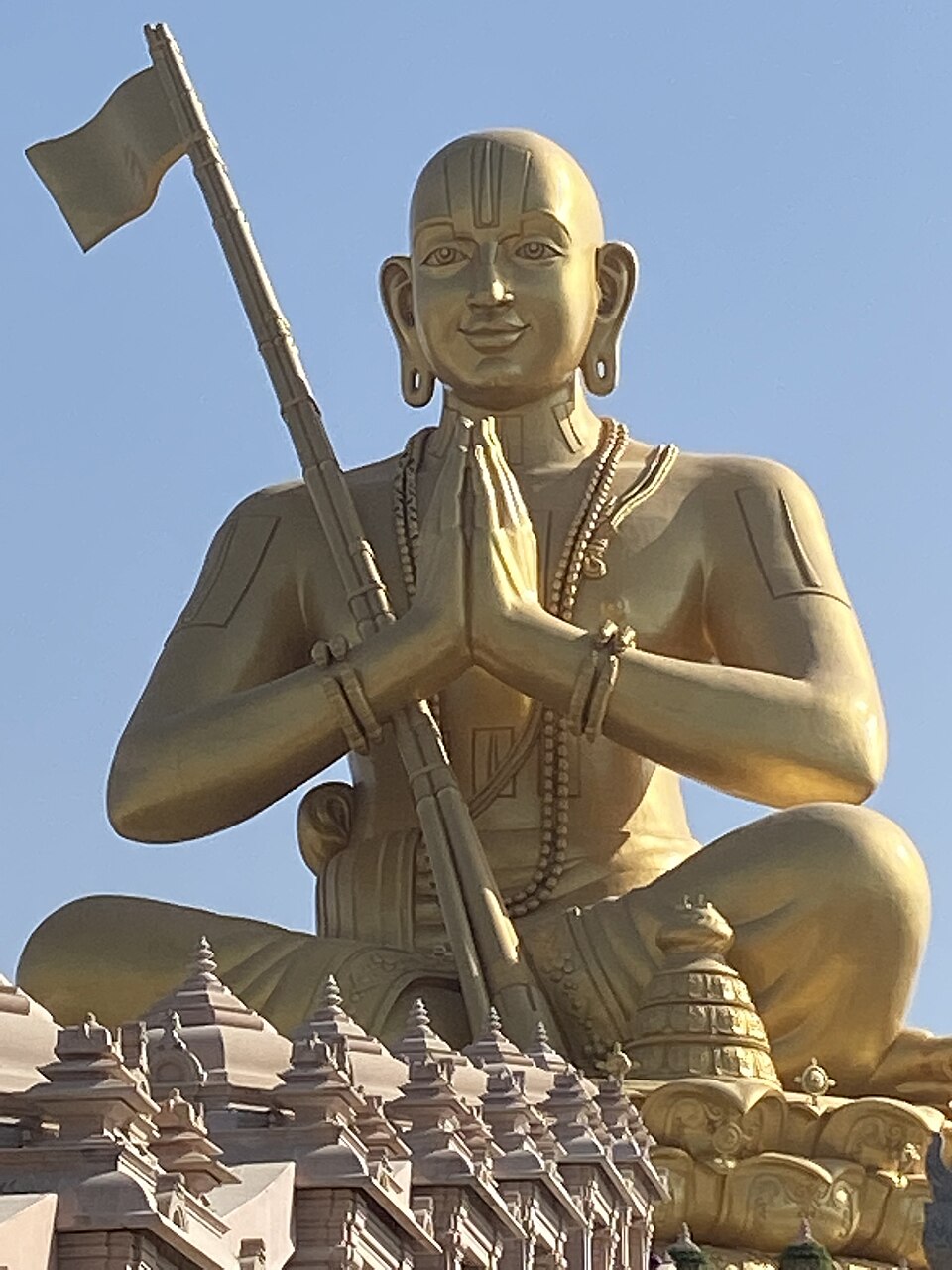
- Ramanuja (traditionally 1017–1137), of Srirangam, taught Vishishtadvaita — qualified non-dualism, in which souls and matter are real but constitute the body of the one Brahman; his commentary on the Brahma Sutras is the Sribhashya.
- Madhvacharya, of Udupi in Karnataka and of the thirteenth century, taught Dvaita — dualism, holding God, souls and matter to be eternally distinct.
- Nimbarka taught Dvaitadvaita — difference-and-non-difference — and his tradition centres on the worship of Radha and Krishna; his dates are disputed and are placed variously in the twelfth or thirteenth century.
- Vallabhacharya (1479–1531) taught Shuddhadvaita — pure non-dualism, dispensing with maya — and founded the Pushtimarg path of grace, associated with Srinathji at Nathdwara.
- All four defined themselves against Adi Shankara's Advaita, absolute non-dualism, which does not appear in List II.
- The four are conventionally treated as the founders of the four Vaishnava sampradayas: Sri (Ramanuja), Brahma (Madhva), Sanakadi or Nimbarka, and Rudra, the line to which Vallabhacharya belongs.
- Confusing Madhvacharya, the thirteenth-century founder of Dvaita, with the later Vijayanagara scholar Madhava (Vidyaranya) of the Parashara Madhaviya — the paper's spelling 'Madhavacharya' invites exactly this slip.
- Mixing up Dvaita with Dvaitadvaita; the second is Nimbarka's difference-and-non-difference, not Madhva's outright dualism.
- Looking for Advaita in List II and losing time; Shankara is not one of the four philosophers listed.
UPPSC asks this as a four-row match list of acharya to school, or as a one-liner such as 'Vishishtadvaita was propounded by'; UPSC has preferred to test the same figures through chronology and through their bhakti lineages, as with its sequence question on Shankaracharya, Ramanuja and Chaitanya.
Which one of the following sequences indicates the correct chronological order?
- (a) Shankaracharya - Ramanuja - Chaitanya
- (b) Ramanuja - Shankaracharya - Chaitanya
- (c) Ramanuja - Chaitanya - Shankaracharya
- (d) Shankaracharya - Chaitanya - Ramanuja
Answer(a) Shankaracharya - Ramanuja - Chaitanya
The same Vedanta acharyas tested through chronology instead of doctrine — Shankara's Advaita first, Ramanuja's Vishishtadvaita in answer to it, and the later bhakti teachers who built on both.
Match List – I with List – II and select the correct answer using the code given below the lists. List – I (Disciple) A. Kabir B. Amir Khusrau C. Surdas D. Mardana List – II (Guru) 1. Guru Nanak Dev 2. Swami Ramananda 3. Nizamuddin Auliya 4. Vallabhacharya Code :
- (a) A-3, B-2, C-4, D-1
- (b) A-2, B-3, C-4, D-1
- (c) A-3, B-2, C-1, D-4
- (d) A-2, B-3, C-1, D-4
Answer(b) A-2, B-3, C-4, D-1
The same match-list technique applied to the next generation — Vallabhacharya, the Shuddhadvaita teacher of this question, reappears there as the guru of Surdas, showing how the acharyas feed directly into the bhakti lineages.
- practice — not a real PYQ
Which one of the following pairs is NOT correctly matched?
- (a)Ramanuja — Vishishtadvaita
- (b)Nimbarka — Dvaitadvaita
- (c)Vallabhacharya — Dvaita
- (d)Adi Shankara — Advaita
Answer(c) Vallabhacharya — Dvaita is the wrong pair. Vallabhacharya taught Shuddhadvaita, pure non-dualism; Dvaita is Madhvacharya's school.
- practice — not a real PYQ
The Pushtimarg, the devotional path of divine grace associated with Srinathji at Nathdwara, was founded by
- (a)Nimbarka
- (b)Vallabhacharya
- (c)Madhvacharya
- (d)Ramananda
Answer(b) Vallabhacharya — the teacher of Shuddhadvaita, whose Pushtimarg emphasises grace rather than works or knowledge as the means to liberation.