
Solar energy is converted into electric energy through
- (a)Leclanché cells
- (b)Photo voltaic cells
- (c)Dry cells
- (d)Voltaic cells
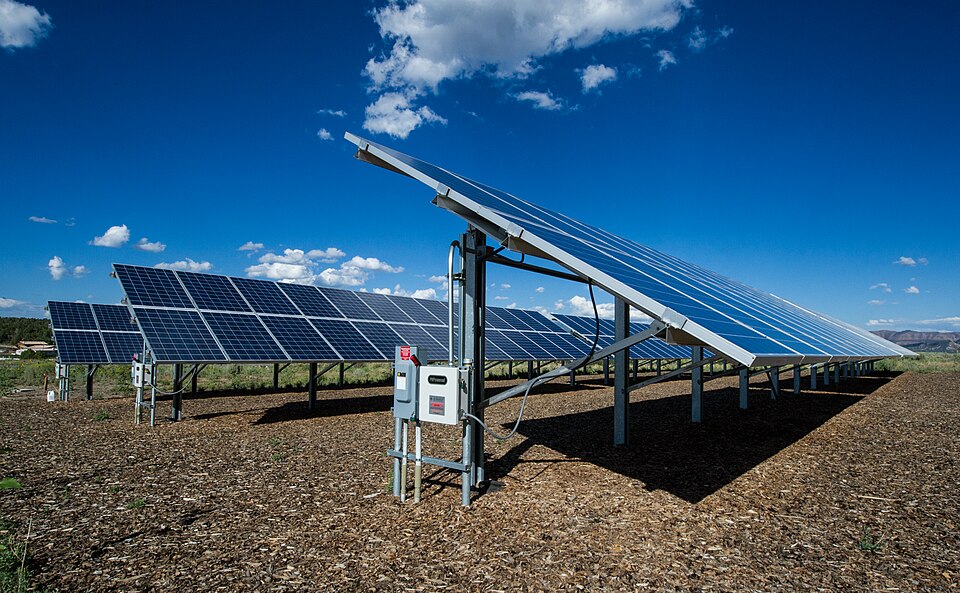
Correct — B, Photo voltaic cells. A photovoltaic cell is a semiconductor device, almost always built on silicon, in which two layers of differently doped material meet at a p–n junction. Sunlight arriving at the cell is a stream of photons; a photon whose energy exceeds the semiconductor's band gap is absorbed and knocks an electron loose, leaving behind a positively charged hole. The built-in electric field across the junction sweeps electrons one way and holes the other, so charge accumulates on the two faces of the cell and, when an external circuit is connected, a current flows. That is a direct conversion of light into electricity — the photovoltaic effect, first observed by Edmond Becquerel in 1839 — with no combustion, no working fluid, no heat engine and no moving parts. The current produced is direct current, which is why a rooftop system needs an inverter before it can feed household appliances or the grid. The word itself decodes the answer: 'photo' for light and 'voltaic' for electricity.
- (a)Leclanché cells — An electrochemical cell, not a light-driven one. The Leclanché cell, devised by Georges Leclanché in the 1860s, uses a zinc anode, a manganese dioxide cathode and an ammonium chloride electrolyte, and converts chemical energy into electrical energy. It is the direct ancestor of the modern zinc–carbon torch battery. Sunlight plays no part in its operation.
- (c)Dry cells — The sealed, paste-electrolyte descendant of the Leclanché cell — the ordinary battery used in a torch, clock or remote control. Its energy comes from a chemical reaction between the electrodes and the electrolyte, and it runs down as the reactants are consumed, whether it sits in sunlight or in a drawer.
- (d)Voltaic cells — The generic name for a galvanic cell, the class that began with Volta's pile of 1800: two dissimilar metals in an electrolyte, generating current from a spontaneous redox reaction. Again the conversion is chemical to electrical. Notice the structure of this option set — three of the four choices are variants of the same electrochemical family, and only one is a light-driven device, so the item is answered by spotting the odd one out.
There are two quite different ways to make electricity from sunlight, and examiners test the distinction constantly. Photovoltaics converts light directly into electricity in a semiconductor junction: sunlight in, direct current out, with efficiency falling as the cell heats up and output vanishing the moment a cloud passes. Solar thermal, or concentrating solar power, does it indirectly: mirrors or troughs focus sunlight to heat a fluid, the heat raises steam, and the steam drives a conventional turbine and generator — so the electricity is produced by a heat engine exactly as in a coal plant, and the heat can be stored in molten salt to keep generating after sunset. Photovoltaics dominates in practice because modules are modular, need no water and can be mounted on a roof, a canal or a field. The same photovoltaic and photoelectric physics also underlies light-sensing devices such as the photo cell in a smoke detector or an automatic street light, where the point is not power but the electrical signal that light produces.
This question can be answered without any physics at all, simply by reading the options: Leclanché cell, dry cell and voltaic cell are three names for members of one family of chemical batteries, and photovoltaic cell is the only one whose name contains a reference to light. When an option list has three near-synonyms and one outlier, the outlier is almost always the answer. For revision, fix the chain of energy conversions rather than the label alone — light energy to electrical energy in a photovoltaic cell, chemical to electrical in a battery, mechanical to electrical in a generator, and solar to heat to mechanical to electrical in a solar thermal plant. UPPSC returns to this chain year after year in one form or another.
- A photovoltaic cell converts light directly into electricity at a semiconductor p–n junction, usually made of silicon; the phenomenon is the photovoltaic effect, first observed by Edmond Becquerel in 1839.
- Photons with energy greater than the semiconductor's band gap free electron–hole pairs, and the junction's built-in field separates them to drive a current.
- Photovoltaic cells generate direct current, so an inverter is required to supply AC appliances or feed the grid.
- Solar thermal or concentrating solar power works differently — mirrors focus sunlight to raise steam, which drives a turbine, so the conversion runs through heat.
- Leclanché cells, dry cells and voltaic cells are all electrochemical devices that convert chemical energy into electrical energy and have nothing to do with sunlight.
- India's push on solar generation runs through the Jawaharlal Nehru National Solar Mission, launched in 2010, and the International Solar Alliance, headquartered at Gurugram.
- Confusing a solar photovoltaic cell with a solar thermal plant — only the first converts light directly into electricity.
- Assuming solar panels supply alternating current; the cells produce DC, and an inverter does the conversion.
- Treating a 'solar cell' and a 'solar water heater' as the same technology — the heater produces no electricity at all.
UPPSC asks it as a plain conversion statement — 'solar energy is converted into electrical energy through' — or through a device such as the photo cell in a fire alarm; UPSC prefers multi-statement items contrasting photovoltaic with solar thermal technology, or questions on solar policy such as net metering and domestic content requirements.
With reference to technologies for solar power production, consider the following statements: 1. 'Photovoltaics' is a technology that generates electricity by direct conversion of light into electricity, while 'Solar Thermal' is a technology that utilizes the Sun's rays to generate heat which is further used in electricity generation process. 2. Photovoltaics generates Alternating Current (AC), while Solar Thermal generates Direct Current (DC). 3. India has manufacturing base for Solar Thermal technology, but not for Photovoltaics. Which of the statements given above is/are correct?
- (a) 1 only
- (b) 2 and 3 only
- (c) 1, 2 and 3
- (d) None
Answer(a) 1 only
The same conversion tested at greater depth — its first statement is exactly the definition this question wants, and its second corrects the common belief that photovoltaic cells produce alternating current.
Which of the following is used in fire alarm ?
- (a) Photo cell
- (b) Water
- (c) Solar cell
- (d) None of the above
Answer(a) Photo cell
The same physics used for sensing instead of power — a photo cell turns incident light into an electrical response, which is what a photovoltaic cell does on a scale large enough to supply energy.
The First Union Territory of India to run 100 percent on solar energy is
- (a) Andaman-Nicobar
- (b) Chandigarh
- (c) Diu
- (d) Puducherry
Answer(c) Diu
The same technology at deployment scale — Diu's ground-mounted and rooftop photovoltaic capacity is what allowed a Union Territory to meet its daytime demand entirely from sunlight.
- practice — not a real PYQ
Electricity produced by a rooftop solar photovoltaic module is fed to household appliances only after passing through an inverter because
- (a)the module produces alternating current that must be smoothed
- (b)the module produces direct current, while appliances and the grid run on alternating current
- (c)the inverter increases the efficiency of the semiconductor junction
- (d)the inverter stores surplus energy as heat
Answer(b) the module produces direct current, while appliances and the grid run on alternating current — the photovoltaic effect yields DC by its very nature.
- practice — not a real PYQ
Which one of the following describes a concentrating solar power (solar thermal) plant rather than a solar photovoltaic plant?
- (a)Sunlight is converted directly into electricity at a semiconductor junction
- (b)Mirrors focus sunlight to heat a fluid, which raises steam to drive a turbine
- (c)Electricity is generated by a chemical reaction between two electrodes
- (d)Sunlight splits water to release hydrogen, which is then burnt
Answer(b) Mirrors focus sunlight to heat a fluid, which raises steam to drive a turbine — solar thermal generates through a heat engine, whereas photovoltaics converts light directly.