
Match List – I with List – II and select the correct answer using the code given below the lists. List – I (Disciple) A. Kabir B. Amir Khusrau C. Surdas D. Mardana List – II (Guru) 1. Guru Nanak Dev 2. Swami Ramananda 3. Nizamuddin Auliya 4. Vallabhacharya Code :
- (a)A-3, B-2, C-4, D-1
- (b)A-2, B-3, C-4, D-1
- (c)A-3, B-2, C-1, D-4
- (d)A-2, B-3, C-1, D-4
Correct — B, A-2, B-3, C-4, D-1: Kabir with Swami Ramananda, Amir Khusrau with Nizamuddin Auliya, Surdas with Vallabhacharya and Mardana with Guru Nanak Dev. Take them one at a time. Kabir, the weaver-poet of Varanasi and the towering voice of the nirguna stream of the Bhakti movement, is placed by the tradition in the line of Swami Ramananda, the Vaishnava teacher of Varanasi who broke with convention by admitting disciples without regard to caste; the well-known story has the young Kabir lying across the steps of a ghat before dawn so that Ramananda, descending to bathe, would step on him and involuntarily utter the name of Rama, which Kabir then claimed as his initiation. Amir Khusrau, the Persian poet of Delhi who served seven sultans, was a devoted murid of the Chishti saint Shaikh Nizamuddin Auliya — the most securely documented pair on the list, and the one you can still see, since Khusrau lies buried a few steps from his master in the Nizamuddin dargah complex in Delhi. Surdas, the blind poet of Krishna's childhood whose padas fill the Sursagar, belongs to the Pushtimarg of Vallabhacharya and is counted the first of the Ashtachhap, the eight poets of that sampradaya. Mardana was the Muslim minstrel of Talwandi who accompanied Guru Nanak Dev on his long journeys, playing the rabab while the Guru sang, and he is remembered as Nanak's earliest and most constant companion; verses attributed to him are preserved in the Guru Granth Sahib. Two of these pairs — Khusrau and Mardana — are matters of documented record; the other two are the settled tradition of the sampradayas concerned, and that is what the examiner is testing.
- (a)A-3, B-2, C-4, D-1 — Gets Surdas and Mardana right but swaps the first two, sending Kabir to Nizamuddin Auliya and Amir Khusrau to Swami Ramananda. Both halves of the swap are impossible. Kabir's world is Varanasi and the vernacular nirguna Bhakti of the fifteenth century; Nizamuddin Auliya was a Chishti Sufi of Delhi who died in 1325, generations earlier and in a different tradition. Amir Khusrau, for his part, was a Persian-writing Muslim courtier and Sufi disciple in Delhi, and had no connection whatever with a Vaishnava Bhakti teacher of Varanasi.
- (c)A-3, B-2, C-1, D-4 — The worst of the four, because it gets every pair wrong. It repeats the Kabir–Nizamuddin and Khusrau–Ramananda swap of option (a), and then adds a second swap at the other end, tying Surdas to Guru Nanak Dev and Mardana to Vallabhacharya. Surdas belongs to the Krishna-devotion of Braj and the Pushtimarg; Mardana belongs to Nanak's travelling company in Punjab. Nothing in this option survives contact with the actual figures.
- (d)A-2, B-3, C-1, D-4 — The dangerous near-miss. It settles the first two pairs exactly as the key does — Kabir with Ramananda, Khusrau with Nizamuddin Auliya — and then reverses the last two, giving Surdas to Guru Nanak Dev and Mardana to Vallabhacharya. A candidate who is sure only of Kabir and Khusrau, and who guesses the tail, lands here half the time. The check is simple and worth internalising: Surdas sang of Krishna in Braj Bhasha and stands at the head of Vallabhacharya's Ashtachhap, while Mardana was the rabab player who walked beside Guru Nanak. Their traditions do not overlap even geographically.
Between the fourteenth and sixteenth centuries north India produced several devotional lineages that a prelims paper likes to shuffle together, because each is organised around a guru and the disciples who carried his teaching forward. Ramananda's line in Varanasi opened Vaishnava devotion to disciples of every caste and gave the nirguna poets, Kabir foremost among them, their vernacular voice. Vallabhacharya's Pushtimarg in the Braj country worshipped Krishna in his childhood form and gathered around it the eight poets called the Ashtachhap, of whom Surdas is the greatest. Guru Nanak Dev, founding the Sikh tradition in Punjab, travelled for decades with the Muslim rabab player Mardana at his side. Running parallel to all of these is the Chishti silsila of Sufism, whose Delhi khanqah under Shaikh Nizamuddin Auliya drew in the poet and musician Amir Khusrau. The paper mixes a Sufi pir into a list of Bhakti gurus deliberately: the shared vocabulary of guru and disciple, of poet and master, is exactly what makes the confusion possible.
Match-list questions are won by anchoring, not by solving. Find the pair you are certain of, fix it, and let it eliminate options. Here the safest anchor for most candidates is Amir Khusrau, because he is the only Muslim Persian poet in List I and Nizamuddin Auliya the only Sufi in List II — pairing them is almost forced, and it immediately kills options (a) and (c), which both put Khusrau with Ramananda. That leaves (b) and (d), which differ only in the last two pairs, so the whole question collapses to a single decision: does Surdas go with Vallabhacharya or with Guru Nanak Dev? Surdas is a Krishna poet of Braj and the leading figure of Vallabhacharya's Ashtachhap, so the answer is Vallabhacharya, and (b) follows. Note also the honest caveat worth carrying into the exam hall: the Kabir–Ramananda and Surdas–Vallabhacharya links come from hagiographic tradition and modern historians have questioned the chronology of the first. Examiners nonetheless test the traditional attribution, so learn it as the tradition and answer accordingly.
- Swami Ramananda, the Vaishnava teacher of Varanasi, is remembered for admitting disciples irrespective of caste, and the tradition places Kabir, Ravidas and Sena in his line; Kabir himself was a weaver by occupation, a fact UPSC has tested directly
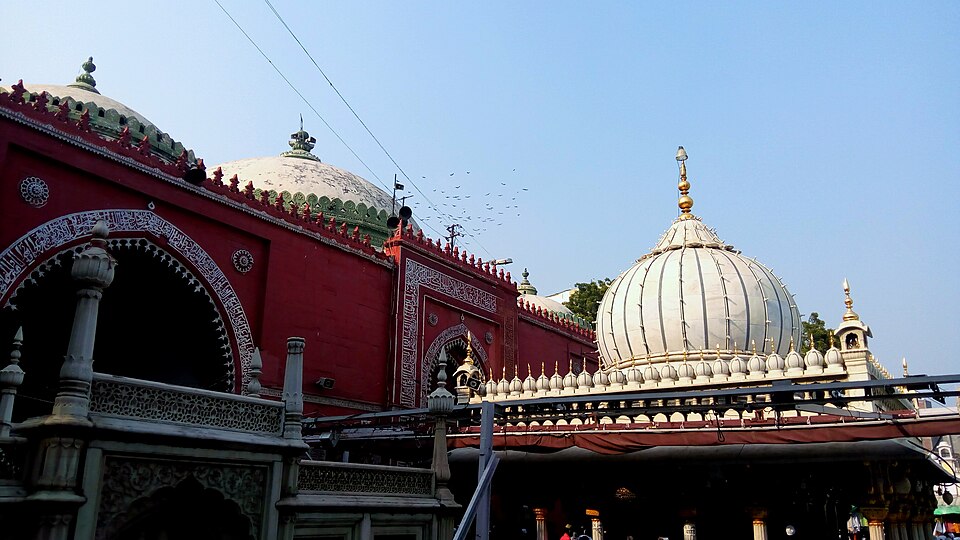
- Amir Khusrau (c. 1253–1325) was a disciple of the Chishti saint Shaikh Nizamuddin Auliya of Delhi, is credited with the early Indian form of the qawwali, and is buried in his master's dargah complex at Nizamuddin in Delhi
- Surdas, author of the Sursagar and the foremost of the Ashtachhap, belongs to the Pushtimarg founded by Vallabhacharya, which worships Krishna in his child form in the Braj region
- Mardana, a Muslim of Talwandi, accompanied Guru Nanak Dev on his udasis as his rabab player; compositions attributed to him are included in the Guru Granth Sahib
- Nizamuddin Auliya belongs to the Chishti silsila of Sufism and was based at Delhi, not at Multan — Multan was the centre of the Suhrawardi order under Shaikh Bahauddin Zakariya, a distinction UPPSC has asked about before
- Swapping Kabir and Amir Khusrau at the head of the list. Kabir belongs to Ramananda's Bhakti line at Varanasi; Khusrau to Nizamuddin Auliya's Chishti khanqah at Delhi. Options (a) and (c) both exploit this
- Guessing the tail of the list. Options (b) and (d) agree on Kabir and Khusrau and differ only over whether Surdas goes to Vallabhacharya or to Guru Nanak Dev — settle that on the merits rather than by elimination alone
- Treating the traditional guru–disciple attributions as hard biography. The Kabir–Ramananda and Surdas–Vallabhacharya links come from sampradaya tradition and are debated by historians; know them as the tradition the examiner is testing, and do not build a Mains argument on them
UPPSC returns to this ground almost every year in match-list or 'which pair is NOT correctly matched' form — saint to guru, saint to profession, Sufi to city, poet to text — and it habitually mixes a Sufi figure into a Bhakti list. UPSC prefers the analytical framing: which stream a named saint belonged to, who was a contemporary of whom, or whether one saint could have influenced another given the dates.
Who among the following was the first Bhakti saint to use Hindi for the propagation of his message?
- (a) Dadu
- (b) Kabir
- (c) Ramananda
- (d) Tulsidas
Answer(c) Ramananda
Puts Ramananda and Kabir in the same option list and asks which of them came first in the vernacular — which is the guru-disciple relationship of pair A stated as a question of precedence. Ramananda is the teacher who moved Bhakti into the spoken language of north India, and Kabir is the disciple who made that language famous.
Match List I with List II and select the correct answer using the codes given below the Lists: List I (Bhakti Saint) I. Namdev II. Kabir III. Ravidas IV. Sena List II (Profession) A) Barber B) Weaver C) Tailor D) Cobbler
- (a) I-B, II-C, III-A, IV-D
- (b) I-C, II-B, III-D, IV-A
- (c) I-C, II-B, III-A, IV-D
- (d) I-B, II-C, III-D, IV-A
Answer(b) I-C, II-B, III-D, IV-A
The same match-list machinery applied to the Ramananda circle from a different angle. Kabir the weaver, Ravidas the cobbler and Sena the barber were all artisans, and that is precisely why Ramananda's willingness to initiate across caste lines matters for pair A of the present question.
Consider the following statement: 1. Kitab-I-Nauras, a collection of songs in praise of Hindu deities and Muslim saints, was written by Ibrahim Adil Shah II 2. Amir Khusrau was the originator in India of the early form of the musical style known as Qawwali. Which of these statements is/are correct?
- (a) Only 1
- (b) Only 2
- (c) Both 1 and 2
- (d) Neither 1 nor 2
Answer(c) Both 1 and 2
Fixes Amir Khusrau in his Chishti setting, which is what pair B depends on. Qawwali grew in the sama assemblies of the Chishti khanqah, and Khusrau's association with that music is inseparable from his discipleship under Nizamuddin Auliya.
The book 'Fawaid ul Fawad' is the record of the conversations of Shaikh Nizamuddin Auliya, it was compiled by
- (a) Amir Hassan Sizzi
- (b) Amir Khusro
- (c) Ziauddin Barni
- (d) Hasan Nizami
Answer(a) Amir Hassan Sizzi
Tests the same discipleship from inside the khanqah and uses Amir Khusrau as its principal distractor. The malfuzat of Nizamuddin Auliya was set down by Amir Hasan Sijzi, not by Khusrau — a useful reminder that Khusrau's relationship to the saint was that of a devoted disciple and poet rather than of a chronicler.
Which of the following is NOT correctly matched ?
- (a) Shaikh Moinuddin Chishti – Ajmer
- (b) Shaikh Burhanuddin Gharib – Daulatabad
- (c) Shaikh Mohammad Hussaini – Gulbarga
- (d) Shaikh Nizamuddin Auliya – Multan
Answer(d) Shaikh Nizamuddin Auliya – Multan
Locates Nizamuddin Auliya where pair B needs him — at Delhi, in the Chishti order — by making the Multan mismatch the answer. Anyone who can place the saint's khanqah in Delhi can also see why Amir Khusrau, a poet of the Delhi court, and not a Varanasi Bhakti teacher, is his disciple in this list.
- practice — not a real PYQ
Surdas, the author of the Sursagar, is counted among the Ashtachhap poets of which of the following sampradayas?
- (a)The Pushtimarg founded by Vallabhacharya
- (b)The Varkari tradition of Maharashtra
- (c)The Gaudiya Vaishnavism of Chaitanya
- (d)The nirguna line of Ramananda
Answer(a) The Pushtimarg founded by Vallabhacharya — Surdas is the foremost of the Ashtachhap, the eight poets of the Vallabha sampradaya who sang of Krishna's childhood in Braj Bhasha.
- practice — not a real PYQ
Which one of the following pairs is NOT correctly matched?
- (a)Amir Khusrau — Nizamuddin Auliya
- (b)Mardana — Guru Nanak Dev
- (c)Kabir — Vallabhacharya
- (d)Ravidas — Ramananda
Answer(c) Kabir — Vallabhacharya. Kabir is placed by tradition in the line of Swami Ramananda at Varanasi; Vallabhacharya founded the Pushtimarg, whose leading poet was Surdas.