
T. Malthus propounded one of the most famous theories, called 'The Malthusian Theory' which is related to
- (a)Population
- (b)Poverty
- (c)Economy
- (d)Unemployment
Answer
Why
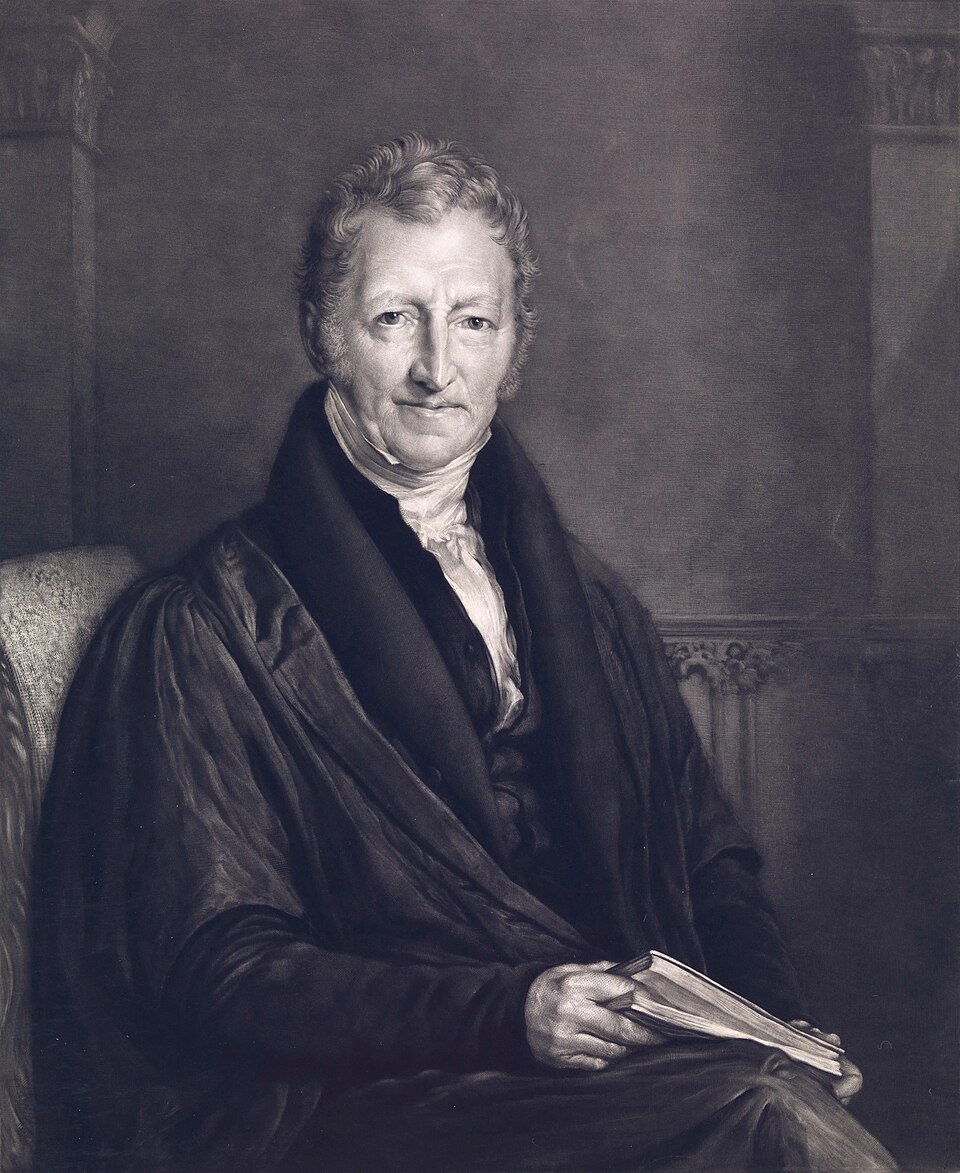
Correct — A, Population. Thomas Robert Malthus (1766–1834) set out the argument in An Essay on the Principle of Population, first published anonymously in 1798, and everything the phrase 'Malthusian theory' refers to comes from that book. Its claim is a comparison of two growth rates: human numbers, if unchecked, multiply in a geometric progression (1, 2, 4, 8, 16…), while the means of subsistence can at best be increased in an arithmetic progression (1, 2, 3, 4, 5…). Because a geometric series must eventually outrun an arithmetic one, population presses permanently against the food supply, and the gap is closed by checks — 'positive' checks such as famine, epidemic disease and war that raise the death rate, and 'preventive' checks such as delayed marriage and moral restraint that lower the birth rate. The theory is named for what it explains: the size of the population and the limits on its growth.
Why the others are wrong
- (b)Poverty — Poverty is a consequence in Malthus's argument, not its subject. He held that misery and want are what appear when numbers press on subsistence, and he used the argument against poor-relief schemes on that reasoning — but the theory itself is a statement about how population grows relative to food, not a theory of poverty. The named theories of poverty belong to other writers.
- (c)Economy — Too broad, and it points at the wrong book. Malthus did write on general economics — his Principles of Political Economy of 1820 argued about gluts and effective demand, a line later taken up by Keynes — but that work is not what 'the Malthusian theory' names. In every syllabus and every textbook the phrase refers to the population principle of 1798.
- (d)Unemployment — Unemployment is not the variable Malthus modelled. His two series are population and subsistence; the adjustment mechanism he described works through mortality and marriage, not through the labour market. The classical treatment of unemployment as a central problem comes much later, with Keynes in the 1930s.
Concept
Malthus's principle of population is the founding pessimistic model of population–resource relations. Two growth rates are set against each other — population geometric, subsistence arithmetic — so any gain in food output is, on his account, swallowed by the extra numbers it permits, and living standards are pulled back to bare subsistence. The corrective he identified is a system of checks: positive checks (famine, disease, war) that operate on deaths, and preventive checks (late marriage, moral restraint) that operate on births. The whole apparatus is about the size of the population; everything else in it — want, mortality, the level of wages — is downstream of that.
The distractors are all things a student can associate with Malthus in a loose way, which is exactly why the question works. The discipline is to ask what the theory's variables are, not what its consequences touch. Malthus's variables are numbers of people and quantity of food; poverty, hunger and mortality are outcomes. Historically, the prediction failed for the industrialised world — the agricultural and later Green Revolutions raised food output far faster than arithmetically, and fertility fell as incomes rose, a pattern captured instead by the demographic transition model. The Malthusian frame survives in a modified form in debates about carrying capacity, ecological limits and the sustainability of resource use.
Key facts
- An Essay on the Principle of Population was published in 1798, at first anonymously; Malthus expanded it through several later editions.
- The core proposition: population grows geometrically while subsistence grows arithmetically.
- Checks are of two kinds — positive (famine, disease, war), which raise mortality, and preventive (delayed marriage, moral restraint), which reduce fertility.
- Malthus was an English cleric and political economist (1766–1834) and held a chair of history and political economy at the East India Company's Haileybury College.
- His separate work Principles of Political Economy (1820) dealt with gluts and demand — important in the history of economics, but not what 'Malthusian theory' means.
Study next
Common traps
- Reading 'Malthusian' as a theory of poverty or of general economics because his argument has consequences for both
- Reversing the two progressions — population is the geometric one, food supply the arithmetic one
- Confusing positive checks (which raise the death rate) with preventive checks (which lower the birth rate); 'positive' here does not mean desirable
UPPSC asks Malthus in three shapes — the subject of the theory, the two progressions to fill in, and a match-list pairing population theories with the writers who propounded them. UPSC prefers the model that replaced him, asking the ordering of the stages of demographic transition. Learn Malthus and the transition model together; they are asked as a pair.
Related PYQs
Consider the following specific stages of demographic transition associated with economic development: 1. Low birthrate with low death rate 2. High birthrate with high death rate 3. High birthrate with low death rate Select the correct order of the above stages using the codes given below:
- (a) 1, 2, 3
- (b) 2, 1, 3
- (c) 2, 3, 1
- (d) 3, 2, 1
Answer(c) 2, 3, 1
The theory that displaced Malthus, on the same syllabus ground of population growth. Malthus expected numbers to be held down by rising mortality; the transition model shows death rates falling first and birth rates following, so growth is a passing stage rather than a permanent trap.
Malthus argued that the population grows in a ______ progression, while agricultural production/food supply grows in a ______ progression. From the following options, choose the correct answer to fill in the blanks :
- (a) Linear, Exponential
- (b) Exponential, Linear
- (c) Arithmetic, Geometric
- (d) Geometric, Arithmetic
Answer(d) Geometric, Arithmetic
The same theory asked one level deeper. 2022 asks what the Malthusian theory is about; 2024 asks for its actual mechanism — population geometric, food supply arithmetic. Note the near-miss option (c), which reverses the two.
Match list-I with list-II and select the correct answer using code given below the lists – List - I (Theories of Population): (A) Optimum Population Theory (B) Social Mal-adjustment Theory (C) Demographic Transition Theory (D) Population-Food Supply Relationship Theory List - II (Propounders of Theories): (1) Thompson (2) Malthus (3) Edwin Kennan (4) Henry George Code -
- (a) A-(1), B-(2), C-(3), D-(4)
- (b) A-(3), B-(4), C-(1), D-(2)
- (c) A-(2), B-(3), C-(4), D-(1)
- (d) A-(4), B-(3), C-(1), D-(2)
Answer(b) A-(3), B-(4), C-(1), D-(2)
Malthus placed among the rival population theories. The pairing that matters here is D–(2): the 'population–food supply relationship' theory is Malthus's, which is precisely what the 2022 question calls the Malthusian theory.
Practice
- practice — not a real PYQ
In Malthus's theory of population, which of the following are classified as 'positive checks'? 1. Famine 2. Epidemic disease 3. Delayed marriage
- (a)1 and 2 only
- (b)2 and 3 only
- (c)1 and 3 only
- (d)1, 2 and 3
Answer(a) 1 and 2 only — positive checks raise the death rate; delayed marriage is a preventive check, working on the birth rate. - practice — not a real PYQ
Malthus's 'An Essay on the Principle of Population' was first published in which year?
- (a)1776
- (b)1798
- (c)1820
- (d)1848
Answer(b) 1798 — 1776 is Adam Smith's Wealth of Nations and 1820 is Malthus's own Principles of Political Economy, a different book.