
Malthus argued that the population grows in a ______ progression, while agricultural production/food supply grows in a ______ progression. From the following options, choose the correct answer to fill in the blanks :
- (a)Linear, Exponential
- (b)Exponential, Linear
- (c)Arithmetic, Geometric
- (d)Geometric, Arithmetic
Correct — D, Geometric, Arithmetic. This is Thomas Robert Malthus's own vocabulary, and the question is quoting him. In An Essay on the Principle of Population, first published anonymously in 1798, he wrote that population, when unchecked, increases in a geometrical ratio, while subsistence increases only in an arithmetical ratio. The two named progressions are what make the argument bite. A geometric progression multiplies by a fixed ratio at each step — 1, 2, 4, 8, 16 — so it doubles over a constant interval; an arithmetic progression adds a fixed difference — 1, 2, 3, 4, 5 — so it climbs by the same absolute amount each time. Whatever the starting gap between mouths and food, a multiplying series must eventually overtake an adding series, and from that purely mathematical asymmetry Malthus drew his conclusion: population is necessarily held down to the level of the means of subsistence by checks. He divided those checks into preventive checks, which lower the birth rate — moral restraint, late marriage, celibacy — and positive checks, which raise the death rate, namely famine, epidemic disease and war. Note the honest point about option (b), because it is the reason this item feels unfair: 'exponential' and 'linear' describe the same two curves in modern language, and a candidate who chose (b) understood Malthus perfectly well. The blanks, however, ask for a named progression, and in mathematics the named progressions are geometric and arithmetic — 'exponential progression' and 'linear progression' are not standard terms for a sequence. The key marks (d), and (d) is also the phrasing Malthus actually used.
- (a)Linear, Exponential — Reverses the whole thesis. If food supply grew exponentially and population only linearly there would be no Malthusian problem at all — subsistence would outrun population indefinitely and the checks Malthus described would be unnecessary. This option describes the optimistic case that his critics, from Ester Boserup to the Green Revolution agronomists, later argued was closer to the truth; it is not what Malthus said.
- (b)Exponential, Linear — Not marked, and it deserves a straight answer rather than a bluff. Mathematically this option puts the two variables on the same growth paths as the correct option: an exponential curve is the continuous analogue of a geometric progression, and a linear one of an arithmetic progression. What it does not do is fill the blanks with the names of progressions, which is what the sentence asks for, and it does not reproduce Malthus's own words. When a fill-in-the-blank question is quoting a classical author, answer in that author's vocabulary — here 'geometrical ratio' and 'arithmetical ratio' from the 1798 Essay.
- (c)Arithmetic, Geometric — The exact inversion of the correct pair, and the single most common error on this question. It has population creeping up by equal additions while food multiplies — again the reverse of the Essay. The way to keep the order straight is to remember what Malthus was arguing for: he needed the faster-growing series to be population, because his whole case was that human numbers press permanently on the means of subsistence.
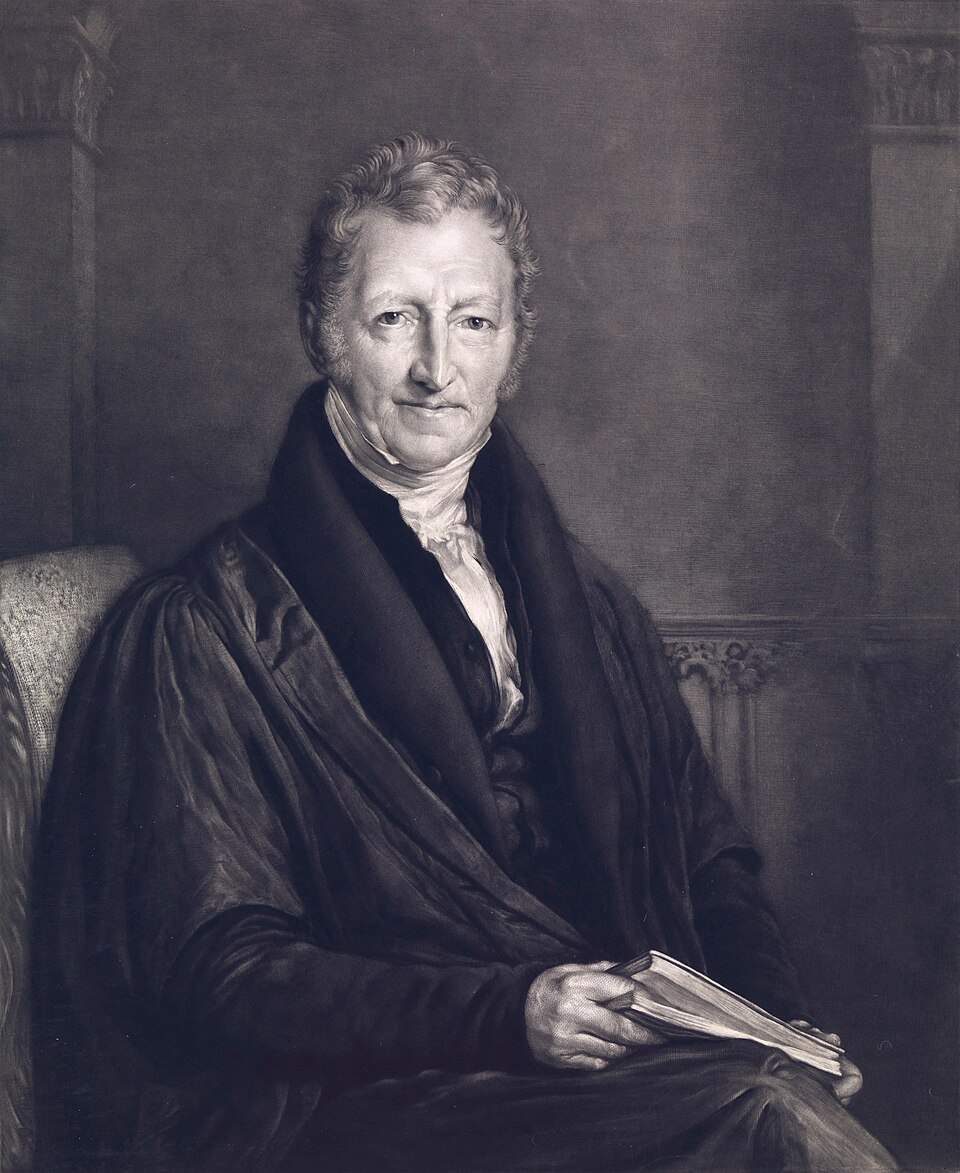
Thomas Robert Malthus (1766-1834) was an English cleric and one of the first professional political economists. His Essay on the Principle of Population, published anonymously in 1798 and expanded through further editions up to 1826, was written against the optimism of Condorcet and William Godwin, who believed human society was perfectible. Malthus's counter-argument was arithmetical rather than moral: two unequal rates of growth, one multiplicative and one additive, guarantee that population presses on subsistence, so that misery and vice are permanent features of human society unless numbers are restrained. The gap is closed by checks — preventive checks working on the birth rate and positive checks working on the death rate.
The trap in this question is not the economics but the pair of words, and three of the four options are built out of that. Two options simply swap the terms, and one substitutes modern synonyms. Fix the direction first — population is the runaway series, food the plodding one — and only then choose the vocabulary. It is also worth knowing why the prediction has not held at the world scale, because UPSC likes the critique more than the theory: agricultural productivity rose faster than Malthus could imagine, through the nineteenth-century opening of new farmland, mechanisation, synthetic fertiliser and the Green Revolution; fertility fell of its own accord as incomes and female education rose, which is the demographic transition; and Ester Boserup argued that the causality runs the other way, that population pressure is itself the spur to agricultural intensification. Malthus survives in the exam as the ancestor of neo-Malthusian thinking — Paul Ehrlich's The Population Bomb (1968) and the Club of Rome's Limits to Growth (1972).
- An Essay on the Principle of Population was published anonymously in 1798; Malthus's claim was that population when unchecked increases in a geometrical ratio while subsistence increases only in an arithmetical ratio.
- Geometric progression multiplies by a constant ratio (1, 2, 4, 8, 16); arithmetic progression adds a constant difference (1, 2, 3, 4, 5). The multiplying series must eventually overtake the adding one, whatever the head start.
- Malthus's checks: preventive checks act on the birth rate (moral restraint, delayed marriage, celibacy); positive checks act on the death rate (famine, disease, war).
- Both Charles Darwin and Alfred Russel Wallace recorded that reading Malthus gave them the idea of the struggle for existence that underlies natural selection.
- The counter-arguments a candidate should carry: the demographic transition, in which fertility falls as incomes and education rise; technological change in agriculture, above all the Green Revolution; and Ester Boserup's thesis that population pressure induces agricultural innovation rather than famine.
- Swapping the two progressions. Population is geometric, food supply arithmetic — never the other way round.
- Reaching for the modern synonyms. Exponential and linear describe the same curves, but a fill-in-the-blank that quotes Malthus wants his named progressions, geometric and arithmetic.
- Crediting Malthus with the demographic transition theory (Thompson) or the optimum population theory (Cannan). UPPSC has already asked exactly that match-list, and Malthus belongs only to the population-food supply relationship.
UPPSC asks this as a fill-in-the-blank or as a theory-to-propounder match list; UPSC prefers the consequences — the stages of demographic transition, or the reasons a State such as Kerala completed its fertility transition early. Learn the theory, its author, its two checks and its two standard critiques and all these formats are covered.
Consider the following specific stages of demographic transition associated with economic development: 1. Low birthrate with low death rate 2. High birthrate with high death rate 3. High birthrate with low death rate Select the correct order of the above stages using the codes given below:
- (a) 1, 2, 3
- (b) 2, 1, 3
- (c) 2, 3, 1
- (d) 3, 2, 1
Answer(c) 2, 3, 1
The theory that displaced Malthus. The demographic transition model says the high-birth, high-death regime gives way to falling death rates and then to falling birth rates — that is, populations stop growing geometrically of their own accord, which is precisely what Malthus did not anticipate.
India's population growth during the 20th century can be classified into four distinct phases. Match List I (Period) with List II (Phase) and select the correct answer using the codes given below the lists: List I (Period) List II (Phase) A. 1901-21 1. Steady growth B. 1921-51 2. Rapid high growth C. 1951-81 3. Stagnant growth D. 1981-2001 4. High growth with definite signs of slowdown Codes: A B C D
- (a) 3 1 4 2
- (b) 1 3 2 4
- (c) 3 1 2 4
- (d) 1 3 4 2
Answer(c) 3 1 2 4
Malthusian dynamics read off India's own record. The 1901-21 stagnation was the positive checks at work — famine and the influenza epidemic — while the rapid growth after 1951 came from falling death rates with birth rates still high, the phase the transition model predicts.
Match list-I with list-II and select the correct answer using code given below the lists – List - I (Theories of Population): (A) Optimum Population Theory (B) Social Mal-adjustment Theory (C) Demographic Transition Theory (D) Population-Food Supply Relationship Theory List - II (Propounders of Theories): (1) Thompson (2) Malthus (3) Edwin Kennan (4) Henry George Code -
- (a) A-(1), B-(2), C-(3), D-(4)
- (b) A-(3), B-(4), C-(1), D-(2)
- (c) A-(2), B-(3), C-(4), D-(1)
- (d) A-(4), B-(3), C-(1), D-(2)
Answer(b) A-(3), B-(4), C-(1), D-(2)
UPPSC asked the same syllabus point one year earlier as a theory-to-propounder match list, and Malthus appears there as the author of the population-food supply relationship theory — the identification this fill-in-the-blank assumes you already have.
- practice — not a real PYQ
In Malthus's theory of population, which of the following are described as 'positive checks'?
- (a)Moral restraint, late marriage and celibacy
- (b)Famine, epidemic disease and war
- (c)Contraception and sterilisation
- (d)Migration and urbanisation
Answer(b) Famine, epidemic disease and war — the positive checks work by raising the death rate. Moral restraint, delayed marriage and celibacy are the preventive checks, which work on the birth rate.
- practice — not a real PYQ
Which thinker argued, against Malthus, that population pressure is itself the stimulus for agricultural innovation and intensification?
- (a)Warren Thompson
- (b)Edwin Cannan
- (c)Ester Boserup
- (d)Paul Ehrlich
Answer(c) Ester Boserup — in The Conditions of Agricultural Growth (1965) she reversed Malthus's causality. Thompson gave the demographic transition theory, Cannan the optimum population theory, and Ehrlich revived Malthusian pessimism in The Population Bomb.