
Given below are two statements, one is labelled as Assertion (A) and the other as Reason (R). Assertion (A) : Agra and Darjeeling are located on the same latitude but temperature of January in Agra is 16° Centigrade whereas it is only 4° Centigrade in Darjeeling. Reason (R) : Temperature decreases with height and due to thin air, places in the mountains are cooler than places in the plains. Select the correct answer from the code given below : Code :
- (a)(A) is true but (R) is false
- (b)Both (A) and (R) are true and (R) is the correct explanation of (A)
- (c)(A) is false but (R) is true
- (d)Both (A) and (R) are true but (R) is not the correct explanation of (A)
Correct — B, Both (A) and (R) are true and (R) is the correct explanation of (A). Check the Assertion first. Agra stands at about 27°11′N and Darjeeling at about 27°02′N — the same parallel for practical purposes — so latitude, and therefore the angle of the incoming sun, is effectively held constant between them. What is not constant is height: Agra lies at roughly 170 m above sea level, Darjeeling at roughly 2,045 m. Agra is decidedly the warmer of the two in January and Darjeeling decidedly the colder, by something of the order of ten to twelve degrees, so the Assertion's contrast is sound (its two figures are the paper's own; see the note in the key facts). The Reason then supplies exactly the missing variable. Temperature falls with height in the troposphere at an average environmental lapse rate near 6.5°C per 1,000 m; the roughly 1,875 m that separate the two towns predict about 12°C of cooling, which is the size of the gap the Assertion states. Since the Assertion is a puzzle only until altitude is introduced, and the Reason introduces altitude, R is not merely also true — it is the explanation. Hence option (b) on this paper's code.
- (a)(A) is true but (R) is false — The Reason is not false. Temperature does fall with height through the troposphere, and mountain stations are systematically colder than plains stations on the same latitude — this is the single most reliable control on temperature after latitude itself. The Reason's wording is loose in one respect only: 'thin air' is a contributing factor rather than the whole mechanism (see the concept note), but the proposition it states is correct.
- (c)(A) is false but (R) is true — The Assertion is not false. Agra and Darjeeling really do sit on nearly the same parallel — about 27°N — and Agra really is far warmer in January. Rejecting the Assertion usually comes from doubting the two exact temperature figures, but the claim being tested is the contrast between a plains station and a hill station at equal latitude, and that contrast holds.
- (d)Both (A) and (R) are true but (R) is not the correct explanation of (A) — This is the trap option, and the one to reason about carefully. It would be right only if some other factor accounted for the gap — but latitude is held constant by design, both towns are inland and neither is coastal, and the difference in elevation is nearly two kilometres. Altitude is not one candidate explanation among several here; it is the only variable that has changed.
Latitude and altitude are the two dominant controls on temperature, and this question isolates the second by holding the first fixed. In the troposphere the air is warmed chiefly from below: the ground absorbs short-wave solar radiation and re-radiates it as long-wave terrestrial radiation, which the lower atmosphere absorbs. Air therefore gets colder as you move away from that heat source, and it also cools adiabatically as it rises into lower pressure and expands. The combined result is the environmental lapse rate, averaging about 6.5°C per 1,000 m of ascent. Thinner air aggravates the effect — a less dense atmosphere holds less heat and radiates it away faster, which is why hill stations also swing sharply between day and night — but the primary reason is heating from the surface upward, not thinness by itself.
The reasoning route is to ask what the examiner has deliberately kept constant. Both places sit near 27°N, both are inland, and the month is the same, so insolation angle, continentality and season are all neutralised; only elevation is left, and it differs by nearly 1,900 m. Multiply that by the lapse rate and you recover the stated gap almost exactly — which is the cleanest possible demonstration that R explains A. Two cautions. First, do not fight the question over its exact numbers: they are approximations, and the correct examination response is to judge the direction and the order of magnitude, both of which are right. Second, this paper's assertion–reason code is scrambled, so 'both true and R explains A' is at (b) here, not at the (a) most candidates expect — always read the printed option text before answering.
- Agra lies at about 27°11′N and roughly 170 m above sea level; Darjeeling lies at about 27°02′N and roughly 2,045 m — essentially the same latitude, about 1,875 m apart in height.
- The environmental lapse rate averages about 6.5°C per 1,000 m of ascent, so 1,875 m predicts roughly 12°C of cooling — the size of the gap the Assertion describes.
- The troposphere is heated mainly from below, by long-wave terrestrial radiation from the ground, which is why temperature normally falls with height in it.
- The question's specific figures (16°C for Agra, 4°C for Darjeeling) are the paper's own. Current climatological normals differ somewhat — Agra's January mean is nearer 18°C, and Darjeeling's January daily maximum and minimum are about 11°C and 2°C — but the direction and the roughly 12-degree contrast that the Assertion rests on are correct.
- This paper places 'both true and R is the correct explanation' at option (b); at (a) it places '(A) true, (R) false', at (c) '(A) false, (R) true', and at (d) 'both true but R does not explain A'.
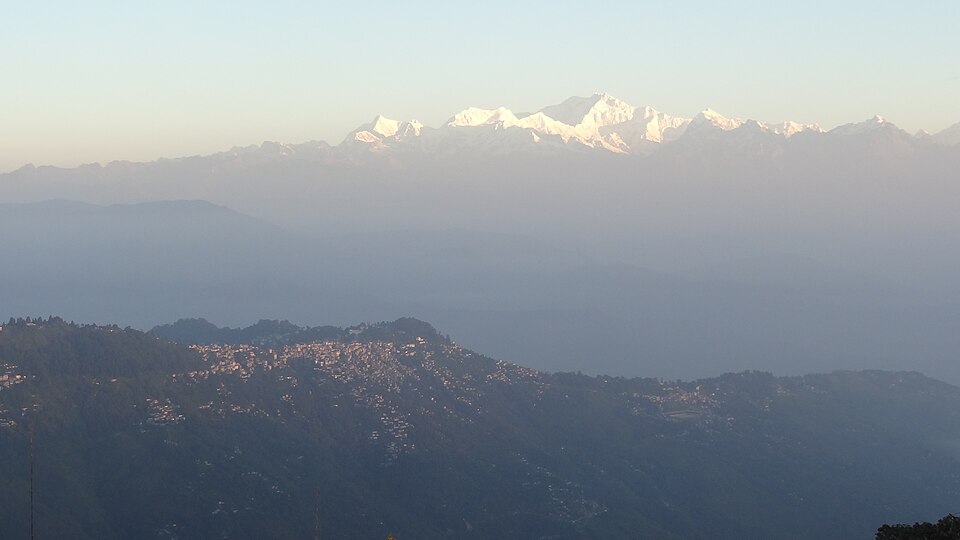
- Rejecting the Assertion because the two temperature figures are not exactly the current normals — judge the contrast, not the decimal
- Choosing 'both true but R does not explain A' out of caution when latitude has been deliberately held constant and only altitude varies
- Assuming the assertion–reason letters carry their usual UPSC meanings; in this 2022 paper every one of the four is moved
UPPSC uses paired real places at the same latitude and asks you to name the control — here Agra against Darjeeling. UPSC asks the same physics directly, as 'why does temperature decrease with height', with the mechanism itself among the statements. Either way the answer is heating from the surface upward plus adiabatic cooling on ascent.
Normally, the temperature decreases with the increase in height from the Earth's surface, because 1. The atmosphere can be heated upwards only from the Earth's surface. 2. There is more moisture in the upper atmosphere. 3. The air is less dense in the upper atmosphere. Select the correct answer using the codes given below:
- (a) 1 only
- (b) 2 and 3 only
- (c) 1 and 3 only
- (d) 1, 2 and 3
Answer(c) 1 and 3 only
Exactly the Reason of this question, unpacked into its parts. UPSC confirms both halves of the mechanism — the atmosphere is heated upward from the surface, and the thinner upper air contributes — while rejecting the idea that the upper atmosphere holds more moisture.
Given below are two statements, one is labelled as Assertion (A) and the other as Reason (R). Assertion (A) : In the Himalayan mountains different types of vegetation are found. Reason (R) : In Himalayas, there are variations in climate with change in altitude. Select the correct answer from the code given below : Code :
- (a) Both (A) and (R) are true, but (R) is not the correct explanation of (A)
- (b) (A) is true, but (R) is false
- (c) (A) is false, but (R) is true
- (d) Both (A) and (R) are true and (R) is the correct explanation of (A)
Answer(d) Both (A) and (R) are true and (R) is the correct explanation of (A)
The same altitude control, applied to vegetation instead of temperature, and with the same verdict — both true, R explains A. Compare the option letters: the identical meaning sits at (b) in the 2022 paper and at (d) in the 2025 paper, which is why the printed text must be read every time.
- practice — not a real PYQ
The average environmental lapse rate in the troposphere is closest to
- (a)1.0°C per 1,000 metres
- (b)6.5°C per 1,000 metres
- (c)10.0°C per 1,000 metres
- (d)16.0°C per 1,000 metres
Answer(b) 6.5°C per 1,000 metres — about 10°C per 1,000 m is the dry adiabatic lapse rate, which applies to a rising parcel of unsaturated air, not to the ambient atmosphere.
- practice — not a real PYQ
Two stations lie on the same latitude and both are far inland, yet one records a markedly lower mean January temperature. Which factor most likely explains the difference?
- (a)Difference in altitude
- (b)Difference in the angle of insolation
- (c)Difference in distance from the sea
- (d)Difference in day length
Answer(a) Difference in altitude — same latitude fixes both insolation angle and day length, and 'far inland' removes the maritime influence, leaving elevation as the operative control.