
With reference to Chandragupta – II, which of the following statements is/are correct ? 1. The strongest evidence in the context of Shaka Victory is the silver coins of this King. 2. The weight of these coins used to be about 33 grains. Select the correct answer from the code given below : Code :
- (a)Both 1 and 2
- (b)Only 1
- (c)Neither 1 nor 2
- (d)Only 2
Answer
Why
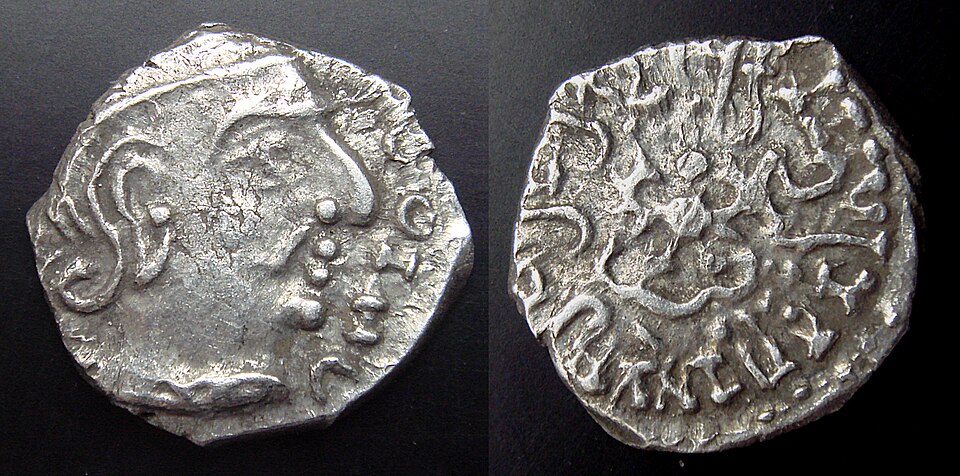
Correct — A, Both 1 and 2. Statement 1 is true. Until Chandragupta II the Guptas struck gold almost exclusively; a Gupta silver coinage appears only after he overran the Western Kshatrapas — the 'Shakas' — who ruled Gujarat, Saurashtra and Malwa. That silver was deliberately made to replace the Kshatrapa silver already circulating in the conquered west: it copies the Kshatrapa drachm in size, metal and weight, and the one visible change is on the reverse, where the Kshatrapa three-arched hill gives way to the Gupta Garuda. A conqueror who takes over the defeated dynasty's own currency standard and stamps his own emblem on it leaves a harder record of the conquest than any eulogy does, which is why numismatists treat this issue as the strongest evidence for the Shaka victory. Statement 2 is also true, on the standard the coins were copied from: the Western Kshatrapa drachm ran at roughly 2.1–2.2 grams, and Indian numismatic handbooks state the Gupta silver at about 32–33 grains — a documented specimen measures 15 mm and 2.1 g, which is close to 32 grains. Both statements therefore stand, and the answer is 'Both 1 and 2'.
Why the others are wrong
- (b)Only 1 — This keeps the numismatic argument but rejects the weight. The weight is not the weak half: the Gupta silver was struck on the Western Kshatrapa drachm standard of roughly two grams, which is about 32–33 grains, so the question's 'about 33 grains' is a fair statement of it. Note the figure describes the light silver issue only — Gupta gold dinaras were around four times heavier.
- (c)Neither 1 nor 2 — It throws away two correct statements. The silver coinage is real and it is the recognised material evidence of the western conquest, and its weight standard is the one the question quotes. Nothing in the pair is fabricated.
- (d)Only 2 — This accepts the weight but denies the evidential claim, which is the better-established of the two. The silver series is confined to the western provinces, is modelled on Kshatrapa coinage, and carries the Gupta Garuda in place of the Kshatrapa hill — the whole issue only makes sense as the currency of a newly annexed Shaka territory.
Concept
Gupta coinage is read as a political document, not just as money. The dynasty's prestige metal was gold — the dinara, a heavy coin of roughly eight grams carrying the emperor in scenes of archery, lion-slaying or sacrifice. Silver enters the Gupta series only with Chandragupta II (Vikramaditya, c. 375–415 CE), and only in the west, because that is where he displaced the Western Kshatrapas, whose economy already ran on a light silver drachm. Rather than force a new standard on a conquered province, he issued silver on the Kshatrapa weight and format and changed the emblem — Garuda for the three-arched hill. Coinage of this kind fixes both the fact and the geography of a conquest.
The trap in this question is the number. Candidates who know that Gupta coins were 'heavy gold' see '33 grains' and reject it as far too light, marking 'Only 1'. The way out is to notice that statement 2 says 'these coins' — the silver ones — not Gupta coins generally. Once you separate the two metals the arithmetic is easy: a grain is about 0.065 g, so 33 grains is a shade over 2 grams, exactly the Kshatrapa drachm the Gupta silver was copying, while an 8-gram gold dinara would be nearer 123 grains. A second reason not to reject statement 1 is that no literary source states the Shaka conquest plainly; the numismatic evidence is what fills the gap, supported by Chandragupta II's title Vikramaditya and by the westward reach of his successors' inscriptions.
Key facts
- Chandragupta II (Vikramaditya), c. 375–415 CE, annexed the Western Kshatrapa territory of Gujarat, Saurashtra and Malwa — the event the question calls the 'Shaka victory'.
- Gupta silver coinage begins with him and was intended to replace the Kshatrapa silver already circulating in the west; it copies Kshatrapa size, metal and weight.
- The design change identifies the new master: the Kshatrapa three-arched hill on the reverse is replaced by the Gupta Garuda.
- Weight: the Western Kshatrapa drachm standard is roughly 2.1–2.2 g — about 32–33 grains; a documented Gupta silver specimen is 15 mm across and 2.1 g. (Numismatic handbooks state 'about 32–33 grains'; there is no single published series-wide figure, so read the question's '33 grains' as the standard, not as a measured average.)
- For contrast, the Gupta gold dinara ran at about 8 g, roughly four times the silver — which is why the two denominations must not be judged by the same weight.
Study next
Common traps
- Applying the weight of the gold dinara (about 8 g) to the silver issue (about 2 g) and rejecting the '33 grains' figure
- Treating the coin weight as an exactly published constant — the honest position is 'the Kshatrapa drachm standard, about 32-33 grains'
- Assuming the Shaka victory is attested by a named inscription or text; the primary evidence is the coinage itself
UPPSC keeps this factual and paired — a claim about what the evidence is plus a number to accept or reject. UPSC has asked the same ground by name (what the Gupta silver coins were called) and by inference (which dynasty a coin type or find-spot belongs to), so learn the metal, the name, the weight band and the emblem together.
Related PYQs
The silver coins issued by the Guptas were called
- (a) rupaka
- (b) karshapana
- (c) dinara
- (d) pana
Answer(a) rupaka
The same coins from the other side. UPPSC asks what the Gupta silver proves and what it weighed; UPSC asks what it was called — rupaka for the silver, dinara for the gold. Learn the name, the metal and the weight band as one package.
With reference to the Puranas, which one of the following statements is correct? (1) Information about the Mauryan dynasty is found in the Vishnu Puran. (2) Vayu Puran throws light on the Gupta's governance system.
- (a) Both 1 and 2
- (b) Only 1
- (c) Only 2
- (d) Neither 1 nor 2
Answer(a) Both 1 and 2
The same examiner interest in what our evidence for a dynasty actually is. That question tests the Puranas as a textual source for the Mauryas and Guptas; this one tests coinage as the material source for Chandragupta II's western conquest.
Practice
- practice — not a real PYQ
The silver coinage introduced by Chandragupta II in western India was modelled on the coinage of which power?
- (a)The Kushanas
- (b)The Western Kshatrapas
- (c)The Satavahanas
- (d)The Indo-Greeks
Answer(b) The Western Kshatrapas — the Gupta silver copied their drachm in size, metal and weight, replacing the three-arched hill on the reverse with the Gupta Garuda. - practice — not a real PYQ
Consider the following statements about Gupta coinage: 1. The Guptas issued gold coins known as dinaras. 2. Gupta silver coins were considerably lighter than Gupta gold coins. Which of the statements given above is/are correct?
- (a)Only 1
- (b)Only 2
- (c)Both 1 and 2
- (d)Neither 1 nor 2
Answer(c) Both 1 and 2 — the gold dinara ran at roughly 8 grams while the silver issue followed the Kshatrapa drachm standard of about 2 grams.