
In which one of the following layers of the atmosphere all weather phenomenon occur ?
- (a)Mesosphere
- (b)Troposphere
- (c)Thermosphere
- (d)Stratosphere
Answer
Why
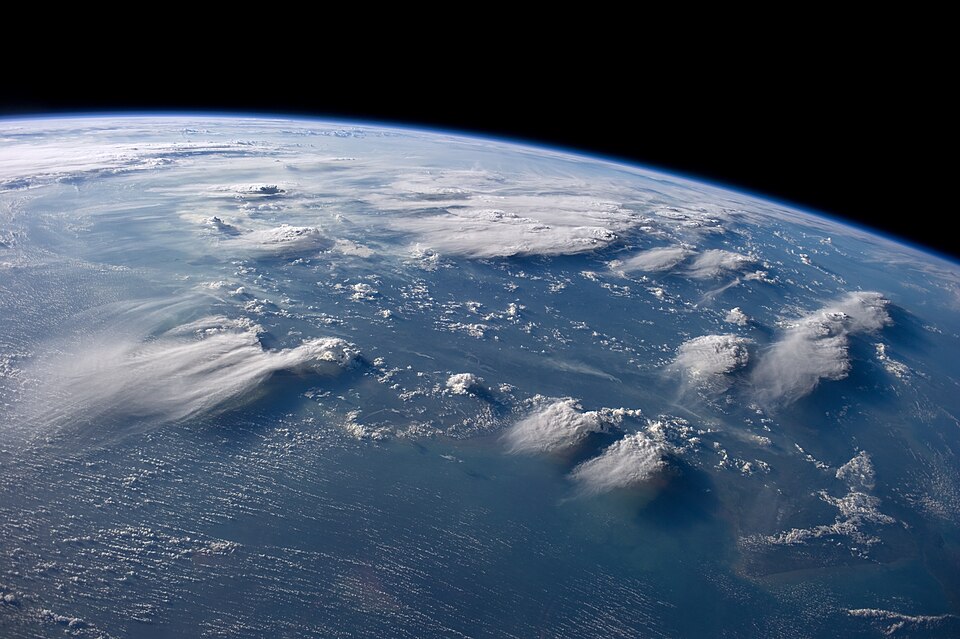
Correct — B, troposphere. The troposphere is the lowest layer of the atmosphere, averaging about 13 km in thickness — roughly 8 km over the poles and about 18 km over the equator, because strong convection carries heat to great heights there. It holds nearly all of the atmosphere's water vapour and dust, so clouds, rain, thunderstorms, fog and every other weather phenomenon are confined to it; the standard geography text puts it flatly that all changes in climate and weather take place in this layer. Temperature inside it falls with height at about 1 degree C for every 165 m, which is what keeps the air convectively active.
Why the others are wrong
- (a)Mesosphere — The mesosphere is the third layer up, well above the ozone-bearing stratosphere. It is where meteors burn up, and it is far too thin and far too dry to hold clouds, rain or storms.
- (c)Thermosphere — The thermosphere lies above the mesosphere, its temperature rises with height, and it contains the ionised layers that reflect radio waves back to Earth. Nothing that a forecaster would call weather happens there.
- (d)Stratosphere — The strongest distractor. The stratosphere sits directly above the troposphere and holds the ozone layer, but it is stable, almost free of water vapour and nearly cloudless — which is precisely why jet aircraft cruise in its lower part to avoid weather rather than to fly through it.
Concept
The atmosphere is divided by its temperature behaviour into troposphere, stratosphere, mesosphere, thermosphere and exosphere. The troposphere is heated from below, because sunlight passes largely through the air and warms the ground, and the warmed ground then heats the air in contact with it. That bottom-up heating is why temperature falls with height in this layer, and falling temperature with height is what makes air rise, condense and produce weather.
The trap is the stratosphere, which students associate with the atmosphere's most famous feature, the ozone layer. The discriminator is water vapour plus vertical motion. The troposphere holds the moisture and is convectively unstable; the stratosphere is dry and stable, so it damps vertical motion instead of feeding it. A useful check when a question offers the two together is to ask where the clouds are. It is also worth carrying the boundary itself — the tropopause caps the weather, and because it is higher over the equator than over the poles, tropical thunderstorm tops reach much greater heights than mid-latitude ones.
Key facts
- The troposphere is the lowermost layer of the atmosphere; its average height is about 13 km, extending to roughly 8 km near the poles and about 18 km at the equator.
- All changes in climate and weather take place in the troposphere, which also holds the atmosphere's dust particles and water vapour.
- Temperature in the troposphere falls at about 1 degree C for every 165 m of height, the normal lapse rate.
- Moving upward from the surface the layers run troposphere, stratosphere, mesosphere, thermosphere and exosphere.
Study next
Common traps
- Choosing the stratosphere because the ozone layer makes it the most talked-about layer.
- Assuming the ceiling of weather sits at a fixed altitude; it is the tropopause, which is higher over the equator.
As a which-layer item like this one, as an ordering of the layers from the surface upward, or through the lapse rate and the tropopause.
Related PYQs
The correct sequence of different layers of the atmosphere from the surface of the Earth upwards is
- (a) Troposphere, Stratosphere, Ionosphere, Mesosphere
- (b) Stratosphere, Troposphere, Ionosphere, Mesosphere
- (c) Troposphere, Stratosphere, Mesosphere, Ionosphere
- (d) Stratosphere, Troposphere, Mesosphere, Ionosphere
Answer(c) Troposphere, Stratosphere, Mesosphere, Ionosphere
The same structure asked as an ordering. NDA wants to know which layer holds the weather, UPSC wants the stack in order — and the troposphere sits at the bottom of both answers.
Which one of the following layers of the atmosphere is responsible for the deflection of radio waves?
- (a) Troposphere
- (b) Stratosphere
- (c) Mesosphere
- (d) Ionosphere
Answer(d) Ionosphere
The mirror image of this item — one layer owns the weather, a much higher one owns long-distance radio. Learning what each layer is for, rather than only its name, answers both.
Which one of the following is the correct sequence of layers as we move from the Earth's surface upwards?
- (a) Troposphere, Stratosphere, Thermosphere, Mesosphere
- (b) Troposphere, Stratosphere, Mesosphere, Thermosphere
- (c) Thermosphere, Mesosphere, Stratosphere, Troposphere
- (d) Stratosphere, Mesosphere, Troposphere, Thermosphere
Answer(b) Troposphere, Stratosphere, Mesosphere, Thermosphere
NDA's own earlier version of the same topic. Learn the stack once in order and both the sequence item and this weather-layer item fall out of it.
Practice
- practice — not a real PYQ
The layer of the atmosphere lying immediately above the troposphere is the
- (a)mesosphere
- (b)stratosphere
- (c)thermosphere
- (d)exosphere
Answer(b) stratosphere — the order upward is troposphere, stratosphere, mesosphere, thermosphere, exosphere. - practice — not a real PYQ
The thickness of the troposphere is greatest
- (a)over the poles
- (b)over the equator
- (c)over the Tropic of Cancer
- (d)it is the same everywhere
Answer(b) over the equator — about 18 km there against roughly 8 km at the poles, because strong convection carries heat to great heights.