
An important cause of tooth decay by the bacterium Streptococcus mutans is because of their ability to attach to teeth surface by producing slime layer from
- (a)Sugar
- (b)Alcohol
- (c)Saliva
- (d)Teichoic acid
Answer
Why
Correct — A, Sugar. Streptococcus mutans carries enzymes called glucosyltransferases which take the glucose half of sucrose — ordinary table sugar from the diet — and polymerise it into a sticky, dextran-like polysaccharide outside the cell. That secreted gum is the slime layer named in the stem. It cements the bacteria to the enamel and to one another, building the film we call dental plaque, and once anchored the same organisms ferment sugars into lactic acid that dissolves the mineral of the tooth. Take the dietary sugar away and the glue cannot be made.
Why the others are wrong
- (b)Alcohol — Alcohol is not a building block for the adhesive polymer. The bacterium's sugar metabolism in the mouth runs to lactic acid, and no ethanol-derived slime is involved in fixing it to the tooth.
- (c)Saliva — Saliva does coat the tooth with a thin protein film that bacteria can settle on, but the slime layer the question describes is a polysaccharide the bacterium itself manufactures, and it manufactures it from dietary sugar, not from saliva.
- (d)Teichoic acid — Teichoic acids are polymers built into the cell wall of Gram-positive bacteria. They are part of the organism's own wall rather than a secreted extracellular gum, so they are not the slime layer that sticks the colony to the enamel.
Concept
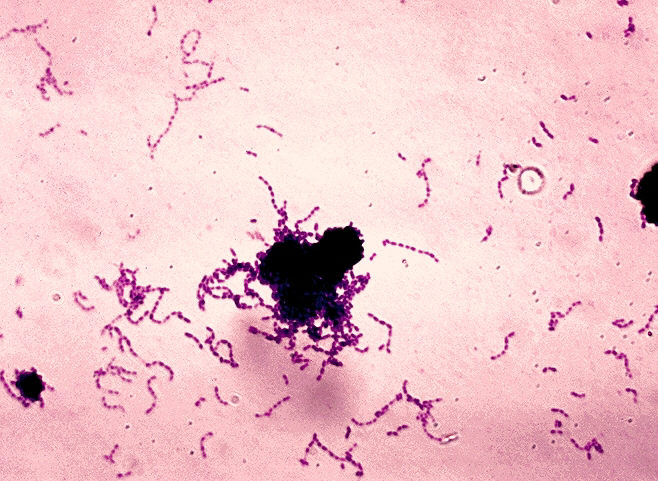
Dental caries is a two-step microbial process. First the bacteria must stay put — Streptococcus mutans achieves this by converting the glucosyl part of sucrose into a sticky extracellular polysaccharide that lets its cells cohere and form plaque on the tooth. Then the same bacteria ferment dietary sugars to lactic acid, and the acid conditions under the plaque strip calcium and phosphate out of the enamel until a cavity opens.
The stem gives away more than it looks. It asks what the slime layer is made from, so the answer must be a raw material the bacterium consumes, not a structure it already owns. That rules out teichoic acid, which is part of its own wall. Saliva is tempting because it is always present in the mouth, but the polysaccharide is synthesised, not borrowed. Sugar is the only substrate on the list, and it is also the standard public-health message behind advice to cut sugary food and drink.
Key facts
- Streptococcus mutans uses glucosyltransferase enzymes to convert the glucosyl part of sucrose into a sticky, dextran-like extracellular polysaccharide.
- That sticky polysaccharide makes the bacteria cohere and form dental plaque on the tooth surface.
- The same organisms ferment sugars to lactic acid, and the resulting acidity leaves the highly mineralised enamel open to decay.
- Streptococcus mutans is regarded as the primary causal agent in the initiation and development of dental caries.
Study next
Common traps
- Choosing saliva because it is the obvious mouth fluid, when the polymer is synthesised by the bacterium.
- Choosing teichoic acid because it sounds technical — it belongs to the cell wall, not to a secreted slime.
- Confusing the sticking step (polysaccharide glue) with the damaging step (acid production).
Asked as a mechanism item like this one, as 'which bacterium causes tooth decay', or in a toothpaste and fluoride framing.
Related PYQs
Toothpaste prevents tooth decay by :
- (a) neutralizing the excess acidity.
- (b) means of emulsification.
- (c) the action of fluoride.
- (d) making a coat of calcium over the teeth surface.
Answer(a) neutralizing the excess acidity. or (c) the action of fluoride.
The defence side of the same story. This question explains how the bacteria attack the tooth; the earlier one asks how toothpaste blocks that attack, by countering the acid and by supplying fluoride.
Practice
- practice — not a real PYQ
Tooth enamel is damaged in dental caries mainly because the bacteria in plaque produce
- (a)an alkali
- (b)an acid
- (c)an enzyme that digests calcium
- (d)a gas
Answer(b) an acid — sugars are fermented to lactic acid, and the acid conditions demineralise the enamel. - practice — not a real PYQ
The sticky film of bacteria and their secreted polysaccharide that builds up on the tooth surface is called
- (a)dentine
- (b)dental plaque
- (c)pulp
- (d)cementum
Answer(b) dental plaque — the biofilm formed once the bacteria cohere through their polysaccharide.