
Consider the following reaction : 2HgO —Δ→ 2Hg + O₂ The respective state of HgO, Hg and O₂ in the above reaction is
- (a)Liquid, solid, gas
- (b)Solid, solid, gas
- (c)Liquid, solid, liquid
- (d)Solid, liquid, gas
Answer
Why
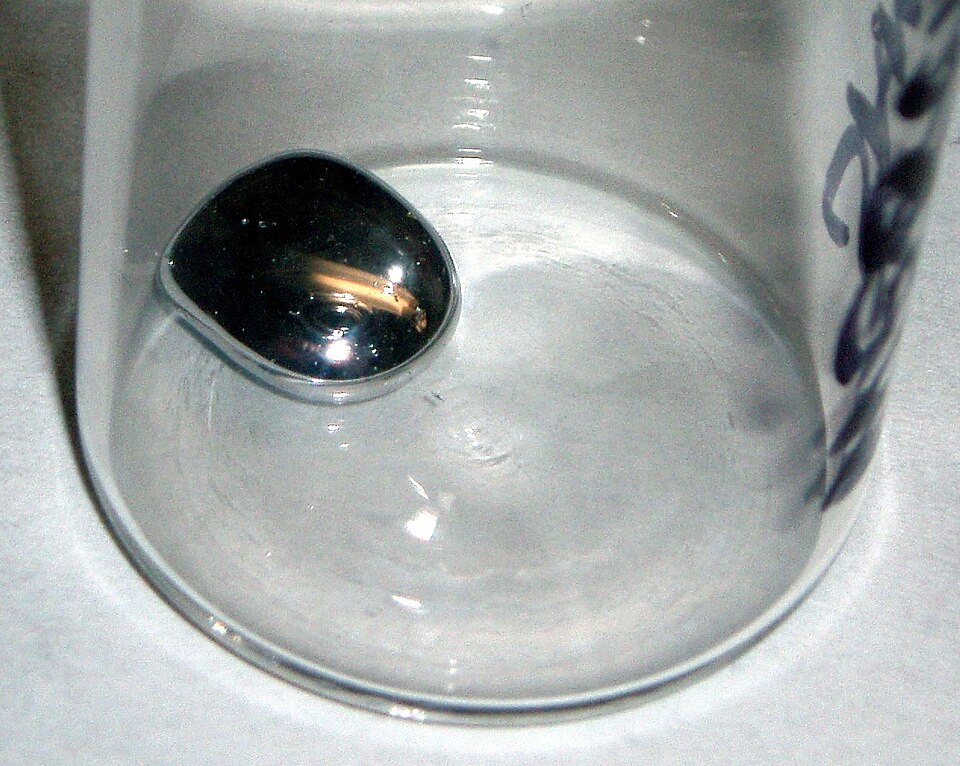
Correct — D, Solid, liquid, gas. Written out with state symbols the equation is 2HgO(s) —Δ→ 2Hg(l) + O₂(g). Mercury(II) oxide is a solid powder. Mercury is the one metal that is liquid at ordinary room temperature, its melting point being about −39 °C. Oxygen is a gas. So the three states run solid, liquid, gas in that order, and the Δ over the arrow simply tells you the change is driven by heating.
Why the others are wrong
- (a)Liquid, solid, gas — This swaps the first two. Mercuric oxide is not a liquid — it is a solid powder — and the mercury it releases is not a solid.
- (b)Solid, solid, gas — It gets the oxide and the oxygen right but calls mercury a solid. Mercury freezes only around −39 °C, so at ordinary temperature the metal collected here is a liquid.
- (c)Liquid, solid, liquid — Wrong on all three counts. It makes the oxide a liquid, the mercury a solid, and turns oxygen — a gas at room temperature — into a liquid.
Concept
This is a thermal decomposition — a single compound broken by heat into two simpler substances. Reading such an equation means knowing the ordinary state of each species. Mercury(II) oxide is a red or orange solid; it breaks down on strong heating or on exposure to light. Mercury is the only metallic element that is liquid at room temperature. Oxygen is a colourless gas.
You do not need any chemistry beyond the three physical states — the item is really testing whether you know mercury is a liquid metal. Fix that one fact and options (b) and (c) fall away at once, and (a) fails because a powdered oxide cannot be a liquid. Be honest about one wrinkle: the decomposition itself needs about 500 °C, and at that temperature the mercury comes off as vapour. The state symbols in the printed equation are the conventional room-temperature states, and that convention is what this question is asking you to reproduce.
Key facts
- Mercury is the only metal that is liquid at ordinary room temperature, melting at about −39 °C.
- Mercury(II) oxide is a solid, and it decomposes on heating above roughly 500 °C or on exposure to light.
- The balanced equation with state symbols is 2HgO(s) → 2Hg(l) + O₂(g).
- In 1774 Joseph Priestley obtained a gas by heating mercuric oxide, which he called dephlogisticated air and which was later identified as oxygen.
Study next
Common traps
- Assuming every metal must be a solid, and so marking mercury as solid.
- Reading Δ as a catalyst or as electrolysis instead of as simple heating.
- Mixing up the reactant and product order — the question asks for HgO first, then Hg, then O₂.
Asked as a state-symbol identification, as a 'name the type of reaction' item on the same equation, or as a general-science item on which element is a liquid metal.
Related PYQs
Which one of the following reactions is an example of decomposition reaction?
- (a) CH₄(g) + 2O₂(g) → CO₂(g) + 2H₂O(g)
- (b) 2AgCl(s) —Sunlight→ 2Ag(s) + Cl₂(g)
- (c) CuO + H₂ —Heat→ Cu + H₂O
- (d) Fe(s) + CuSO₄(aq) → FeSO₄(aq) + Cu(s)
Answer(b) 2AgCl(s) —Sunlight→ 2Ag(s) + Cl₂(g)
The same reaction family with state symbols already printed — one compound splitting into two simpler ones. Silver chloride is broken by light where mercuric oxide is broken by heat.
Which of the following compounds undergoes/undergo thermal decomposition?
- (a) Zinc oxide
- (b) Silver oxide and zinc oxide
- (c) Silver oxide
- (d) Magnesium oxide
Answer(c) Silver oxide
Directly on thermal decomposition of a metal oxide — the same idea as heating mercuric oxide, and it makes the point that only the oxides of the least reactive metals break up this easily.
Practice
- practice — not a real PYQ
The reaction 2HgO —Δ→ 2Hg + O₂ is an example of
- (a)a combination reaction
- (b)a thermal decomposition reaction
- (c)a displacement reaction
- (d)a double displacement reaction
Answer(b) a thermal decomposition reaction — one compound is split by heat into two simpler substances. - practice — not a real PYQ
Which one of the following elements is a liquid at ordinary room temperature?
- (a)Sodium
- (b)Iodine
- (c)Mercury
- (d)Phosphorus
Answer(c) Mercury — the only metal that is liquid at room temperature.