
Which one of the following processes involves chemical reaction ?
- (a)Evaporation of petrol
- (b)Dissolution of salt in water
- (c)Storing of oxygen gas under pressure in a gas cylinder
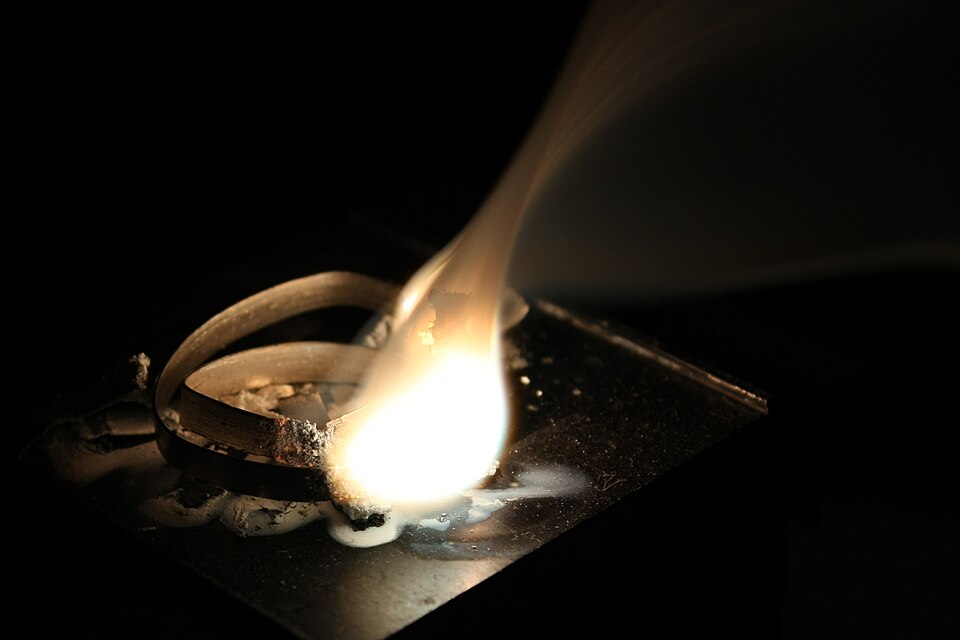
- (d)Burning of magnesium ribbon in air
Answer
Why
Correct — D, Burning of magnesium ribbon in air. Magnesium combines with the oxygen of the air to give magnesium oxide, 2Mg + O₂ → 2MgO. A brand-new substance appears — a white powder whose composition and properties are nothing like the shiny metal ribbon it came from — and you cannot get the ribbon back by cooling or by any simple physical step. That is the definition of a chemical reaction. The other three options rearrange or move molecules around without changing what those molecules are.
Why the others are wrong
- (a)Evaporation of petrol — Evaporation is a change of state. The petrol molecules leave the liquid and enter the vapour, but they are still the same molecules — cool the vapour and you get liquid petrol back. No new substance is formed, so it is a physical change.
- (b)Dissolution of salt in water — Dissolving separates the sodium and chloride ions that were already present in the crystal; it does not build any new compound. Boil the water off and the same salt is recovered unchanged, which is why dissolving is treated as a physical change.
- (c)Storing of oxygen gas under pressure in a gas cylinder — Compressing a gas only pushes the same O₂ molecules closer together. Release the pressure and ordinary oxygen comes out. Nothing has reacted — this is a physical change of volume and pressure.
Concept
A chemical reaction is a change in which the atoms are regrouped into one or more substances that were not there before, so the products differ from the reactants in composition and in properties. A physical change alters only state, shape, size or the degree of mixing, and the substance itself survives intact. The usual field signs of a reaction are a new colour, a gas bubbling off, a precipitate settling, a smell appearing, or heat and light being given out.
Work through the four options asking a single question — after the change, is a different substance present? Petrol vapour is still petrol; salt solution still contains sodium chloride; compressed oxygen is still oxygen. Only the magnesium ribbon comes out as something else, magnesium oxide. Options (a) and (c) tempt candidates because they involve energy or force, and (b) tempts because the crystal visibly disappears — but disappearance is not the test, a new substance is.
Key facts
- Burning magnesium in air forms magnesium oxide, 2Mg + O₂ → 2MgO.
- Magnesium oxide dissolved in water gives magnesium hydroxide, which is basic and turns red litmus blue.
- Evaporation, dissolution, melting, boiling and compression are physical changes — the substance is recoverable.
- Burning, rusting, souring of milk and digestion of food are chemical changes — a new substance is formed.
Study next
Common traps
- Treating dissolution as a chemical change because the solid vanishes from sight.
- Treating any change that needs energy — heating, compressing — as chemical.
- Forgetting that reversibility by simple physical means is a strong hint of a physical change.
Asked as a straight 'which one is a chemical change' pick, or in statement form where crystallisation and melting are offered alongside one genuine reaction.
Related PYQs
Which of the following is/are the example/examples of chemical change? 1. Crystallization of sodium chloride 2. Melting of ice 3. Souring of milk Select the correct answer using the code given below.
- (a) 1 and 2 only
- (b) 3 only
- (c) 1, 2 and 3
- (d) None
Answer(b) 3 only
The identical test. UPSC put crystallisation and melting in as physical changes and kept only the souring of milk as chemical; NDA swapped in evaporation, dissolution and compression as the physical decoys and burning magnesium as the reaction.
Which one of the following is a chemical change?
- (a) Dissolving sugar in water
- (b) Melting of ice
- (c) Crystallization
- (d) Milk turning sour
Answer(d) Milk turning sour
The same item one session earlier, with dissolving and melting again used as the physical decoys — proof that this is a recurring NDA GAT slot rather than a one-off.
Practice
- practice — not a real PYQ
Which one of the following is a physical change?
- (a)Rusting of iron
- (b)Sublimation of camphor
- (c)Burning of coal
- (d)Curdling of milk
Answer(b) Sublimation of camphor — the solid turns straight to vapour, but it is still camphor, so no new substance is formed. - practice — not a real PYQ
The white powder formed when magnesium ribbon is burnt in air is
- (a)magnesium carbonate
- (b)magnesium nitride only
- (c)magnesium oxide
- (d)magnesium hydroxide
Answer(c) magnesium oxide — magnesium combines with atmospheric oxygen to give MgO.