
Consider the following reaction : Fe₂O₃(s) + 2Al(s) → 2Fe(s) + Al₂O₃(s) Which of the following statements about the given reaction is NOT correct ?
- (a)It is an example of displacement reaction
- (b)It is highly endothermic reaction
- (c)Fe₂O₃ acts as oxidizing agent
- (d)This reaction is applicable to joining of railway tracks
Answer
Why
Correct — B, It is highly endothermic reaction. The stem asks which statement is NOT correct, and this is the one that fails. The reaction of iron(III) oxide with aluminium is the thermit reaction, and NCERT Class 10 Science describes such displacement reactions as highly exothermic — the amount of heat evolved is so large that the metal is produced in the molten state, and NCERT writes the equation with the word Heat on the product side. An endothermic reaction absorbs heat from its surroundings and cools them; this one pours heat out, which is the whole reason it is any use. The other three statements are all correct descriptions, so option (b) is the answer.
Why the others are wrong
- (a)It is an example of displacement reaction — This statement is correct, so it cannot be the answer. Aluminium stands above iron in the reactivity series, so it takes the oxygen and pushes iron out of its own oxide — one element displacing another from its compound is the definition of a displacement reaction.
- (c)Fe₂O₃ acts as oxidizing agent — This statement is also correct. Iron(III) oxide hands over its oxygen to aluminium, so aluminium is oxidised to Al₂O₃ while Fe₂O₃ is itself reduced to iron. The substance that supplies oxygen and is reduced is the oxidising agent, so Fe₂O₃ is the oxidising agent and aluminium is the reducing agent.
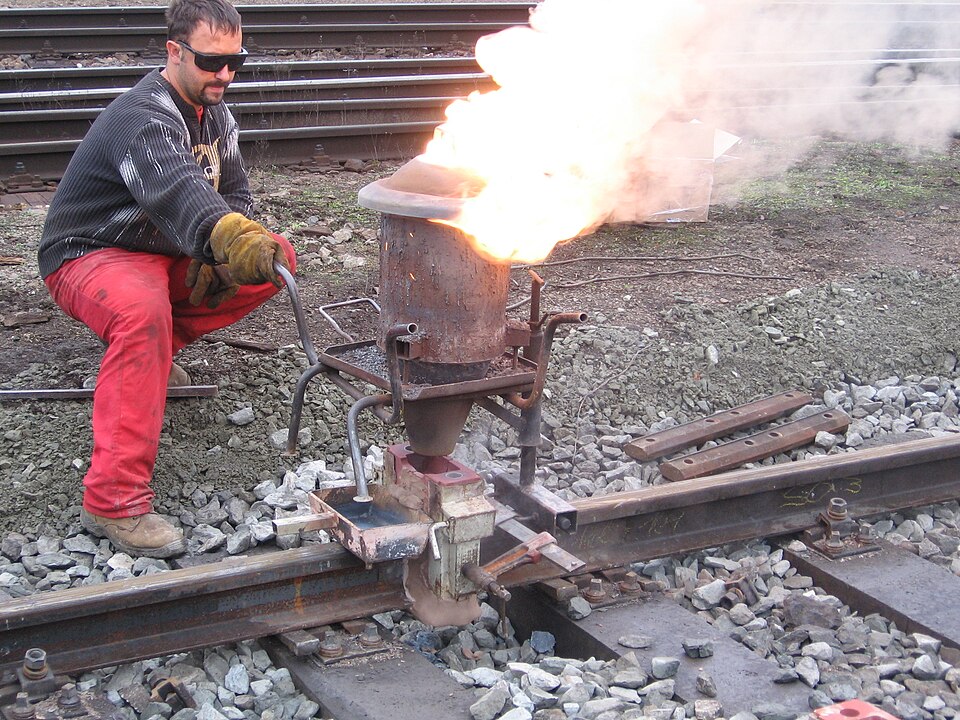
- (d)This reaction is applicable to joining of railway tracks — Correct as well, and the textbook says so in as many words — the reaction of iron(III) oxide with aluminium is used to join railway tracks or cracked machine parts, which is why it carries the name thermit reaction.
Concept
In the thermit reaction a more reactive metal, aluminium, displaces a less reactive one, iron, from its oxide. That single reaction is simultaneously three things — a displacement reaction by type, a redox reaction in which aluminium is oxidised and iron(III) oxide reduced, and a strongly exothermic process that releases enough heat to leave the iron molten. Its practical use follows from the heat, since molten iron poured into a gap welds the two pieces together.
Two things make this item easy to get wrong. First, the stem asks for the statement that is NOT correct, and a quick reader marks the first true statement instead. Second, the reaction has to be started with an ignition source, which tempts candidates into calling it endothermic. The ignition only supplies the activation energy to get it going; once started the reaction gives out far more heat than it took in, which is the meaning of exothermic.
Key facts
- NCERT Class 10 Science writes the reaction as Fe₂O₃(s) + 2Al(s) → 2Fe(l) + Al₂O₃(s) + Heat and calls it the thermit reaction.
- The same text states that these displacement reactions are highly exothermic, evolving so much heat that the metals are produced in the molten state.
- The stated use is joining railway tracks or cracked machine parts.
- Aluminium lies above iron in the reactivity series, so aluminium is oxidised and acts as the reducing agent while Fe₂O₃ is reduced and acts as the oxidising agent.
Study next
Common traps
- Missing the word NOT in the stem and marking a statement that is perfectly true.
- Assuming a reaction that needs an ignition must be endothermic — the ignition only starts it, after which heat is released.
- Naming aluminium as the oxidising agent; aluminium is the reducing agent and Fe₂O₃ is the oxidising agent.
NDA either names the thermit reaction and asks for its industrial use, or prints the equation and asks which statement about its type, its heat change or its agents is wrong.
Related PYQs
Consider the following statements: Coke is one of the materials of the charge added to blast furnace for the production of steel/iron. Its function is to I. Act as a reducing agent. II. Remove silica associated with the iron ore. III. Function as fuel, to supply heat. IV. Act as an oxidizing agent. Of these statements:
- (a) I and II are correct
- (b) II and IV are correct
- (c) I and III are correct
- (d) III and IV are correct
Answer(c) I and III are correct
Turns on the same reducing-agent idea applied to iron oxide — coke reduces the ore in a blast furnace exactly as aluminium reduces Fe₂O₃ in the thermit reaction, and the trap option there is also the oxidising-agent label.
Which one of the following reactions is an example of decomposition reaction?
- (a) CH₄(g) + 2O₂(g) → CO₂(g) + 2H₂O(g)
- (b) 2AgCl(s) —Sunlight→ 2Ag(s) + Cl₂(g)
- (c) CuO + H₂ —Heat→ Cu + H₂O
- (d) Fe(s) + CuSO₄(aq) → FeSO₄(aq) + Cu(s)
Answer(b) 2AgCl(s) —Sunlight→ 2Ag(s) + Cl₂(g)
Asks you to classify reactions by type from their equations, the same skill the first statement here needs; its option (d) is the standard displacement reaction and its option (c) a reduction.
Practice
- practice — not a real PYQ
In the reaction Fe₂O₃ + 2Al → 2Fe + Al₂O₃, the substance acting as the reducing agent is
- (a)Fe₂O₃
- (b)Al
- (c)Fe
- (d)Al₂O₃
Answer(b) Al — aluminium takes the oxygen from iron(III) oxide, so it is itself oxidised and reduces Fe₂O₃. - practice — not a real PYQ
The thermit reaction is used for
- (a)galvanising iron sheets
- (b)joining railway tracks or cracked machine parts
- (c)electroplating ornaments with gold
- (d)refining copper by electrolysis
Answer(b) joining railway tracks or cracked machine parts — the heat released leaves the iron molten, and the molten iron welds the pieces together.