
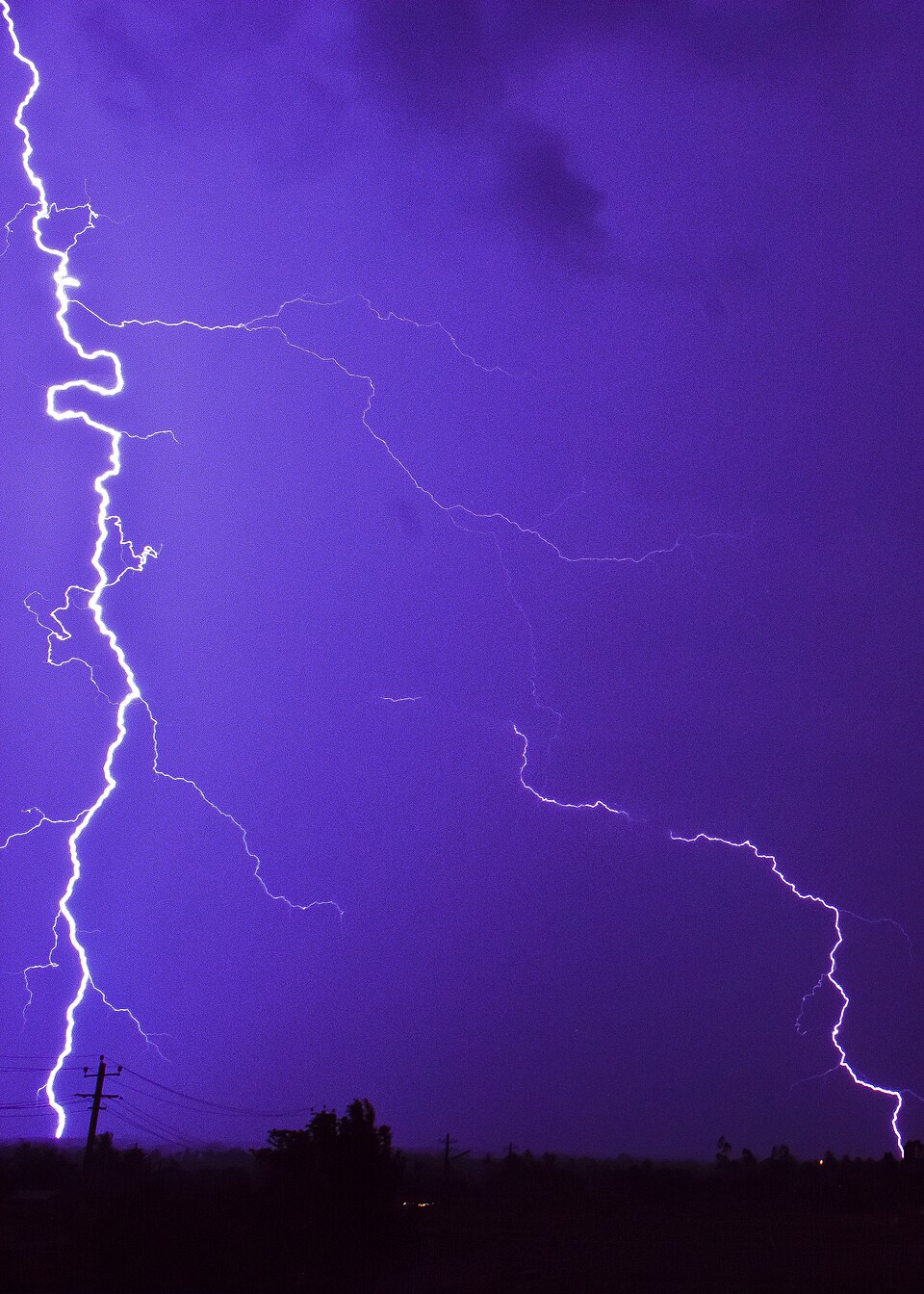
The flash of lightning is seen before the thunderstorm is heard. It verifies that
- (a)sound travels much faster than light
- (b)light travels much faster than sound
- (c)light and sound both travel with same speed
- (d)intensity of flash of lightning is very high during thunderstorm
Answer
Why
Correct — B, light travels much faster than sound. A lightning stroke and the thunder that follows it are two effects of one single event, and they begin at the same instant and at the same place — the thunder is the sound of air that has been violently heated and expanded by the electrical discharge. Since both signals start together and travel the same distance to the observer, the one that arrives first must be the faster one. Light covers a few kilometres of air in a few hundred-thousandths of a second, at roughly 3 × 10⁸ metres per second, while sound crawls along at only a few hundred metres per second in air. So the flash arrives effectively at once and the thunder trails behind by a few seconds — the gap is direct evidence that light is far the faster of the two.
Why the others are wrong
- (a)sound travels much faster than light — This reverses the true order. If sound were the faster signal the thunder would reach the observer first and the flash would follow, which is the opposite of what everyone actually observes during a storm.
- (c)light and sound both travel with same speed — Equal speeds would mean the two signals cover the same distance in the same time and arrive together, leaving no gap at all between the flash and the thunder. The observed delay of several seconds rules this out.
- (d)intensity of flash of lightning is very high during thunderstorm — Brightness explains why the flash is easy to notice, not why it arrives earlier. The observation being explained here is an ordering in time, and the intensity of a signal has nothing to do with the speed at which it travels.
Concept
Light and sound are different kinds of wave and travel at wildly different speeds. Light is an electromagnetic wave that needs no material medium and moves through air at about 3 × 10⁸ metres per second. Sound is a mechanical wave that must have a medium and moves through air at only a few hundred metres per second, roughly 330 to 340 m/s at ordinary temperatures. Lightning and thunder start together, so the delay between them is simply the difference in travel time.
The trap is option (d), which is a true statement about lightning that happens to answer a different question. Read the stem carefully — it asks what the ordering in time verifies, not what makes the flash conspicuous. Two side notes on the printed paper are worth flagging. The stem loosely says the thunderstorm is heard when what is actually heard is the thunder; and the practical use of this fact is that sound takes roughly three seconds per kilometre, so dividing the flash-to-thunder gap in seconds by about three gives the distance to the strike in kilometres.
Key facts
- Light travels through air at about 3 × 10⁸ metres per second; sound in air at ordinary temperatures travels at only about 330 to 340 metres per second.
- Thunder is the sound produced by air that is suddenly heated and expanded by the lightning discharge, so the flash and the thunder begin at the same moment.
- Because sound needs roughly three seconds to travel a kilometre in air, the delay in seconds divided by about three gives the distance to the strike in kilometres.
- Sound needs a material medium and cannot cross a vacuum; light can, which is why sunlight reaches the Earth through empty space.
Study next
Common traps
- Answering about the brightness of the flash when the question is about the time gap.
- Assuming sound, like light, can travel through a vacuum — it cannot.
- Mixing the speed of sound in air with its far larger values in water and in steel.
NDA asks either which of the two travels faster, or gives the flash-to-thunder delay and a speed of sound and asks for the distance to the strike — remember roughly 340 metres per second for sound in air.
Related PYQs
During a thunderstorm, the thunder in the skies is produced by the 1. Meeting of cumulonimbus clouds in the sky 2. Lightning that separates the nimbus clouds 3. Violent upward movement of air and water particles. Select the correct answer using the codes given below.
- (a) 1 only
- (b) 2 and 3
- (c) 1 and 3
- (d) None of the above produces the thunder
Answer(d) None of the above produces the thunder
Tests the other half of the same physics — thunder is the sound of air suddenly heated and expanded by the lightning discharge, which is why the flash and the thunder start at the same instant.
In which one among the following is the speed of sound maximum?
- (a) Air at 0 °C
- (b) Air at 100 °C
- (c) Water
- (d) Wood
Answer(d) Wood
Same comparison of wave speeds, applied across media — sound is slowest in air, which is exactly why the thunder lags so far behind the flash.
Which one of the following statements about the speed of sound waves is not correct?
- (a) The speed of sound waves in steel is higher than that in water.
- (b) The speed of sound waves in air decreases with increase in temperature.
- (c) The speed of sound waves in air increases with increase in temperature.
- (d) The speed of sound waves in water is higher than that in air.
Answer(b) The speed of sound waves in air decreases with increase in temperature.
Same topic of how fast sound travels and what changes it, the companion fact to knowing that light outruns sound by a factor of about a million in air.
Practice
- practice — not a real PYQ
A student hears thunder 6 seconds after seeing the lightning flash. Taking the speed of sound in air as 340 m/s, the lightning struck at a distance of about
- (a)340 m
- (b)1 km
- (c)2 km
- (d)6 km
Answer(c) 2 km — the distance is speed multiplied by time, 340 × 6 = 2040 m, which is about 2 kilometres; the travel time of the light itself is negligible. - practice — not a real PYQ
Which one of the following can travel through vacuum?
- (a)Sound waves
- (b)Light waves
- (c)Both sound and light waves
- (d)Neither sound nor light waves
Answer(b) Light waves — light is an electromagnetic wave and needs no material medium, whereas sound is a mechanical wave and dies out without one.