
Which one of the following cities of the world would represent the greatest linear velocity of rotation of the Earth?
- (a)Kampala, Uganda
- (b)St. Petersburg, Russia
- (c)Madrid, Spain
- (d)Stockholm, Sweden
Answer
Why
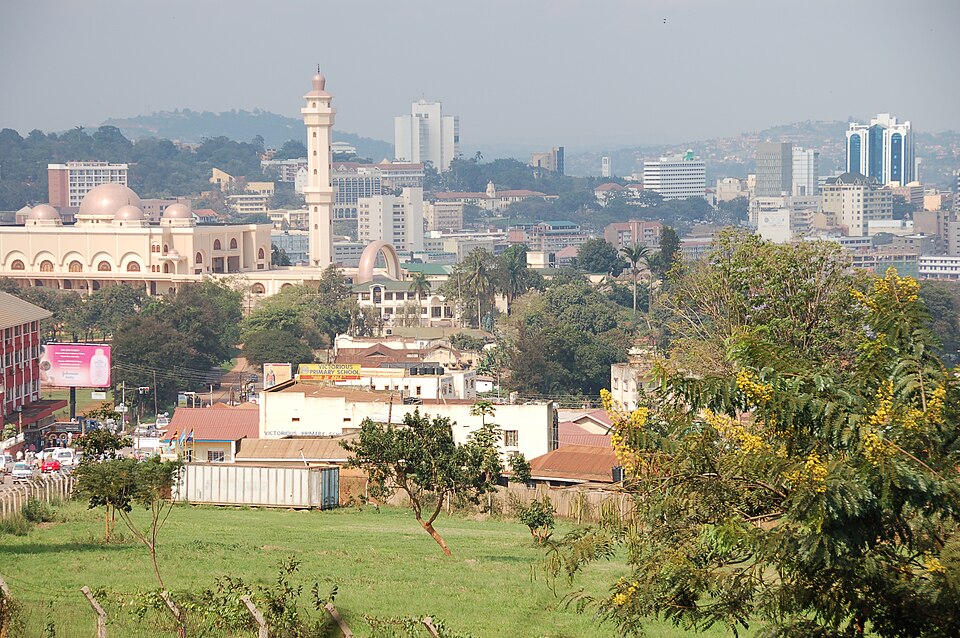
Correct — A, Kampala, Uganda. Every place completes one rotation in the same 24 hours, so what differs is the size of the circle each place travels. That circle is largest at the Equator and shrinks towards the poles, following the cosine of the latitude. Kampala lies almost exactly on the Equator, at roughly a third of a degree north, so it traces the biggest circle of the four and therefore has the greatest linear speed — close to the equatorial figure of about 1,670 km per hour.
Why the others are wrong
- (b)St. Petersburg, Russia — St. Petersburg lies near 60 degrees north, where the circle of latitude is about half the equatorial one, so its linear speed is roughly half that of Kampala.
- (c)Madrid, Spain — Madrid is near 40 degrees north; it is faster than the two Nordic cities but still well short of an equatorial city.
- (d)Stockholm, Sweden — Stockholm sits close to 59 degrees north, almost as far poleward as St. Petersburg, so it is among the slowest of the four.
Concept
Angular velocity is the same everywhere on the Earth — one full turn in about 24 hours. Linear or tangential velocity is the actual distance covered per unit time, and it depends on the radius of the circle of latitude a place sits on. That radius is the Earth's radius multiplied by the cosine of the latitude, so linear speed falls from a maximum at the Equator to zero at the poles.
The question hands you four cities instead of four latitudes, so the work is to recall roughly how far north each lies. Uganda is one of the countries the Equator runs through, which settles it immediately. The other three are all mid to high latitude European cities, and among them the ranking follows the same cosine rule — Madrid fastest, then Stockholm, then St. Petersburg.
Key facts
- The Earth's equatorial circumference is about 40,075 km, giving a surface speed near 1,670 km per hour at the Equator.
- Linear velocity at any latitude is approximately the equatorial speed multiplied by the cosine of that latitude.
- At 60 degrees latitude the cosine is 0.5, so the linear speed is about half the equatorial value.
- The Equator passes through Uganda, and Kampala lies just north of it; the linear velocity of rotation is zero at the poles.
Study next
Common traps
- Confusing angular velocity, which is the same everywhere, with linear velocity, which peaks at the Equator.
- Ranking the cities by how far east or west they lie — longitude has no effect on rotational speed.
A concept item dressed as a place-recall item; you need each city's approximate latitude, then the cosine rule.
Related PYQs
Inhabitants are unaware of the speed of rotation of the planet Earth because 1. the angular velocity is constant for each place on the Earth’s surface 2. the atmosphere rotates with the Earth 3. there are no nearby objects, either stationary or moving at a rate different from that of the Earth Which of the above is/are the correct explanation(s)?
- (a) 1 only
- (b) 1 and 2 only
- (c) 2 and 3 only
- (d) 1, 2 and 3
Answer(d) 1, 2 and 3
The companion item from the previous session, built on the same distinction between the Earth's constant angular velocity and the linear speed of its surface.
Practice
- practice — not a real PYQ
The linear velocity of rotation of the Earth's surface is zero at
- (a)the Equator
- (b)the Tropic of Cancer
- (c)the Arctic Circle
- (d)the poles
Answer(d) the poles — the circle of latitude shrinks to a point there, so the surface only pivots. - practice — not a real PYQ
Rocket launch sites are often located close to the Equator mainly because
- (a)the atmosphere is thinner there
- (b)the Earth's rotational speed gives the launch an extra boost
- (c)gravity is much weaker there
- (d)the magnetic field is absent there
Answer(b) the Earth's rotational speed gives the launch an extra boost — equatorial sites move fastest with the Earth's spin.