
An electric bulb is connected to 220 V generator. The current drawn is 600 mA. What is the power of the bulb?
- (a)132 W
- (b)13·2 W
- (c)1320 W
- (d)13200 W
Answer
Why
Correct — A, 132 W. Electrical power is the product of voltage and current, P = VI. The current must first be converted out of milliamperes, since 600 mA = 600 ÷ 1000 = 0·6 A. Then P = 220 V × 0·6 A = 132 W.
Why the others are wrong
- (b)13·2 W — 13·2 W is 220 × 0·06 — it comes from converting 600 mA into 0·06 A, slipping one decimal place in the milli-to-unit conversion.
- (c)1320 W — 1320 W is 220 × 6, which treats 600 mA as 6 A. That is ten times the actual current, and 1320 W would be a room heater, not a bulb.
- (d)13200 W — 13200 W is 220 × 60 — the current has been left effectively unconverted. 13·2 kW is more than a whole household's connected load, so the figure fails an order-of-magnitude check on sight.
Concept
Electrical power is the rate at which a device converts electrical energy, and for any device it equals the potential difference across it times the current through it, P = VI. For a purely resistive device such as a filament lamp, Ohm's law lets the same quantity be written P = I²R or P = V²/R. The SI unit is the watt, one joule per second.
This is a one-step calculation whose whole difficulty is unit handling — every wrong option here is the right formula with the wrong power of ten. Convert first and calculate second — 1 A = 1000 mA, so 600 mA is 0·6 A. A second defence is a plausibility check, because a domestic bulb draws well under an ampere and consumes tens to a couple of hundred watts; anything in the kilowatt range is a heater or a geyser, not a bulb.
Key facts
- Electrical power P = VI, with volts and amperes giving watts.
- 1 ampere = 1000 milliampere, so 600 mA = 0·6 A.
- For a resistive device the same power can be written P = I²R = V²/R.
- Electrical energy is power × time; a 132 W bulb burning for 10 hours uses 1·32 kWh, and one kWh is the 'unit' on an electricity bill.
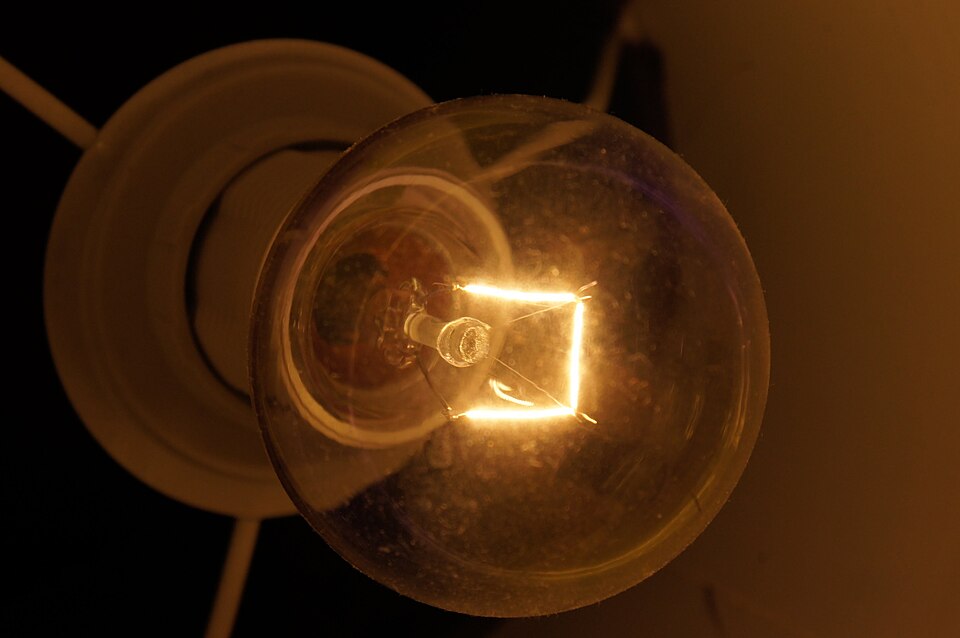
- An incandescent bulb turns only a small fraction of this 132 W into light — most of it leaves as heat from the tungsten filament.
Study next
Common traps
- Forgetting to convert milliamperes to amperes before multiplying.
- Reaching for P = I²R or V²/R when the resistance is not even given.
- Accepting a kilowatt-scale answer for an ordinary light bulb.
Any one of the three quantities can be hidden — power from V and I as here, current from a bulb's rating, or the new power when a rated bulb is run at a different voltage.
Related PYQs
Assertion (A): The temperature of a metal wire rises when an electric current is passed through it. Reason (R): Collision of metal atoms with each other releases heat energy.
- (a) Both A and R are true, and R is the correct explanation of A
- (b) Both A and R are true, but R is NOT a correct explanation of A
- (c) A is true, but R is false
- (d) A is false, but R is true
Answer(c) A is true, but R is false
The same electrical power, seen as heat. The 132 W this bulb draws is dissipated in its filament through electron–lattice collisions — the mechanism the UPSC assertion-reason item pins down.
What is the current required to light a 60 W incandescent bulb in a domestic supply of 240 V?
- (a) 0·5 A
- (b) 0·25 A
- (c) 1·0 A
- (d) 5·0 A
Answer(b) 0·25 A
The identical relation asked in reverse, in the earlier session of the same year. Here you find P from V and I; there you find I from P and V.
An electric bulb is rated as 220 V and 80 W. When it is operated on 110 V, the power rating would be :
- (a) 80 W
- (b) 60 W
- (c) 40 W
- (d) 20 W
Answer(d) 20 W
The next step up from this item. Once P = VI is comfortable, the examiner switches to P = V²/R and asks what happens when the supply voltage changes.
Practice
- practice — not a real PYQ
A heater draws 5 A from a 230 V supply. Its power consumption is
- (a)46 W
- (b)115 W
- (c)1150 W
- (d)11500 W
Answer(c) 1150 W — P = VI = 230 × 5. - practice — not a real PYQ
A 100 W lamp is run on a 250 V supply. The current through it is
- (a)0·4 A
- (b)2·5 A
- (c)4 A
- (d)25 A
Answer(a) 0·4 A — I = P/V = 100 ÷ 250.