
Which one of the following statements regarding a current-carrying solenoid is not correct?
- (a)The magnetic field inside the solenoid is uniform.
- (b)The current-carrying solenoid behaves like a bar magnet.
- (c)The magnetic field inside the solenoid increases with increase in current.
- (d)If a soft iron bar is inserted inside the solenoid, the magnetic field remains the same.
Answer
Why
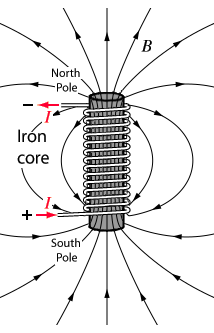
Correct — D, the claim that inserting a soft iron bar leaves the solenoid's field unchanged. That is the statement which is not correct, which is what the question asks for. A soft iron core does not leave the field as it was; it multiplies it. Iron has a high magnetic permeability, so it concentrates the magnetic flux and the field inside becomes B = μ₀μᵣnI in place of B = μ₀nI, where μᵣ for soft iron runs into the hundreds or thousands. This is exactly how an electromagnet is built — a coil wound on a soft iron core — and if the core made no difference, electromagnets would not work.
Why the others are wrong
- (a)The magnetic field inside the solenoid is uniform. — This statement is correct, so it cannot be the answer to a 'not correct' question. Well inside a long solenoid the field lines are straight, parallel and evenly spaced, giving the same magnitude and direction at every point.
- (b)The current-carrying solenoid behaves like a bar magnet. — Also correct. The field pattern outside a current-carrying solenoid is indistinguishable from that of a bar magnet, with one end acting as a north pole and the other as a south pole.
- (c)The magnetic field inside the solenoid increases with increase in current. — Also correct. From B = μ₀nI the field inside is directly proportional to the current, and also to the number of turns per unit length.
Concept
A solenoid is a long coil of insulated wire wound in close turns. When current flows, the fields of the individual turns reinforce one another along the axis and largely cancel outside, producing a strong, nearly uniform field inside and a bar-magnet-like pattern outside. The field inside a long solenoid is B = μ₀nI, where n is the number of turns per unit length. Putting a ferromagnetic core inside multiplies this by the material's relative permeability.
Three of the four statements are the standard textbook facts about a solenoid, so the item is really testing one thing — what a soft iron core actually does. It strengthens the field, and by a large factor. Soft iron is chosen for the core rather than steel because it magnetises strongly but loses that magnetism the moment the current is switched off, which is what a controllable electromagnet needs; steel retains its magnetism and is therefore used for permanent magnets. Reading the stem is as important as the physics here, since the question asks for the statement that is not correct.
Key facts
- The magnetic field well inside a long current-carrying solenoid is uniform and is given by B = μ₀nI, where n is the number of turns per unit length.
- A current-carrying solenoid produces the same external field pattern as a bar magnet, with a north pole at one end and a south pole at the other.
- Inserting a soft iron core greatly increases the field inside, because the iron's high permeability multiplies the flux density.
- Soft iron is used for electromagnet cores because it loses its magnetism when the current stops, whereas steel retains it and is used for permanent magnets.
Study next
Common traps
- Missing the word 'not' in the stem and marking one of the three correct statements.
- Believing that a core merely guides the field rather than strengthening it.
A 'which statement is NOT correct' item in which three claims are standard textbook facts and one inverts the role of the iron core.
Related PYQs
The magnetic field produced by a current-carrying straight wire at a point outside the wire depends
- (a) inversely on the distance from it
- (b) directly on the distance from it
- (c) inversely at short distances and directly at large distances from it
- (d) directly on the distance (at short distances) and inversely on the distance (at long distances) from it
Answer(a) inversely on the distance from it
The same chapter on the magnetic effects of electric current, six months earlier. That item tests the field of a single straight conductor; this one tests what happens when the conductor is wound into a coil and given an iron core.
Which one of the following statements regarding magnetic field is NOT correct ?
- (a) Magnetic field is a quantity that has direction and magnitude
- (b) Magnetic field lines are closed curves
- (c) Magnetic field lines are open curves
- (d) No two magnetic field lines are found to cross each other
Answer(c) Magnetic field lines are open curves
The identical question format on the same topic — three true statements about magnetic fields and one inverted claim, with the stem asking for the one that is not correct.
Practice
- practice — not a real PYQ
The magnetic field inside a long current-carrying solenoid is doubled if
- (a)the current through it is halved
- (b)the number of turns per unit length is doubled
- (c)the radius of the solenoid is doubled
- (d)the length is doubled while the total number of turns is unchanged
Answer(b) the number of turns per unit length is doubled — B = μ₀nI, so B is proportional to n. - practice — not a real PYQ
A soft iron core rather than a steel core is used in an electromagnet because soft iron
- (a)is cheaper than steel
- (b)conducts electricity better than steel
- (c)loses its magnetism as soon as the current is switched off
- (d)has a lower magnetic permeability than steel
Answer(c) loses its magnetism as soon as the current is switched off — that is what makes the magnet controllable.