
Which one of the following battles could be seen as laying the formal foundation of the British Raj in India?
- (a)Third Battle of Panipat
- (b)Battle of Plassey
- (c)Battle of Buxar
- (d)Revolt of 1857
Answer
Why
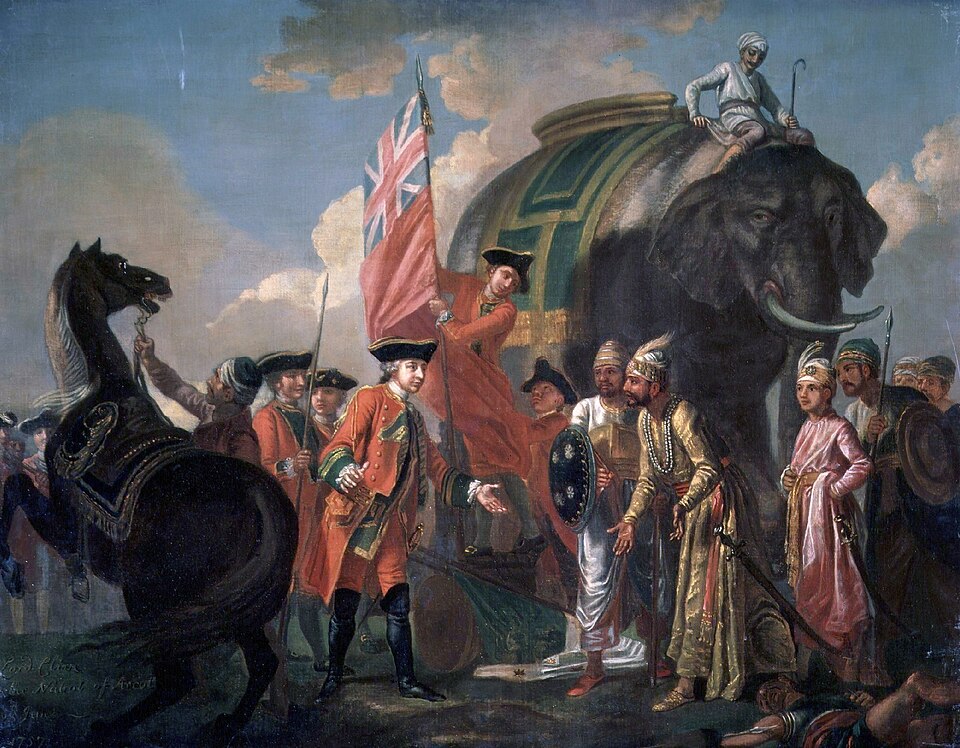
Correct — B, Battle of Plassey. On 23 June 1757 Robert Clive's East India Company force defeated Siraj-ud-Daulah, the Nawab of Bengal, at Plassey. The victory owed less to fighting than to a conspiracy — Mir Jafar, the Nawab's own commander, had come to terms with the English beforehand and held his troops back. Clive then installed Mir Jafar as Nawab. From that moment the Company could decide who ruled the richest province in India and could draw money out of it at will, which is why the standard formulation, and the official key here, treat Plassey as the battle that laid the foundation of British rule in India.
Why the others are wrong
- (a)Third Battle of Panipat — Fought in 1761 between Ahmad Shah Abdali and the Marathas, with the English not a party to it. It crippled Maratha power and so indirectly cleared a rival out of the Company's path, but it founded nothing British.
- (c)Battle of Buxar — A genuine contender, and the reason many students lose this mark. Buxar in 1764 defeated the combined armies of Mir Qasim, Shuja-ud-Daulah of Awadh and the Mughal emperor Shah Alam II, and it led directly to the grant of the Diwani of Bengal, Bihar and Odisha in 1765. But Buxar is conventionally described as confirming and consolidating what Plassey had begun, and the official key marks Plassey for the word 'foundation'.
- (d)Revolt of 1857 — Not a battle that founded anything — it was a rebellion against a power already a century old, and its outcome was the transfer of Indian government from the Company to the British Crown in 1858. It marks the end of Company rule, not its beginning.
Concept
British territorial power in India grew out of a short chain of events in Bengal. Plassey in 1757 gave the Company the ability to make and unmake the Nawab; Buxar in 1764 defeated a wider coalition and destroyed any prospect of a rival authority; and the Diwani grant of 1765 gave the Company the legal right to collect the revenue of Bengal, Bihar and Odisha. Trading company became revenue state in eight years.
Examiners separate Plassey and Buxar with a specific verb, and reading it carefully is the whole skill here. Plassey is said to have laid the foundation of British rule; Buxar is said to have confirmed or consolidated it and to have produced the Diwani. So if a question asks which battle gave the Company the legal right to collect revenue, the answer is Buxar through the 1765 grant; if it asks which laid the foundation, as this one does, the answer is Plassey. There is an honest historical argument that Buxar mattered more in military terms, since Plassey was won by defection rather than by force of arms — but the official key for this paper marks Plassey, and that is the answer to carry into the exam hall.
Key facts
- The Battle of Plassey was fought on 23 June 1757 between Robert Clive's Company force and Siraj-ud-Daulah, Nawab of Bengal.
- Mir Jafar, the Nawab's commander, had conspired with the English and withheld his troops; he was installed as Nawab after the victory.
- The Battle of Buxar in 1764 was fought against the combined armies of Mir Qasim, Shuja-ud-Daulah of Awadh and the Mughal emperor Shah Alam II.
- The settlement after Buxar gave the Company the Diwani of Bengal, Bihar and Odisha in 1765 — the right to collect land revenue.
Study next
Common traps
- Swapping Plassey and Buxar — check whether the stem says 'foundation' or says 'Diwani' and 'confirmed'.
- Assuming the British fought at the Third Battle of Panipat; that battle was Abdali against the Marathas.
Either a one-line 'which battle founded British rule' item or a chronology and matching set drawn from Ambur, Plassey, Wandiwash and Buxar.
Related PYQs
Which one of the following is the correct chronological order of the battles fought in India in the 18th Century?
- (a) Battle of Wandawash - Battle of Buxar - Battle of Ambur - Battle of Plassey
- (b) Battle of Ambur - Battle of Plassey - Battle of Wandawash - Battle of Buxar
- (c) Battle of Wandawash - Battle of Plassey - Battle of Ambur - Battle of Buxar
- (d) Battle of Ambur - Battle of Buxar - Battle of Wandawash - Battle of Plassey
Answer(b) Battle of Ambur - Battle of Plassey - Battle of Wandawash - Battle of Buxar
The same eighteenth-century sequence, tested as chronology. Ambur 1749, Plassey 1757, Wandiwash 1760, Buxar 1764 — holding those four dates settles both this UPSC item and the Plassey-versus-Buxar choice in the NDA question.
Consider the following statements: 1. In the Third Battle of Panipat, Ahmed Shah Abdali defeated Ibrahim Lodi. 2. Tipu Sultan was killed in the Third Anglo-Mysore War. 3. Mir Jafar entered in a conspiracy with the English for the defeat of Nawab Siraj-ud-daulah in the Battle of Plassey.
- (a) 1, 2 and 3
- (b) 3 only
- (c) 2 and 3
- (d) None
Answer(b) 3 only
Confirms the two facts this NDA question rests on — Mir Jafar's conspiracy at Plassey, and that the Third Battle of Panipat was Abdali against the Marathas, not a British affair.
Practice
- practice — not a real PYQ
The Diwani of Bengal, Bihar and Odisha was granted to the East India Company in 1765 following its victory in the
- (a)Battle of Plassey
- (b)Battle of Buxar
- (c)Battle of Wandiwash
- (d)Third Battle of Panipat
Answer(b) Battle of Buxar — the 1764 victory led to the Diwani grant by Shah Alam II in 1765. - practice — not a real PYQ
Who was the Nawab of Bengal defeated by the English at the Battle of Plassey in 1757?
- (a)Mir Jafar
- (b)Mir Qasim
- (c)Siraj-ud-Daulah
- (d)Alivardi Khan
Answer(c) Siraj-ud-Daulah — Mir Jafar was his commander who defected and was made Nawab afterwards.