
Which one of the following was composed by Harishena?
- (a)Nashik Inscription of Gautami Balashri
- (b)Prayaga Prashasti of Samudragupta
- (c)Deopara Prashasti of Vijayasena
- (d)Hathigumpha Inscription of Kharavela
Answer
Why
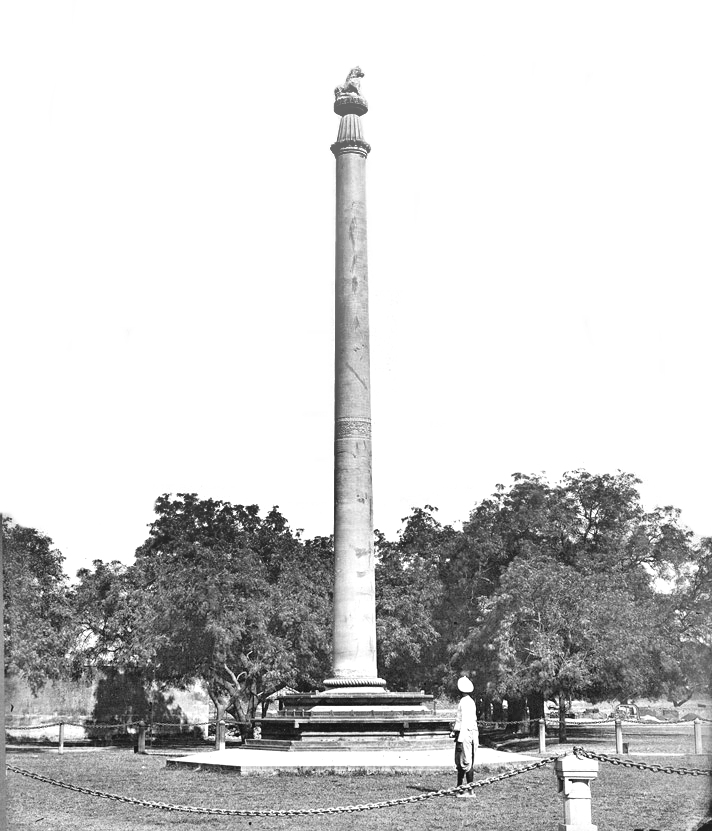
Correct — B, Prayaga Prashasti of Samudragupta. Harishena was a poet and high officer in the court of the Gupta emperor Samudragupta, and he composed the eulogy engraved on the stone pillar at Prayagraj (Allahabad) that we call the Prayaga Prashasti or Allahabad Pillar inscription. It is written in polished Sanskrit, mixing verse and prose, and catalogues Samudragupta's campaigns against the kings of the Ganga plain, the rulers of the south and the frontier states. The pillar it is carved on is itself older — it already carried Ashoka's pillar edicts — which is why the same shaft is claimed by two different eras of Indian history.
Why the others are wrong
- (a)Nashik Inscription of Gautami Balashri — This cave inscription at Nashik was issued in the name of Gautami Balashri, mother of the Satavahana king Gautamiputra Satakarni, and belongs to the Satavahana Deccan, not the Gupta court. Harishena had nothing to do with it.
- (c)Deopara Prashasti of Vijayasena — The Deopara Prashasti was composed by Umapati Dhara, a poet and minister at the Sena court of Bengal; it praises the Sena king Vijayasena. Wrong composer, wrong dynasty and wrong region.
- (d)Hathigumpha Inscription of Kharavela — The Hathigumpha inscription is carved in the Udayagiri hills near Bhubaneswar and records the reign of the Kalinga king Kharavela in Prakrit. It is centuries earlier than the Guptas and carries no attribution to Harishena.
Concept
A prashasti is a formal eulogy of a ruler, usually commissioned by a court and composed by a named poet, then engraved on stone or copper. Because these texts name their author, their patron and the king's achievements, they are among the most useful sources for reconstructing dynastic history. The catch is that they are praise literature, so their claims about conquests have to be read critically.
The fastest route to the answer is to anchor Harishena to a dynasty. He belongs to the Gupta court of Samudragupta, and only one option names a Gupta ruler. The other three each carry their own dynastic marker — Gautami Balashri points to the Satavahanas, Vijayasena to the Senas of Bengal, and Kharavela to Kalinga — so recognising any one of them clears an option immediately.
Key facts
- Harishena composed the Prayaga Prashasti of Samudragupta, engraved on the pillar that now stands inside Allahabad Fort at Prayagraj.
- The same pillar also carries Ashoka's pillar edicts from the third century BCE and a later Persian inscription from Jahangir's reign.
- The Deopara Prashasti, which praises the Sena king Vijayasena, was composed by Umapati Dhara, a minister at the court of Lakshmana Sena.
- The Nashik cave inscription was issued in the name of Gautami Balashri, mother of the Satavahana ruler Gautamiputra Satakarni.
Study next
Common traps
- Confusing the ruler who commissioned an inscription with the poet who composed it.
- Assuming everything on the Allahabad pillar is Ashokan — the pillar is Ashokan, but the Prayaga Prashasti carved on it is Gupta.
Either a one-line 'who composed this inscription' item or a match-list pairing inscriptions with dynasties, rulers or composers.
Related PYQs
The Allahabad Pillar inscription is associated with which one of the following?
- (a) Mahapadma Nanda
- (b) Chandragupta Maurya
- (c) Ashoka
- (d) Samudragupta
Answer(d) Samudragupta
Same inscription from the other side. UPSC asked which ruler the Allahabad pillar inscription is associated with; NDA asks who composed it. The pair to hold in memory is Harishena, the poet, and Samudragupta, the patron.
Who among the following composed the 'Prayag Prashasti' of Samudragupta ?
- (a) Harishena
- (b) Chand Bardai
- (c) Vishakhadatta
- (d) Kalidasa
Answer(a) Harishena
The identical fact, asked the other way round six months later. NDA-I 2023 gave the inscription and asked for the composer; NDA-II 2022 gave the composer and asked for the inscription.
Practice
- practice — not a real PYQ
The Aihole inscription, a prashasti of the Chalukya ruler Pulakeshin II, was composed by
- (a)Harishena
- (b)Ravikirti
- (c)Umapati Dhara
- (d)Banabhatta
Answer(b) Ravikirti — the Jain poet at Pulakeshin II's court who composed the Aihole prashasti. - practice — not a real PYQ
The Hathigumpha inscription in the Udayagiri hills of Odisha records the reign of
- (a)Rudradaman I
- (b)Kharavela
- (c)Gautamiputra Satakarni
- (d)Samudragupta
Answer(b) Kharavela — the Kalinga ruler whose Prakrit record is carved at Hathigumpha.