
The refractive index of crown glass is close to 3/2. If the speed of light in air is c, then the speed of light in the crown glass will be close to
- (a)(3/2)c
- (b)(4/9)c
- (c)(2/3)c
- (d)(9/4)c
Answer
Why
Correct — C, (2/3)c. The refractive index of a medium is defined as the speed of light in vacuum, taken here as its speed c in air, divided by the speed of light in that medium, so n = c/v. Rearranging gives v = c/n, and with n = 3/2 that is v = c ÷ (3/2) = (2/3)c. In round numbers, light travels through crown glass at about two-thirds of its speed in air, roughly 2 × 10⁸ metres per second. The refractive index is greater than one for every ordinary transparent medium, so the speed inside must always come out smaller than c.
Why the others are wrong
- (a)(3/2)c — This multiplies by the refractive index instead of dividing by it, and the result would be one and a half times the speed of light in air — faster inside glass than outside, which is physically impossible.
- (b)(4/9)c — This is c divided by n², that is c ÷ (9/4). Refractive index enters the speed relation to the first power, not squared, so the reduction is by 3/2 and not by 9/4.
- (d)(9/4)c — This is c multiplied by n², compounding both errors — squaring the index and multiplying rather than dividing. It gives a speed more than twice c, which no medium can produce.
Concept
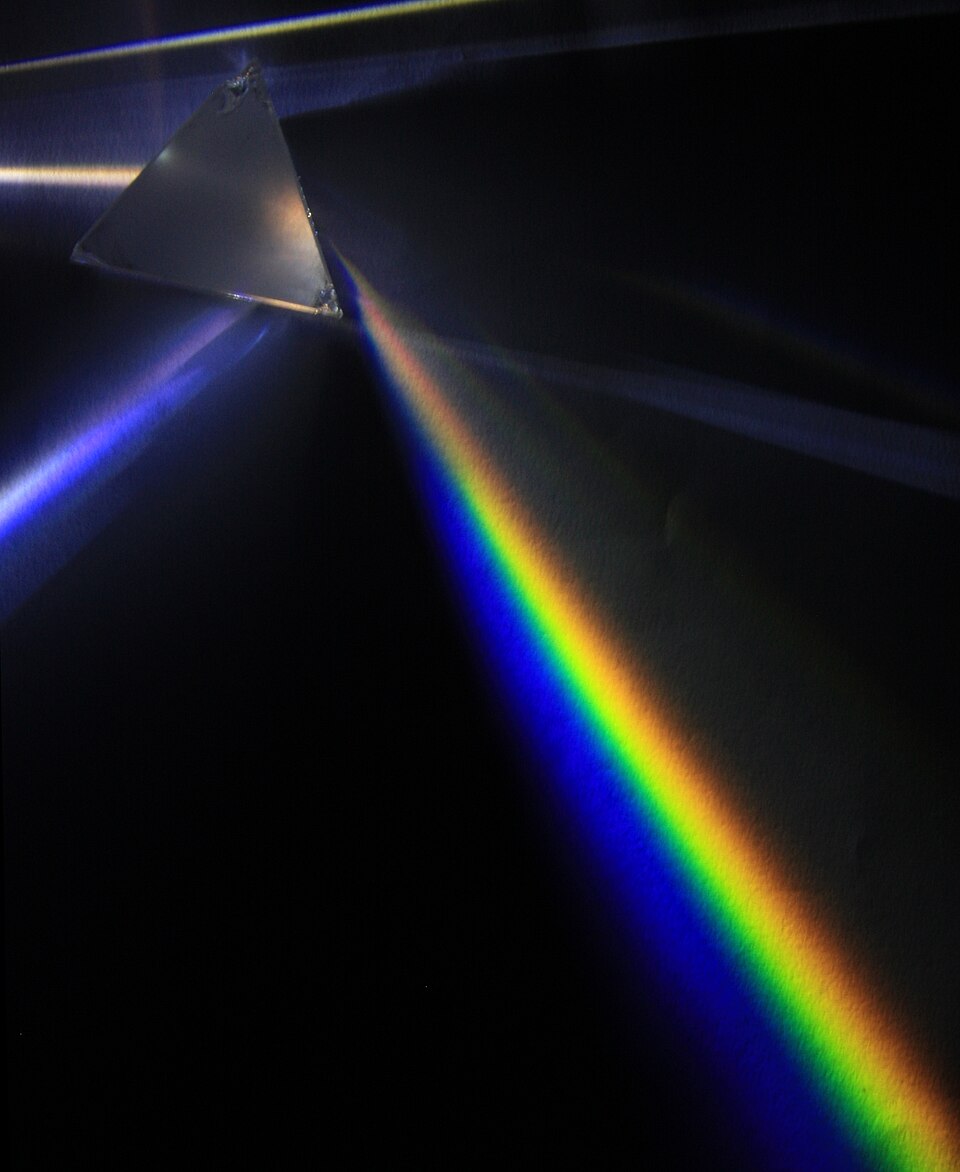
Light travels fastest in vacuum, and in any material medium it slows down. The refractive index n of a medium is precisely the ratio of the two speeds, n = c/v, so a larger index means a slower speed inside. That slowing is what makes light bend at a boundary — the wavefront entering the denser medium at an angle is held back on one side and swings round, which is refraction. Crown glass has an index near 1.5, water about 1.33, and diamond about 2.42, which is why diamond bends and traps light so strongly and sparkles.
The whole item is one rearrangement, so the only real risk is inverting it. Two sanity checks catch every wrong option here. Light cannot travel faster in glass than in air, which kills both options greater than c. And the index appears to the first power, so the answer must be the simple reciprocal 2/3 rather than anything involving 9/4. It also helps to remember that the frequency of light does not change when it enters glass; the speed and the wavelength both fall by the factor n, which is why the colour does not change on entering a window pane.
Key facts
- Refractive index is defined as n = c/v, the speed of light in vacuum divided by its speed in the medium.
- Rearranged, the speed in the medium is v = c/n, so a higher index always means a slower speed.
- With n = 3/2 for crown glass, light travels at (2/3)c inside it, roughly 2 × 10⁸ m/s.
- Water has a refractive index of about 1.33 and diamond about 2.42, so light is slowest of the three in diamond.
Study next
Common traps
- Multiplying by the refractive index instead of dividing, which gives a speed greater than c.
- Squaring the index; it enters the speed relation to the first power.
- Assuming a bigger refractive index means faster light — it means slower.
As a one-step numerical like this, as a comparison of speeds in two named media, or as an assertion-and-reason pair about why diamond sparkles.
Related PYQs
Assertion (A): A diamond sparkles more than a glass imitation cut to the same shape. Reason (R): The refractive index of diamond is less than that of glass.
- (a) Both A and R are true, and R is the correct explanation of A
- (b) Both A and R are true, but R is not a correct explanation of A
- (c) A is true, but R is false
- (d) A is false, but R is true
Answer(c) A is true, but R is false
The same quantity, tested for direction rather than arithmetic. Diamond's index of about 2.42 is far higher than glass's 1.5, so light is slowed and bent more in diamond — the reason statement inverts exactly the relation the NDA item asks you to apply.
The refractive index of fused quartz is 1.46 and that of sapphire is 1.77. If vq is the speed of light in quartz and vs is the speed of light in sapphire, then which one of the following relationships is correct?
- (a) vq > vs
- (b) vs > vq
- (c) vs = vq
- (d) vs = vq/2
Answer(a) vq > vs
The same formula asked qualitatively. NDA 2020 wants only the inequality that follows from v = c/n; NDA-II 2022 asks you to put a number through the identical relation.
Practice
- practice — not a real PYQ
Light travels slowest in which of the following media?
- (a)Air
- (b)Water
- (c)Crown glass
- (d)Diamond
Answer(d) Diamond — it has the highest refractive index of the four, about 2.42, and v = c/n. - practice — not a real PYQ
The refractive index of a medium in which light travels at half its speed in vacuum is
- (a)0.5
- (b)1.5
- (c)2
- (d)4
Answer(c) 2 — from n = c/v with v = c/2.