
The formation of ‘tors’ on small rocky hills is associated with which among the following?
- (a)Granite
- (b)Limestone
- (c)Alluvial
- (d)Dolomite
Answer
Why
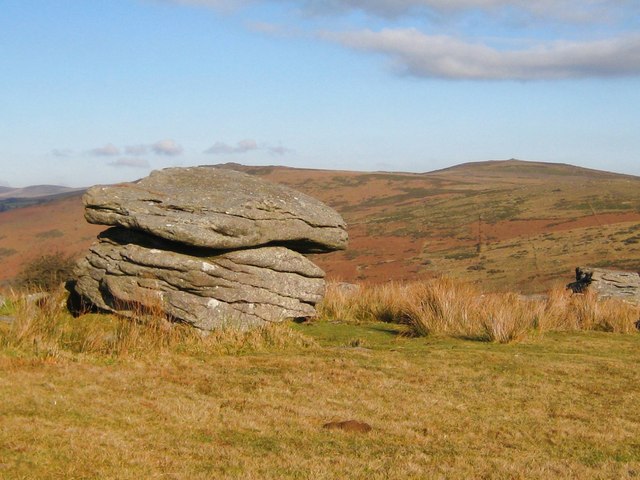
Correct — A, Granite. A tor is a free-standing pile or block of rock left standing abruptly above the smooth rounded summit of a hill, and tors are most commonly formed in granite. Granite cools deep underground and develops a rectangular pattern of joints. Where those joints are closely spaced, water penetrating along them rots the rock chemically into a sandy debris; where the joints happen to be widely spaced, the block between them survives. When the rotted debris is later stripped away by rain wash or by soil creep, the surviving core blocks stand out as tors, their edges rounded by weathering along the joint faces.
Why the others are wrong
- (b)Limestone — Limestone dissolves in weakly acidic rainwater, and that produces karst landforms — sinkholes, caverns, stalactites, underground streams, limestone pavement. Solution removes the rock instead of leaving residual blocks, so a limestone landscape gives caves, not tors.
- (c)Alluvial — Alluvium is loose river-deposited sediment. It has no joint pattern and no coherent blocks to leave behind, so it cannot produce a standing residual outcrop of any kind; alluvial country gives levees, meanders, terraces and deltas.
- (d)Dolomite — Dolomite is a carbonate rock and weathers essentially the way limestone does, by solution. It belongs to the karst family of landforms rather than to the joint-block family that produces tors.
Concept
Every rock type leaves its own fingerprint on the landscape, because the dominant weathering process is set by the rock's chemistry and its joint pattern. Coarse crystalline granite weathers mainly along joints and by granular disintegration, giving rounded boulders, exfoliation domes, inselbergs and tors. Carbonate rocks such as limestone and dolomite weather by solution, giving karst. Unconsolidated alluvium is not weathered into landforms at all; it is deposited and then reworked by the river.
Read the question as asking which rock type leaves blocks standing when everything around it has rotted away. That immediately rules out the two carbonates, because solution takes rock away rather than leaving residuals, and rules out alluvium, which was never solid rock. Granite is the only candidate that both has the joint geometry and resists removal once the weathered debris is stripped. Tors are best known from Dartmoor in south-west England, and comparable granite tor country occurs on the Indian peninsula, for instance in the granite hills around Hyderabad. Tors also form in a few other jointed rocks such as schist, dolerite and coarse sandstone, but granite is the type case and the one exams intend.
Key facts
- A tor is a free-standing rock outcrop rising abruptly from the smooth rounded summit or ridge crest of a hill.
- Tors are most commonly granite, though schist, dolerite, ignimbrite and coarse sandstone can also produce them.
- They survive where joints in the rock are unusually widely spaced, so that core blocks resist the deep weathering that destroys closely jointed rock around them.
- Limestone and dolomite weather chiefly by solution and give karst landforms — sinkholes, caverns and underground drainage — rather than tors.
Study next
Common traps
- Choosing limestone because it is the rock type most associated with dramatic weathering landforms; solution gives caves, not tors.
- Treating dolomite as a different family from limestone — both are carbonates and both give karst.
- Forgetting that the tor itself is a residual, so the process must remove the surrounding rock and leave this one standing.
As a landform-to-rock match, as part of a weathering-process item, or inside a statement set on granite landforms such as inselbergs and exfoliation domes.
Related PYQs
The black cotton soil of India has been formed due to the weathering of
- (a) brown forest soil
- (b) fissure volcanic rock
- (c) granite and achist
- (d) shale and limestone
Answer(b) fissure volcanic rock
The same rule read the other way. UPSC asks which parent rock weathers into a given soil, NDA asks which parent rock weathers into a given landform — in both cases the answer follows from the chemistry and joint pattern of the rock.
Which one of the following is not an igneous rock ?
- (a) Granite
- (b) Slate
- (c) Basalt
- (d) Gabbro
Answer(b) Slate
Granite's identity as a coarse intrusive igneous rock is what gives it the deep rectangular joints. Recognise it as igneous first, and the tor question follows from the joint pattern.
Practice
- practice — not a real PYQ
Sinkholes, caverns and underground drainage are characteristic landforms of
- (a)granite country
- (b)limestone country
- (c)alluvial plains
- (d)basalt plateaus
Answer(b) limestone country — karst landforms are produced by solution of carbonate rock in weakly acidic rainwater. - practice — not a real PYQ
The peeling away of curved rock shells from a granite dome is called
- (a)solution
- (b)exfoliation
- (c)deflation
- (d)abrasion
Answer(b) exfoliation — the outer layers of the rock expand and flake off, rounding the outcrop.