
The book, Kalila wa Dimna is an Arabic translation of the
- (a)Hitopadesha
- (b)Panchatantra
- (c)Suryasiddhanta
- (d)Kathasaritsagar
Answer
Why
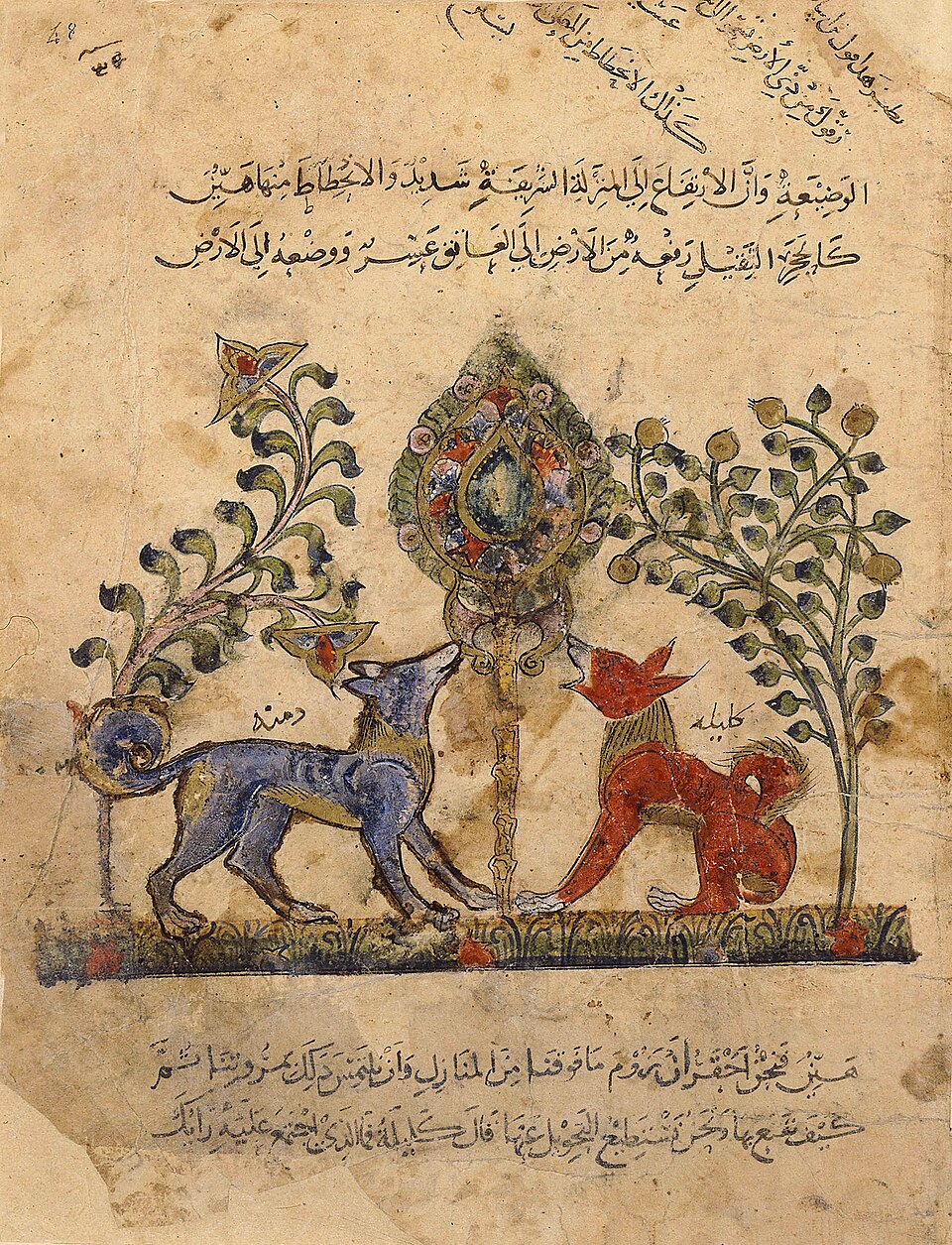
Correct — B, Panchatantra. Kalila wa Dimna is the Arabic version of the Sanskrit Panchatantra, produced by Ibn al-Muqaffa around 750 CE. It did not come straight from Sanskrit: a Persian physician, Borzuy, had first rendered the text into Middle Persian in the sixth century, and Ibn al-Muqaffa worked from that. The title itself is the proof of descent — Kalila and Dimna are the Persian and Arabic forms of Karataka and Damanaka, the two jackals of the Panchatantra's first book, whose names came to stand for the whole collection.
Why the others are wrong
- (a)Hitopadesha — The Hitopadesha is a later Sanskrit collection of animal fables in the same didactic tradition, and it is the sharpest distractor because it looks so much like the Panchatantra in form. But the Arabic Kalila wa Dimna traces to the Panchatantra, and the two jackals whose names give the Arabic book its title come from the Panchatantra's frame story.
- (c)Suryasiddhanta — The Suryasiddhanta is a Sanskrit treatise on astronomy, dealing with planetary motion and calculation. It is not a story collection at all, so it could not be the source of a book of talking-animal fables.
- (d)Kathasaritsagar — The Kathasaritsagara is a vast Sanskrit collection of tales compiled by Somadeva of Kashmir between 1063 and 1081 CE. It is far too late — the Arabic Kalila wa Dimna already existed by about 750 CE, roughly three centuries earlier.
Concept
The Panchatantra is a Sanskrit collection of interlinked animal fables framed as instruction in niti, the practical art of conduct and statecraft, given to three dull princes. Its prelude names a Brahmin, Vishnusharma, as the author, though scholars treat this as a fictitious attribution, and the current scholarly consensus places the text around 300 CE. It travelled further than almost any other Indian book, passing through Middle Persian and Arabic into Syriac, Greek, Hebrew, Latin and the modern European languages.
This question rewards knowing a transmission chain rather than a single fact, and the chain is short enough to memorise: Sanskrit Panchatantra, then Middle Persian by Borzuy in the sixth century, then Arabic as Kalila wa Dimna by Ibn al-Muqaffa around 750 CE. Both the Sanskrit manuscript that Borzuy used and his Persian version are lost, which is why the Arabic text is the pivotal surviving link for the whole later tradition. If the chain does not come to mind in the hall, the title is the clue — a book named after two jackals must come from the collection whose first and longest book is the story of those two jackals.
Key facts
- Kalila wa Dimna is the Arabic version of the Panchatantra, made by Ibn al-Muqaffa around 750 CE.
- It was translated from a Middle Persian version produced by the physician Borzuy in the sixth century, not directly from Sanskrit.
- Kalila and Dimna are the altered forms of Damanaka and Karataka, the two jackals of the Panchatantra's first book.
- The Panchatantra's prelude attributes it to Vishnusharma, and scholarly consensus places the work around 300 CE.
- The Kathasaritsagara is a separate Sanskrit collection, compiled by Somadeva of Kashmir between 1063 and 1081 CE.
Study next
Common traps
- Choosing the Hitopadesha because it is also a collection of animal fables in Sanskrit.
- Assuming the Arabic version was made directly from Sanskrit — it came through Middle Persian.
- Placing the Kathasaritsagara early; it is an eleventh-century compilation, later than the Arabic text.
As this source-of-a-translation item, as an author-and-work matching list, or as a chronology question ordering Sanskrit literary works.
Related PYQs
"YogaVasistha" was translated into Persian by Nizamuddin Panipati during the reign of:
- (a) Akbar
- (b) Humayun
- (c) Shahjahan
- (d) Aurangzeb
Answer(a) Akbar
The same theme of Sanskrit texts crossing into another language, tested in the same year. One asks which Sanskrit work lies behind an Arabic book, the other under which ruler a Sanskrit work was rendered into Persian — both reward keeping a short list of famous translations and their agents.
Who among the following was the author of the famous Sanskrit work 'Mrichchhakatika'?
- (a) Kalidasa
- (b) Bhasa
- (c) Valmiki
- (d) Shudraka
Answer(d) Shudraka
The NDA paper's standing habit of asking one Sanskrit-literature identification a session. Whether the demand is an author or the source of a translation, the preparation is the same — hold a compact list of the classical Sanskrit works with their authors and dates.
Practice
- practice — not a real PYQ
The Panchatantra is traditionally attributed to
- (a)Somadeva
- (b)Vishnusharma
- (c)Bhasa
- (d)Banabhatta
Answer(b) Vishnusharma — the prelude names him as the Brahmin who composed the fables to instruct three princes, though scholars regard the attribution as fictitious. - practice — not a real PYQ
The Kathasaritsagara, a large Sanskrit collection of tales, was compiled by
- (a)Kalidasa
- (b)Somadeva
- (c)Ibn al-Muqaffa
- (d)Vishakhadatta
Answer(b) Somadeva — a Shaiva Brahmin of Kashmir who compiled it in the eleventh century.