
Which one of the following salts does not possess water of crystallization?
- (a)Potassium permanganate
- (b)Blue vitriol
- (c)Washing soda
- (d)Mohr's salt
Answer
Why
Correct — A, potassium permanganate. Potassium permanganate is KMnO₄, an anhydrous salt whose formula carries no water molecules at all, so it has no water of crystallization. Each of the other three is a textbook hydrate with its water written after a dot in the formula — blue vitriol is CuSO₄·5H₂O, washing soda is Na₂CO₃·10H₂O, and Mohr's salt is FeSO₄·(NH₄)₂SO₄·6H₂O.
Why the others are wrong
- (b)Blue vitriol — Blue vitriol is hydrated copper sulphate, CuSO₄·5H₂O, with five molecules of water of crystallization. Heating drives that water off and the blue crystals turn white; adding water brings the blue back.
- (c)Washing soda — Washing soda is sodium carbonate decahydrate, Na₂CO₃·10H₂O — ten water molecules for every formula unit, the largest count among the common school hydrates.
- (d)Mohr's salt — Mohr's salt is ferrous ammonium sulphate hexahydrate, FeSO₄·(NH₄)₂SO₄·6H₂O, a double salt carrying six molecules of water of crystallization.
Concept
Water of crystallization is the fixed number of water molecules chemically bound into one formula unit of a crystalline salt. It is written after a dot in the formula, and it is responsible for the shape of the crystals and often for their colour. Heating a hydrate expels this water and leaves the anhydrous salt behind, a change that is usually reversible when water is added again.
Three of the four names in this list are famous precisely because of their water content, which makes the odd one out identifiable even without recalling the formulas — blue vitriol, washing soda and Mohr's salt are the standard hydrate examples in school chemistry, while potassium permanganate is met as a purple oxidising agent and disinfectant and never as a hydrate. The blue-to-white colour change of copper sulphate on heating is the classic laboratory demonstration of water of crystallization, and the reverse change is used as a test for the presence of water.
Key facts
- Water of crystallization is the fixed number of water molecules present in one formula unit of a crystalline salt.
- Blue vitriol is CuSO₄·5H₂O; heating turns the blue crystals white, and adding water restores the blue.
- Washing soda is Na₂CO₃·10H₂O, and gypsum is CaSO₄·2H₂O.
- Mohr's salt, FeSO₄·(NH₄)₂SO₄·6H₂O, is a double salt with six molecules of water of crystallization.
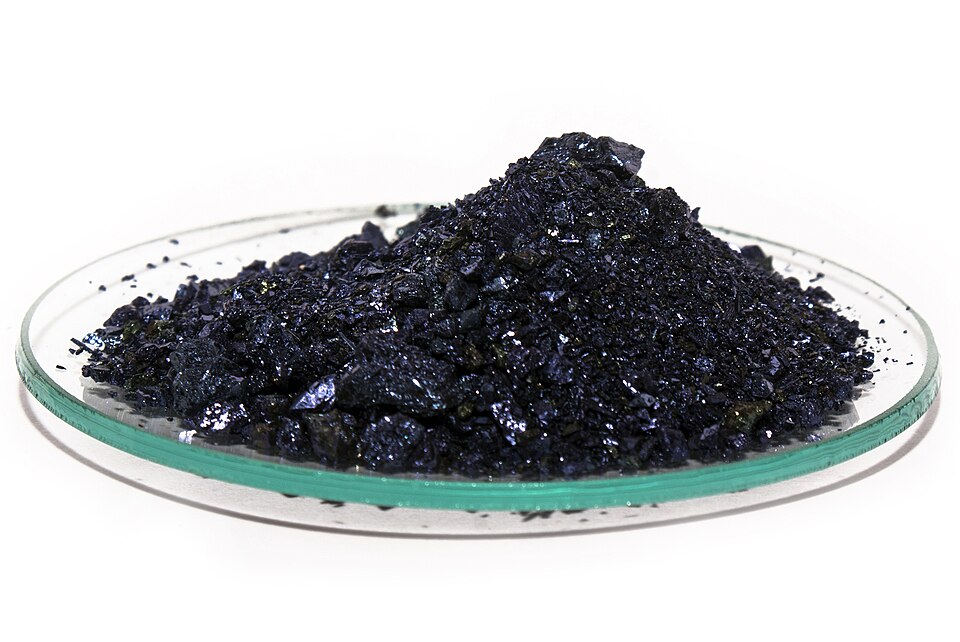
- Potassium permanganate, KMnO₄, is anhydrous — a dark purple oxidising agent used as a disinfectant.
Study next
Common traps
- Assuming every salt with a familiar household name must be a hydrate.
- Mixing up gypsum, CaSO₄·2H₂O, with Plaster of Paris, CaSO₄·½H₂O.
- Reading 'does not possess' too fast and choosing the best-known hydrate instead.
As this odd-one-out, or as a counting item asking how many water molecules a named hydrate carries.
Related PYQs
Match List I with List II and select the correct answer by using the codes given below the lists: List I — I. Blue vitriol, II. Epsom salt, III. Baking soda, IV. Caustic soda; List II — A) Sodium bicarbonate, B) Sodium hydroxide, C) Magnesium sulphate, D) Copper sulphate
- (a) I-C, II-D, III-B, IV-A
- (b) I-D, II-C, III-A, IV-B
- (c) I-C, II-D, III-A, IV-B
- (d) I-D, II-A, III-B, IV-A
Answer(b) I-D, II-C, III-A, IV-B
UPSC prelims tested the same common-name-to-chemical-name mapping, with blue vitriol appearing there too — knowing that blue vitriol is copper sulphate is what unlocks both questions.
Number of molecules of water of crystallization in copper sulphate, sodium carbonate and Gypsum are
- (a) 5, 10 and 2 respectively
- (b) 10, 2 and 5 respectively
- (c) 5, 2 and 10 respectively
- (d) 2, 5 and 10 respectively
Answer(a) 5, 10 and 2 respectively
The 2020 GAT asked for the actual counts rather than the odd one out, using two of the very same salts — so the hydrate formulas learned for one paper answer the other.
Practice
- practice — not a real PYQ
The number of molecules of water of crystallization present in washing soda is
- (a)2
- (b)5
- (c)7
- (d)10
Answer(d) 10 — washing soda is sodium carbonate decahydrate, Na₂CO₃·10H₂O. - practice — not a real PYQ
On strong heating, blue crystals of copper sulphate turn white because
- (a)copper sulphate decomposes into copper oxide
- (b)the water of crystallization is driven off
- (c)the crystals are oxidised by the air
- (d)sulphur trioxide is absorbed from the air
Answer(b) the water of crystallization is driven off — the hydrate CuSO₄·5H₂O becomes anhydrous CuSO₄.