
The presence of magnetic field can be determined using which one of the following instruments?
- (a)Ammeter
- (b)Voltmeter
- (c)Magnetic needle
- (d)Motor
Answer
Why
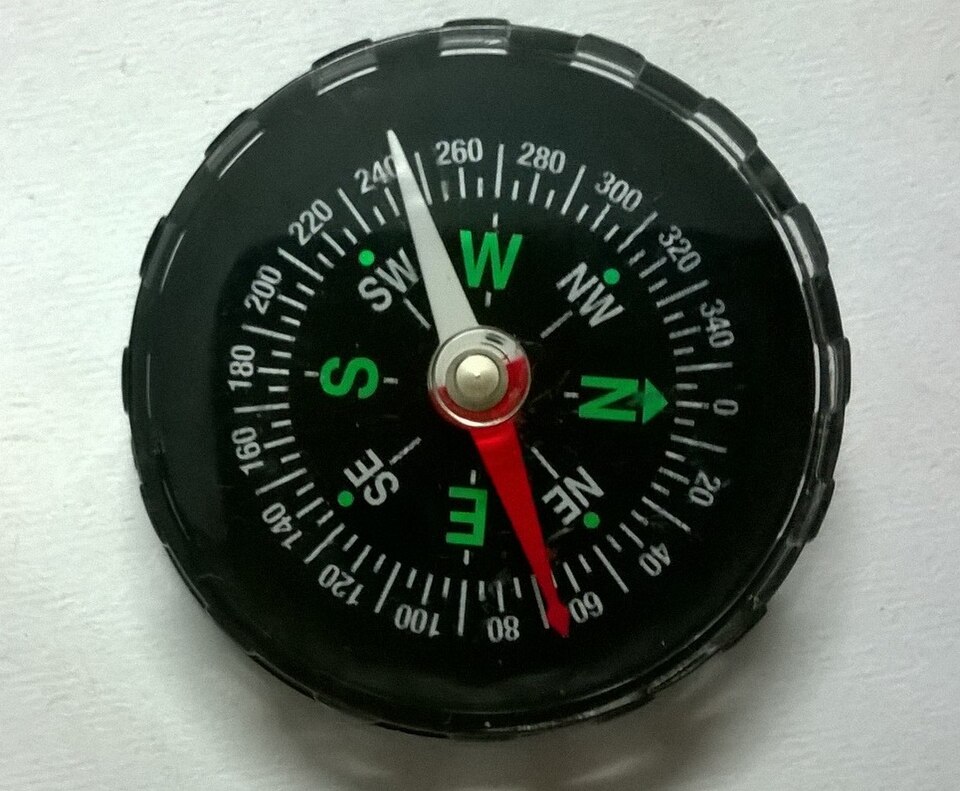
Correct — C, magnetic needle. A magnetic needle is a small bar magnet balanced on a pivot so that it can turn freely. Placed anywhere in a magnetic field it swings until it lies along the field at that point, so it reveals both that a field is present and which way it points. This is exactly how field lines are traced in the laboratory — the needle is moved from point to point around a bar magnet or a current-carrying wire and its successive alignments are joined into a smooth curve.
Why the others are wrong
- (a)Ammeter — An ammeter measures the current flowing in a circuit, in amperes, and is connected in series within that circuit. It reports a circuit quantity and tells you nothing about the field in the space around the wire.
- (b)Voltmeter — A voltmeter measures the potential difference between two points, in volts, and is connected in parallel across a component. Like the ammeter it responds to what is happening inside the circuit, not in the region around it.
- (d)Motor — A motor uses a magnetic field rather than detecting one — it rotates because a current-carrying coil placed in a field experiences a force. It is an application of the field, not an instrument for finding it.
Concept
A magnetic field is a region in which a magnetic material experiences a force, and it is a vector quantity with both magnitude and direction. The simplest possible detector is therefore another magnet, small enough not to disturb what it is measuring — a pivoted magnetic needle, which is what sits inside every compass. By convention the direction of the field at a point is taken as the direction in which the north-seeking end of such a needle comes to rest.
The trap is that the other three options are all electrical instruments or machines, and school physics introduces magnetic fields alongside electric current, so an electrical answer feels natural. But an ammeter and a voltmeter measure quantities inside a circuit, while the question asks about detecting something in the space around it. There is an irony worth carrying: a moving-coil ammeter and a moving-coil voltmeter both contain a permanent magnet and work because of magnetic forces, yet neither is a field detector. As a laboratory routine, iron filings sprinkled on a card over a magnet reveal the pattern of the field lines but not their direction; only a compass needle supplies the direction as well.
Key facts
- A compass contains a pivoted magnetic needle that aligns itself along the magnetic field wherever it is placed.
- Magnetic field is a vector quantity, having both magnitude and direction.
- Field lines are drawn in the direction in which the north pole of a compass needle points; outside a magnet they run from north to south and they are closed curves.
- An ammeter is connected in series and reads current; a voltmeter is connected in parallel and reads potential difference.
- Iron filings show the shape of a field pattern but, unlike a compass, do not show which way the field points.
Study next
Common traps
- Picking an ammeter or a voltmeter because they are the familiar electrical measuring instruments.
- Assuming iron filings by themselves give the direction of the field — they show only the pattern.
- Forgetting that a magnetic field exists in the space around a conductor, not inside the circuit.
As straight recall of the detector, or through the properties of field lines and the rules that fix their direction.
Related PYQs
Which one of the following statements regarding magnetic field is NOT correct ?
- (a) Magnetic field is a quantity that has direction and magnitude
- (b) Magnetic field lines are closed curves
- (c) Magnetic field lines are open curves
- (d) No two magnetic field lines are found to cross each other
Answer(c) Magnetic field lines are open curves
The 2020 paper tested the same underlying idea from the theory side — that a magnetic field has direction as well as magnitude, which is precisely why a pivoted needle can be used to map it.
Practice
- practice — not a real PYQ
The direction of a magnetic field at a point is taken to be the direction in which
- (a)the south pole of a compass needle points
- (b)the north pole of a compass needle points
- (c)iron filings are attracted
- (d)the current in the nearby wire flows
Answer(b) the north pole of a compass needle points — this is the convention used to draw magnetic field lines. - practice — not a real PYQ
Which one of the following reveals the shape of a magnetic field pattern but not its direction?
- (a)A magnetic compass
- (b)Iron filings sprinkled on a card
- (c)A galvanometer
- (d)A voltmeter
Answer(b) Iron filings sprinkled on a card — they line up along the field but have no north-seeking end to indicate direction.