
The focal length of a concave lens is 0.5 m. The power of the lens is
- (a)+0.5 D
- (b)-0.5 D
- (c)+2.0 D
- (d)-2.0 D
Answer
Why
Correct — D, -2.0 D. The power of a lens is the reciprocal of its focal length in metres, P = 1/f, so 1/0.5 = 2 dioptres in magnitude. A concave lens is a diverging lens, and by the sign convention its focal length is taken as negative, so its power is negative — giving -2.0 D.
Why the others are wrong
- (a)+0.5 D — This simply repeats the focal-length number (0.5) with a positive sign. Power is 1/f, not f, and a concave lens is negative, so both the value and the sign are wrong.
- (b)-0.5 D — The negative sign is right for a diverging lens, but the value is wrong. Power is 1/f = 1/0.5 = 2 D; this option forgets to take the reciprocal of the focal length.
- (c)+2.0 D — The magnitude 2 D (= 1/0.5) is correct, but the sign is wrong. A positive power belongs to a convex (converging) lens; a concave lens must be negative.
Concept
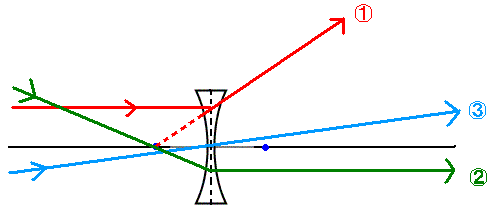
The power of a lens measures how strongly it bends light and is defined as the reciprocal of its focal length in metres, P = 1/f. The unit is the dioptre (D), where 1 D equals 1 per metre. A converging (convex) lens has positive power, while a diverging (concave) lens has negative power.
Two things must both be correct here: the value and the sign. First take the reciprocal of the focal length (1/0.5 = 2), then attach the sign that matches the lens type — negative for a concave, diverging lens. Options that keep the number 0.5, or use a positive sign, are the built-in traps.
Key facts
- The power of a lens is P = 1/f, with f measured in metres; its unit is the dioptre (D).
- A concave (diverging) lens has a negative focal length and therefore negative power; a convex (converging) lens is positive.
- A focal length of 0.5 m corresponds to a power of 2 D in magnitude, because 1 divided by 0.5 equals 2.
- When thin lenses are placed in contact, their powers add: P = P1 + P2 + and so on.
Study next
Common traps
- Power is 1/f, not f — always take the reciprocal of the focal length in metres.
- Sign matters: a concave/diverging lens is negative, a convex/converging lens is positive.
Lens power is asked as a quick 'find P from f' step, with distractors that keep the focal-length value or flip the sign.
Related PYQs
An air bubble in water will act like a
- (a) convex mirror
- (b) convex lens
- (c) concave mirror
- (d) concave lens
Answer(d) concave lens
Same concept — a concave (diverging) lens. UPSC asked students to recognise that an air bubble in water diverges light and so behaves like a concave lens, exactly the lens type whose power is negative in this NDA question.
Which one among the following is the correct focal length of a combination of lenses of power 2.5 D and -2.0 D?
- (a) +0.5 m
- (b) -0.5 m
- (c) +2.0 m
- (d) -2.0 m
Answer(c) +2.0 m
The exact inverse skill — this earlier NDA GAT item goes from lens powers to focal length using f = 1/P, whereas the 2025 question goes from focal length to power using P = 1/f.
Practice
- practice — not a real PYQ
The power of a convex lens of focal length 25 cm is
- (a)+2 D
- (b)+4 D
- (c)-4 D
- (d)+0.25 D
Answer(b) +4 D — f = 0.25 m, so P = 1/0.25 = +4 D, positive because it is a convex lens. - practice — not a real PYQ
Two thin lenses of powers +3 D and -1 D are placed in contact. The power of the combination is
- (a)+2 D
- (b)+4 D
- (c)-2 D
- (d)+3 D
Answer(a) +2 D — the powers of lenses in contact add, so 3 + (-1) = +2 D.