
Which one of the following sculptures found at Sanchi Stupa is NOT directly inspired by Buddhist ideas?
- (a)Empty seat
- (b)Shalbhanjika
- (c)Tree
- (d)Wheel
Answer
Why
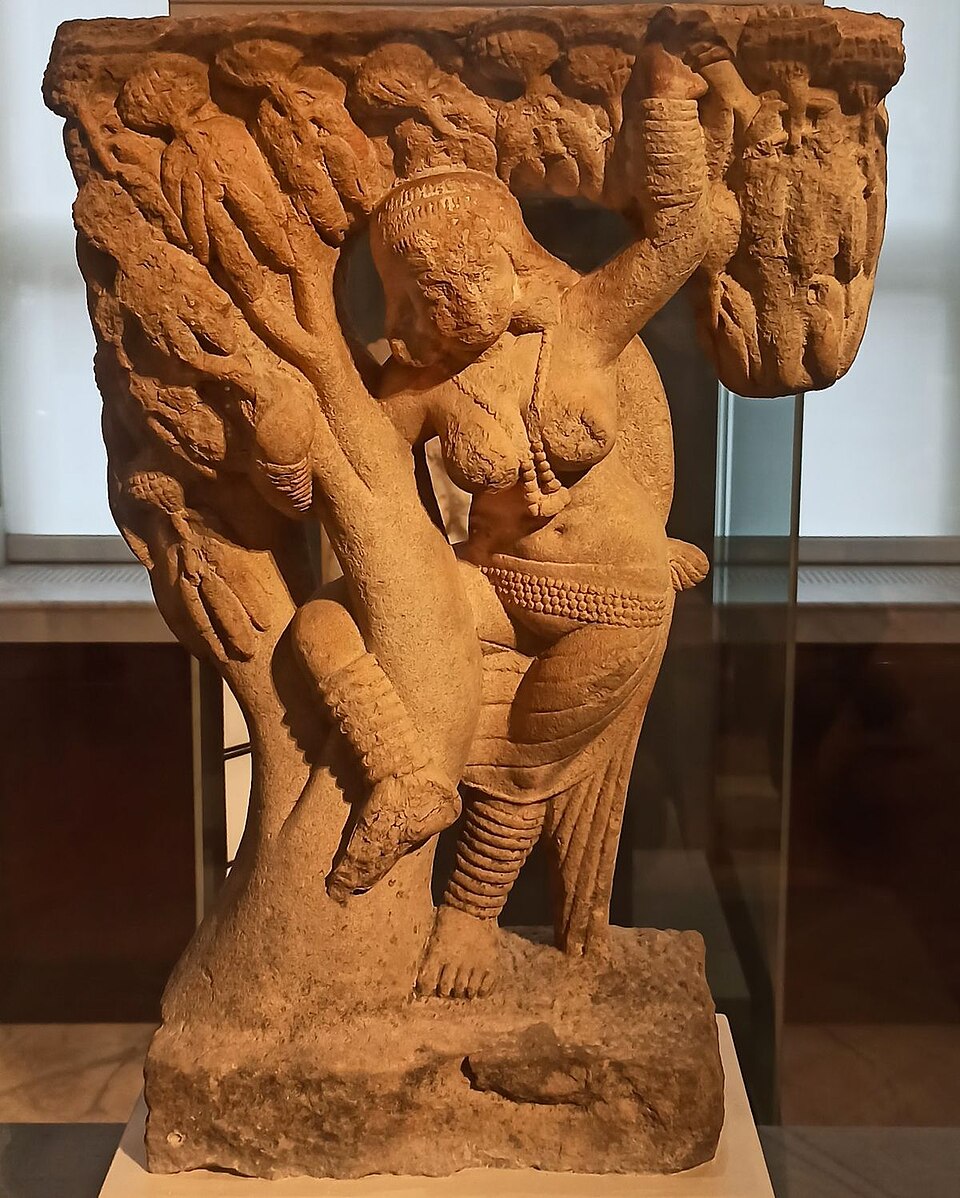
Correct — B, Shalbhanjika. The shalabhanjika at Sanchi — a woman shown grasping the branch of a flowering tree — comes from an older, popular fertility and nature-spirit (yakshi) tradition that predates and lies outside Buddhist doctrine. Sculptors absorbed it into the stupa's decoration as an auspicious motif, but it does not represent a Buddhist idea. By contrast the empty seat, the tree and the wheel are all direct Buddhist symbols.
Why the others are wrong
- (a)Empty seat — The empty seat (or throne) is a classic aniconic symbol of the Buddha's presence — early Buddhist art avoided showing him in human form, so a vacant seat signified the Master himself.
- (c)Tree — The tree stands for the Bodhi tree at Bodh Gaya under which the Buddha attained enlightenment — a core Buddhist symbol, not mere decoration.
- (d)Wheel — The wheel is the dharmachakra, the 'wheel of dharma', symbolising the Buddha's first sermon at Sarnath and his teaching — quintessentially Buddhist.
Concept
Early Buddhist art (as at Sanchi, c.1st century BCE) was largely aniconic: instead of a Buddha statue it used symbols — an empty seat, footprints, the Bodhi tree, the stupa and the dharmachakra — to evoke his life and teaching. Alongside these, sculptors borrowed popular motifs such as yakshas, yakshis and the tree-woman (shalabhanjika) from folk fertility cults.
The question asks which motif is NOT rooted in Buddhist doctrine. Empty seat, tree and wheel each encode a specific event or idea in the Buddha's life. The shalabhanjika is a pre-existing nature-spirit image co-opted for its auspicious, fertility associations — hence it is the odd one out.
Key facts
- Sanchi's early art is aniconic, so the Buddha is shown through symbols (empty seat, footprints, Bodhi tree, wheel, stupa) rather than as a figure.
- The shalabhanjika (tree-woman) derives from folk yaksha/yakshi fertility cults, not from Buddhist teaching.
- Empty seat = the Buddha's presence; Bodhi tree = enlightenment; dharmachakra (wheel) = his first sermon.
- The Great Stupa at Sanchi (Madhya Pradesh) was begun under Ashoka; its carved gateways (toranas) are Shunga-Satavahana work.
Study next
Common traps
- Assuming everything carved on a Buddhist stupa is a Buddhist symbol — folk motifs like the shalabhanjika were borrowed.
- Treating the wheel as a decorative element; the dharmachakra is a core Buddhist symbol.
Asked as 'which Sanchi motif is / is not a Buddhist symbol', or by matching a symbol (wheel, empty seat, Bodhi tree) to what it represents.
Related PYQs
With reference to ancient India, consider the following statements: 1. The concept of Stupa is Buddhist in origin. 2. Stupa was generally a repository of relics. 3. Stupa was a votive and commemorative structure in Buddhist tradition. How many of the above statements are correct?
- (a) Only one
- (b) Only two
- (c) All three
- (d) None
Answer(b) Only two
Same domain — the Buddhist stupa and its symbolism. UPSC probes the origin and function of the stupa (the mound concept predates Buddhism); this NDA item probes which Sanchi motif is not a Buddhist symbol.
Practice
- practice — not a real PYQ
At Sanchi, the Buddha's first sermon is symbolised by the
- (a)lotus
- (b)empty seat
- (c)wheel (dharmachakra)
- (d)elephant
Answer(c) wheel (dharmachakra) — the 'wheel of dharma' stands for the first sermon at Sarnath. - practice — not a real PYQ
The shalabhanjika figure in Indian sculpture is associated with
- (a)a Buddhist monk
- (b)a tree-and-fertility nature spirit (yakshi)
- (c)a Jain Tirthankara
- (d)a royal portrait
Answer(b) a tree-and-fertility nature spirit (yakshi) — a woman grasping a flowering branch.