
When a light beam falls on a triangular glass prism, a band of colours is obtained. Which one of the following statements is correct in this regard?
- (a)Red light bends the most, as the refractive index of glass for red light is greatest.
- (b)Red light bends the most, as the refractive index of glass for red light is lowest.
- (c)Violet light bends the most, as the refractive index of glass for violet light is greatest.
- (d)Violet light bends the most, as the refractive index of glass for violet light is lowest.
Answer
Why
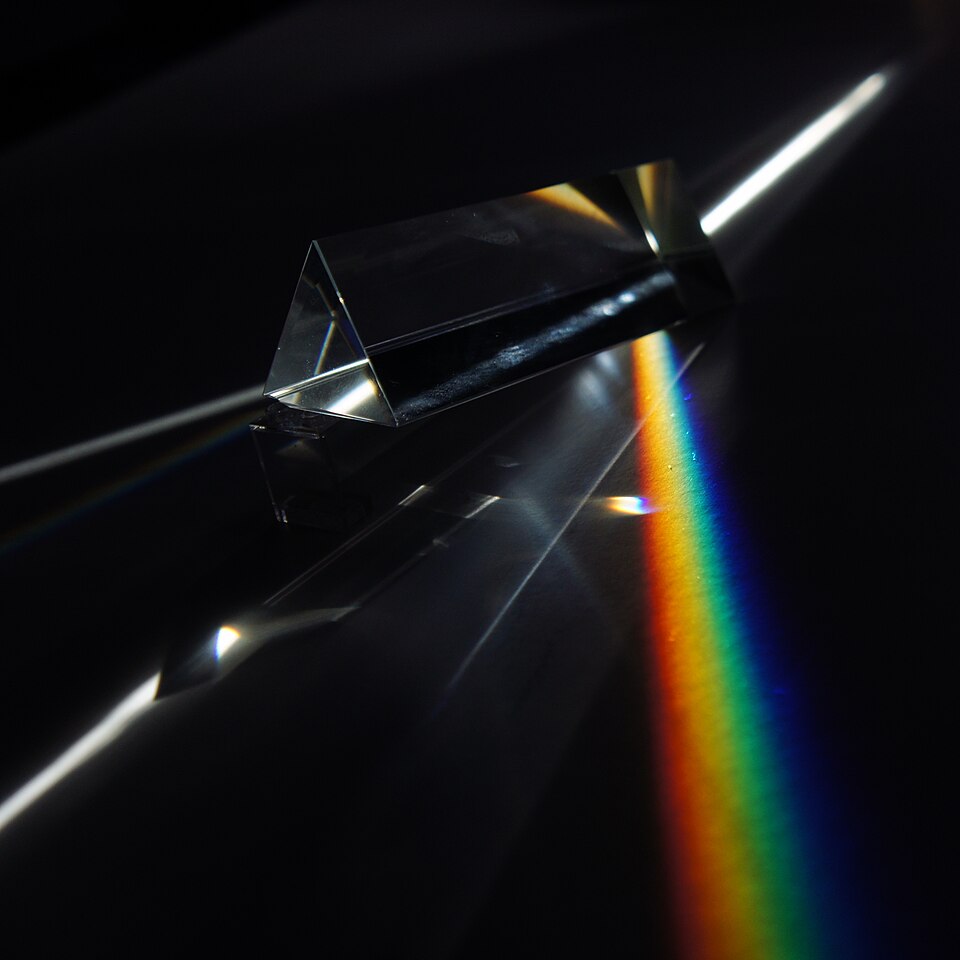
Correct — C, violet light bends the most, as the refractive index of glass for violet light is greatest. White light splits into a band of colours (dispersion) because glass has a slightly different refractive index for each wavelength. The refractive index is highest for violet (the shortest visible wavelength) and lowest for red (the longest). A higher refractive index means greater bending, so violet is deviated the most and red the least — which is why the spectrum runs from red at the top to violet at the bottom.
Why the others are wrong
- (a)Red light bends the most, as the refractive index of glass for red light is greatest. — Both claims are wrong: red bends the least, and glass has its lowest (not greatest) refractive index for red light.
- (b)Red light bends the most, as the refractive index of glass for red light is lowest. — The refractive-index claim is right (it is lowest for red), but a lower index means red bends the least, not the most.
- (d)Violet light bends the most, as the refractive index of glass for violet light is lowest. — The deviation is correctly stated (violet bends most), but the reason is wrong — glass has its greatest, not lowest, refractive index for violet.
Concept
Dispersion is the splitting of white light into its component colours when it passes through a medium such as a glass prism. It happens because the refractive index of the medium varies with the wavelength of light — it is largest for violet (short wavelength) and smallest for red (long wavelength).
The rule to remember is: higher refractive index → greater bending (deviation). Since glass refracts violet the most and red the least, the emerging spectrum spreads from red (least deviated) to violet (most deviated). The distractors mix a right deviation with a wrong reason, or vice versa, so both halves of the statement must be checked.
Key facts
- Dispersion is the splitting of white light into VIBGYOR because the refractive index depends on the wavelength.
- Refractive index of glass is greatest for violet and least for red.
- Higher refractive index means greater bending, so violet deviates most and red least.
- Isaac Newton first used a glass prism to show sunlight is made of these colours.
Study next
Common traps
- Thinking red bends the most; it actually deviates the least.
- Pairing 'violet bends most' with the wrong reason about the refractive index.
Asked as which colour deviates most through a prism and why — a paired deviation-and-refractive-index statement to be verified in full.
Related PYQs
Rainbow is produced when sunlight falls on drops of rain. Which of the following physical phenomena are responsible for this? 1. Dispersion 2. Refraction 3. Internal reflection. Select the correct answer using the codes given below.
- (a) 1 and 2 only
- (b) 2 and 3 only
- (c) 1 and 3 only
- (d) 1, 2 and 3
Answer(d) 1, 2 and 3
The rainbow relies on the same wavelength-dependent refraction (dispersion) as a prism: raindrops refract and disperse sunlight, bending violet more than red — the exact effect that makes violet deviate most in this question.
A glass prism splits white light into different colours. This phenomenon is called dispersion of light by prism. Which one of the following statements is correct?
- (a) Red light will deviate the most and it is because of the reflection of light.
- (b) Violet light will deviate the most and it is because of the refraction of light.
- (c) Red light will deviate the most and it is because of the refraction of light.
- (d) Violet light will deviate the most and it is because of the reflection of light.
Answer(b) Violet light will deviate the most and it is because of the refraction of light.
A near-identical prism-dispersion item: violet deviates the most through refraction, matching this question's point that glass has the greatest refractive index for violet.
Practice
- practice — not a real PYQ
In the spectrum produced by a glass prism, the colour that is deviated the least is
- (a)Violet
- (b)Blue
- (c)Green
- (d)Red
Answer(d) Red — glass has the lowest refractive index for red, so it bends the least. - practice — not a real PYQ
The splitting of white light into its constituent colours by a prism is called
- (a)reflection
- (b)dispersion
- (c)scattering
- (d)total internal reflection
Answer(b) dispersion — caused by the refractive index of the prism varying with wavelength.