
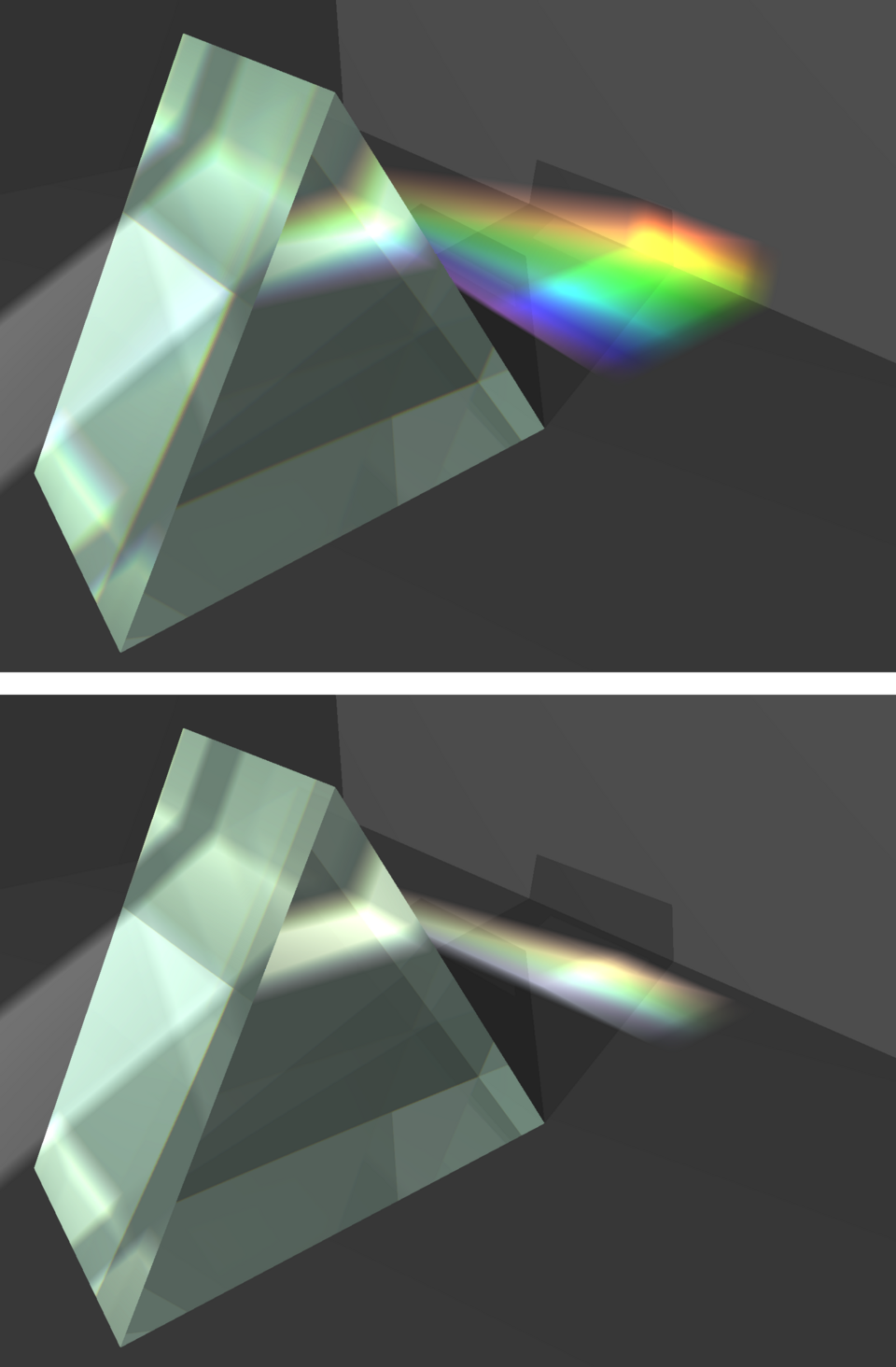
A glass prism splits white light into different colours. This phenomenon is called dispersion of light by prism. Which one of the following statements is correct?
- (a)Red light will deviate the most and it is because of the reflection of light.
- (b)Violet light will deviate the most and it is because of the refraction of light.
- (c)Red light will deviate the most and it is because of the refraction of light.
- (d)Violet light will deviate the most and it is because of the reflection of light.
Answer
Why
Correct — B, 'Violet light will deviate the most and it is because of the refraction of light.' Dispersion happens because the glass bends (refracts) different colours by different amounts. Violet has the shortest wavelength and the highest refractive index in glass, so it slows and bends the most — deviating most. Red, with the longest wavelength, deviates least. The splitting is due to refraction, not reflection, so (b) is the correct statement.
Why the others are wrong
- (a)Red light will deviate the most and it is because of the reflection of light. — Both parts are wrong — red deviates the LEAST, and dispersion is caused by refraction, not reflection.
- (c)Red light will deviate the most and it is because of the refraction of light. — The cause (refraction) is right, but red deviates the least, not the most — violet deviates most.
- (d)Violet light will deviate the most and it is because of the reflection of light. — It is right that violet deviates most, but the cause is refraction, not reflection.
Concept
When white light passes through a prism it is split into its component colours (VIBGYOR) — dispersion. This occurs because the refractive index of glass is slightly different for each colour: it is highest for violet and lowest for red. Since a higher refractive index means more bending, violet is deviated most and red least, spreading the colours into a spectrum.
The question tests two facts at once: which colour bends most (violet) and what causes the splitting (refraction). A common error is to blame reflection or to think red bends most because it is at one end of the spectrum. Remembering 'shortest wavelength → highest index → most bent' pins violet, and dispersion is always a refraction effect.
Key facts
- Dispersion is the splitting of white light into its colours (VIBGYOR) by a prism.
- It is caused by refraction — the refractive index of glass differs for each colour.
- Violet (shortest wavelength) has the highest refractive index and deviates the most.
- Red (longest wavelength) has the lowest refractive index and deviates the least.
Study next
Common traps
- Thinking red deviates most — it deviates least; violet bends most.
- Attributing the splitting to reflection rather than refraction.
Asked by pairing 'which colour deviates most' with 'what causes dispersion', or through rainbow-formation and spectrum questions.
Related PYQs
Rainbow is produced when sunlight falls on drops of rain. Which of the following physical phenomena are responsible for this? 1. Dispersion 2. Refraction 3. Internal reflection
- (a) 1 and 2 only
- (b) 2 and 3 only
- (c) 1 and 3 only
- (d) 1, 2 and 3
Answer(d) 1, 2 and 3
Same concept — dispersion of white light. A rainbow is dispersion in raindrops (with refraction and internal reflection), extending the prism-dispersion idea that violet bends most because of refraction.
Practice
- practice — not a real PYQ
In dispersion by a prism, the colour that bends the least is
- (a)Violet
- (b)Blue
- (c)Green
- (d)Red
Answer(d) Red — it has the longest wavelength and the lowest refractive index in glass. - practice — not a real PYQ
The splitting of white light into its constituent colours by a prism is called
- (a)Reflection
- (b)Dispersion
- (c)Diffraction
- (d)Scattering
Answer(b) Dispersion — caused by wavelength-dependent refraction.