
Which one of the following viruses used to be responsible for highly infectious disease Smallpox?
- (a)Adenovirus
- (b)Variola virus
- (c)Aichi virus
- (d)Coxsackie virus
Answer
Why
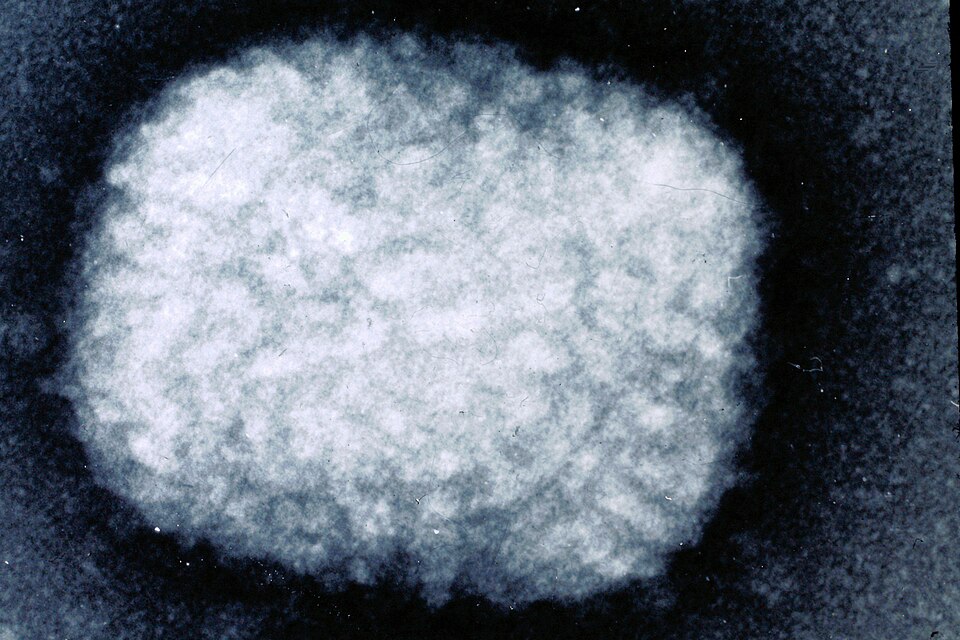
Correct — B, Variola virus. Smallpox was caused by the variola virus, a member of the poxvirus family. The question rightly uses the past tense: after a global vaccination drive led by the World Health Organization, smallpox was declared eradicated in 1980, the only human disease ever wiped out, so the variola virus no longer circulates in nature. Among the options, only variola is the smallpox agent.
Why the others are wrong
- (a)Adenovirus — Adenoviruses cause respiratory illnesses, conjunctivitis and some gastrointestinal infections, not smallpox.
- (c)Aichi virus — The Aichi virus is associated with gastroenteritis (stomach and intestinal upset), not with smallpox.
- (d)Coxsackie virus — Coxsackieviruses cause diseases such as hand, foot and mouth disease and some heart and muscle infections, not smallpox.
Concept
Smallpox was a severe, highly contagious disease marked by fever and a characteristic pustular rash, caused by the variola virus of the poxvirus family. A worldwide vaccination campaign eliminated it, and the World Health Organization certified its eradication in 1980. It remains the only human disease to have been completely eradicated.
Each distractor is a real virus tied to a different illness, so the candidate must attach smallpox specifically to variola. The name variola is itself the historic Latin term for smallpox, which is the memory hook.
Key facts
- Smallpox was caused by the variola virus, a poxvirus.
- It spread person to person and caused fever with a pustular rash.
- A global vaccination programme led to eradication, certified by the World Health Organization in 1980.
- Smallpox is the only human disease so far to be fully eradicated.
Study next
Common traps
- Confusing variola (smallpox) with varicella, the virus of chickenpox.
- Matching smallpox to an unrelated virus like adenovirus or coxsackievirus.
Asked as which virus caused smallpox; the answer is the variola virus, with the past tense reflecting its eradication.
Related PYQs
Match List I with List II and select the correct answer using the codes given below the lists: List I (Disease) — I. Malaria, II. Poliomyelitis, III. Tuberculosis, IV. Ringworm; List II (Organism) — A. Fungi, B. Bacteria, C. Virus, D. Protozoan.
- (a) I-D, II-C, III-B, IV-A
- (b) I-D, II-C, III-A, IV-B
- (c) I-C, II-D, III-A, IV-B
- (d) I-C, II-D, III-B, IV-A
Answer(a) I-D, II-C, III-B, IV-A
Same skill of matching a disease to its causative organism — poliomyelitis is viral in the UPSC set, just as smallpox is viral (variola) here. Sorting diseases by pathogen type is the shared idea.
Which one of the following statements regarding viruses is not true?
- (a) Viruses need living cells to reproduce.
- (b) All viruses are parasites.
- (c) Viruses can synthesize their food through photosynthesis.
- (d) Viruses are similar to chemical substances outside the host.
Answer(c) Viruses can synthesize their food through photosynthesis.
Same domain of virus biology — that NDA item tests the nature of viruses as obligate parasites needing living cells, the same class of pathogen (variola) that caused smallpox in this question.
Practice
- practice — not a real PYQ
Smallpox was declared eradicated worldwide by the World Health Organization in the year
- (a)1970
- (b)1980
- (c)1990
- (d)2000
Answer(b) 1980 — smallpox is the only human disease certified as eradicated. - practice — not a real PYQ
Which one of the following diseases is caused by a virus?
- (a)Tuberculosis
- (b)Malaria
- (c)Smallpox
- (d)Cholera
Answer(c) Smallpox — caused by the variola virus; tuberculosis and cholera are bacterial and malaria is protozoan.