
Movement of materials to different parts of cytoplasm and nucleus is generally carried out by
- (a)Ribosomes.
- (b)Mitochondria.
- (c)Lysosomes.
- (d)Endoplasmic reticulum.
Answer
Why
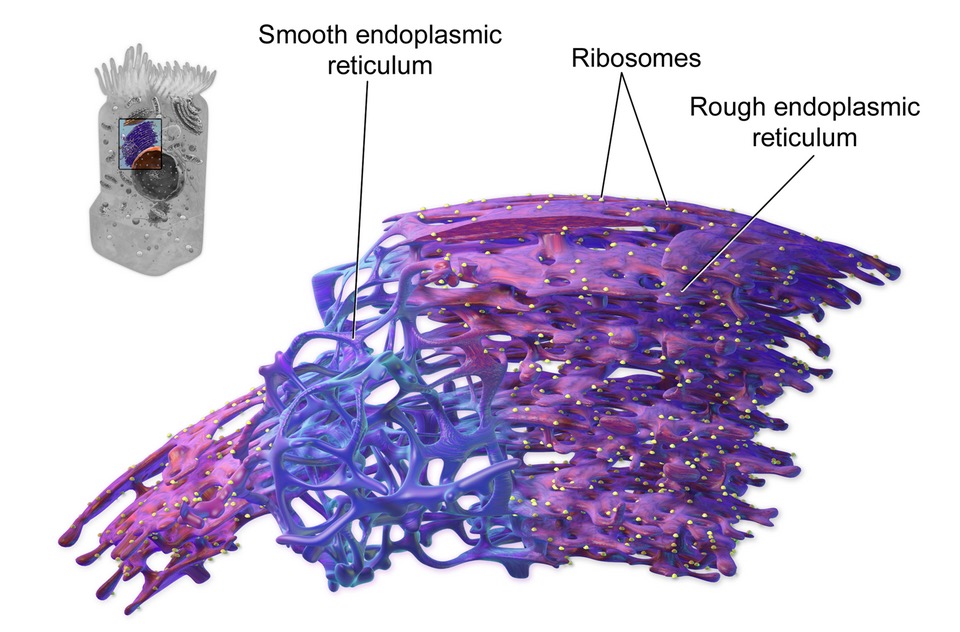
Correct — D, Endoplasmic reticulum. The endoplasmic reticulum (ER) is a network of membrane-bound tubes and sheets that runs through the cytoplasm and connects to the nuclear membrane. It acts as a channel or transport system, carrying materials — especially proteins — between different regions of the cytoplasm and between the cytoplasm and the nucleus.
Why the others are wrong
- (a)Ribosomes. — Ribosomes are the site where proteins are made; they synthesise material but do not form the channels that move it around the cell.
- (b)Mitochondria. — Mitochondria are the powerhouses that release energy as ATP; they are not the cell's transport network.
- (c)Lysosomes. — Lysosomes are the 'suicide bags' that digest worn-out organelles and foreign material; they handle disposal, not intracellular transport.
Concept
The endoplasmic reticulum is a large membranous organelle continuous with the outer nuclear membrane. Rough ER (studded with ribosomes) makes and channels proteins, while smooth ER makes lipids and helps detoxification. In both forms the ER's tube-and-sheet network serves as the cell's internal highway, moving materials through the cytoplasm and to the nucleus.
This is a 'match the organelle to its job' question. Each option is a real organelle, so success depends on recalling that transport/channelling of materials is the ER's signature role, distinct from synthesis (ribosomes), energy (mitochondria) and digestion (lysosomes).
Key facts
- The ER is a membrane network continuous with the nuclear envelope.
- Rough ER bears ribosomes and channels proteins; smooth ER makes lipids and aids detoxification.
- The ER transports materials through the cytoplasm and between cytoplasm and nucleus.
- It also provides a surface for many biochemical activities and gives the cell mechanical support.
Study next
Common traps
- Picking ribosomes because they sit on rough ER — they make protein but do not transport it.
- Confusing transport (ER) with packaging/secretion (Golgi apparatus).
Asked as 'which organelle performs this function?' — match transport/channelling to the ER against synthesis, energy and digestion roles.
Related PYQs
Which of the following cell organelles play the most significant role in protein synthesis?
- (a) Lysosome and Centrosome
- (b) Endoplasmic reticulum and Ribosome
- (c) Golgi apparatus and Mitochondria
- (d) Lysosome and Mitochondria
Answer(b) Endoplasmic reticulum and Ribosome
Same organelle — the endoplasmic reticulum. Here it is paired with ribosomes for making and channelling proteins, the same protein-handling role that makes the ER the cell's transport network.
Practice
- practice — not a real PYQ
Which organelle is often called the 'suicide bag' of the cell because of its digestive enzymes?
- (a)Ribosome
- (b)Lysosome
- (c)Golgi apparatus
- (d)Endoplasmic reticulum
Answer(b) Lysosome — its hydrolytic enzymes digest worn-out organelles and foreign matter. - practice — not a real PYQ
Rough endoplasmic reticulum appears rough because it is studded with
- (a)mitochondria
- (b)ribosomes
- (c)lysosomes
- (d)chloroplasts
Answer(b) ribosomes — which make proteins that enter the ER for transport.