
At which one of the following places was a Shiva temple not constructed under the patronage of the Chola rulers?
- (a)Chidambaram
- (b)Thanjavur
- (c)Gangaikonda Cholapuram
- (d)Naneghat
Answer
Why
Correct — D, Naneghat. Naneghat is an ancient mountain pass in the Western Ghats of Maharashtra, famous for a Satavahana-era cave with inscriptions of Queen Naganika — it lies far outside the Tamil Chola heartland and has no Chola Shiva temple. Chidambaram, Thanjavur and Gangaikonda Cholapuram are all major Chola Shaiva centres, so Naneghat is the odd one out.
Why the others are wrong
- (a)Chidambaram — Chidambaram's Nataraja (Shiva as Lord of Dance) temple was patronised and enlarged by the Cholas, who treated Nataraja as a tutelary deity; it is a genuine Chola Shaiva centre.
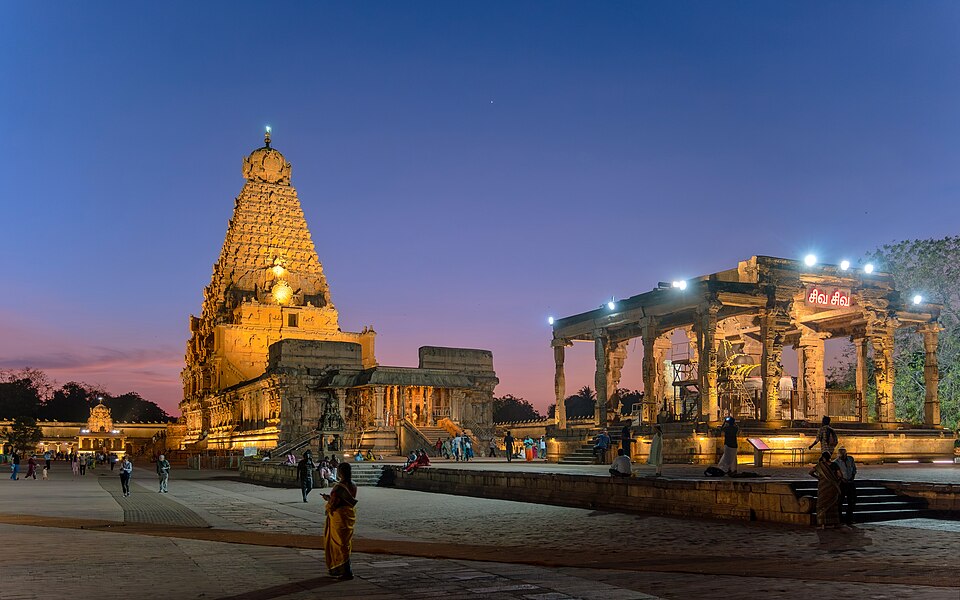
- (b)Thanjavur — The Brihadishvara (Rajarajeshvara) temple at Thanjavur, a UNESCO 'Great Living Chola Temple', was built by Rajaraja I around 1010 CE and is the flagship Chola Shiva temple.
- (c)Gangaikonda Cholapuram — Rajendra I built the Brihadishvara temple at his new capital Gangaikonda Cholapuram to commemorate his northern (Ganga) campaign; it too is a Chola Shiva temple.
Concept
The imperial Cholas (9th–13th centuries) were prolific temple builders in the Dravida style and were devoted patrons of Shiva. Their grandest foundations — the Brihadishvara temples at Thanjavur and Gangaikonda Cholapuram and the Nataraja temple at Chidambaram — are Shaiva. Naneghat, by contrast, belongs to the earlier Satavahana dynasty of the Deccan and is a trade-route pass, not a Chola religious site.
Three options are clustered in the Tamil Chola country; the fourth (Naneghat) is a Deccan/Maharashtra site of a completely different era. Spotting the geographical and dynastic outlier is the fastest route to the answer even if you cannot date each temple.
Key facts
- Brihadishvara temple, Thanjavur — built by Rajaraja I (c. 1010 CE), a Chola Shiva temple.
- Gangaikonda Cholapuram — Rajendra I's capital and Shiva temple, commemorating his Ganga campaign.
- Chidambaram — Nataraja (Shiva) temple, patronised and expanded by the Cholas.
- Naneghat — a Satavahana-period pass and cave in Maharashtra's Western Ghats, with inscriptions of Queen Naganika.
Study next
Common traps
- Assuming any famous Shiva temple must be Chola — Naneghat is Satavahana and not even a temple town.
- Mixing up Gangaikonda Cholapuram (Rajendra I) with Thanjavur (Rajaraja I).
Asked as 'which site is not associated with dynasty X' or by matching a temple/monument to its builder-dynasty.
Related PYQs
Bronze icons of Nataraja cast during the Chola period invariably show the deity with
- (a) eight hands
- (b) six hands
- (c) four hands
- (d) two hands
Answer(c) four hands
Same dynasty and deity — Chola Shaiva art (Nataraja/Shiva), part of the same body of Chola patronage that produced the Chidambaram, Thanjavur and Gangaikonda Cholapuram temples.
Chola inscriptions mention several categories of lands. Which one of the following was meant for the maintenance of school?
- (a) Tirunamattukkani
- (b) Shalabhoga
- (c) Vellanvagai
- (d) Pallichhandam
Answer(b) Shalabhoga
Same polity — Chola administration and its temple/land grants, the institutional backdrop to the great Chola Shiva temples in this question.
Practice
- practice — not a real PYQ
The Brihadishvara temple at Thanjavur was built by which Chola ruler?
- (a)Rajendra I
- (b)Rajaraja I
- (c)Karikala
- (d)Kulottunga I
Answer(b) Rajaraja I — he built the Thanjavur Brihadishvara temple around 1010 CE. - practice — not a real PYQ
The Naneghat pass and its inscriptions are associated with which dynasty?
- (a)Cholas
- (b)Satavahanas
- (c)Pallavas
- (d)Rashtrakutas
Answer(b) Satavahanas — Naneghat, in Maharashtra's Western Ghats, has a cave with inscriptions of the Satavahana queen Naganika.