
Directions : The following six (6) items consist of two statements, Statement I and Statement II. Examine these two statements carefully and select the correct answer using the code given below. Statement I : The pitch of the sound wave depends upon its frequency. Statement II : The loudness of the sound wave depends upon its amplitude.
- (a)Both the statements are individually true and Statement II is the correct explanation of Statement I
- (b)Both the statements are individually true but Statement II is not the correct explanation of Statement I
- (c)Statement I is true but Statement II is false
- (d)Statement I is false but Statement II is true
Answer
Why
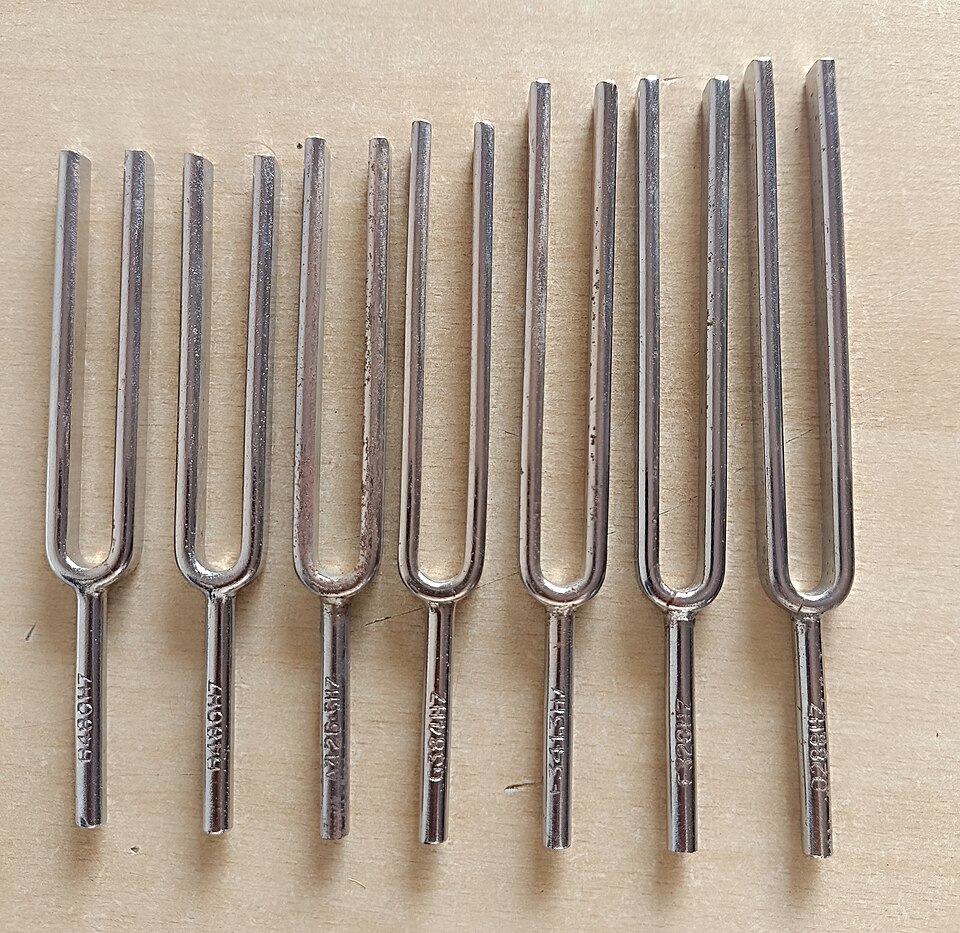
Correct: B, Both the statements are individually true but Statement II is not the correct explanation of Statement I. Take the statements one at a time. Pitch is the quality by which the ear calls a note high or low, and it is set by the frequency of the wave: a 512 Hz fork sounds higher than a 256 Hz fork, so Statement I is true. Loudness is the quality by which the ear calls a sound strong or faint, and for a note of a given frequency it grows with the amplitude of the pressure variation, so Statement II is true as well. Now the second test. Does amplitude explain frequency? It does not. Strike the same tuning fork harder and it gets louder while the note stays exactly where it was; blow across a shorter pipe and the note rises without your blowing any harder. The two statements are a matched pair of facts about two different properties, with no causal link running from one to the other, which is precisely the case option (b) is written for.
Why the others are wrong
- (a)Both the statements are individually true and Statement II is the correct explanation of Statement I: This is the trap the item is built around. It would require the amplitude of the wave to be the reason the pitch is what it is, and amplitude has no bearing on pitch at all: a fork struck gently and a fork struck hard sound the same note.
- (c)Statement I is true but Statement II is false: Statement II is not false. Loudness genuinely tracks amplitude; the intensity carried by a sound wave varies as the square of the amplitude, and greater intensity is heard as greater loudness.
- (d)Statement I is false but Statement II is true: Statement I is not false either. Frequency is the physical quantity that fixes pitch, which is why a shrill whistle and a deep drum differ in frequency and not in how hard they are sounded.
Concept
A musical sound is described by three characteristics, and each one answers to a different property of the wave. Pitch answers to frequency, the number of vibrations per second. Loudness answers to amplitude, the size of the pressure swing, through the intensity of the wave. Quality, or timbre, answers to the shape of the waveform (the mix of harmonics riding on the fundamental) and is what lets you tell a flute from a violin sounding the same note equally loudly.
Work every item of this six-item block in two separate steps, never one. Step one, test each statement on its own for truth and ignore the other completely. Step two, and only if both survived step one, ask whether Statement II states the reason Statement I is true. Two true statements that merely sit side by side give (b), not (a), that single confusion costs more marks in this block than any factual gap. Here both statements are settled physics, so everything turns on step two, and the answer is (b). Keep the distinction between the physical quantity and the sensation clear as well: frequency and intensity are measurable properties of the wave, while pitch and loudness are how the ear registers them, and the relationship between intensity and loudness is not a simple proportion.
Key facts
- Pitch is the perceptual counterpart of frequency: the higher the frequency, the higher the note sounds.
- Loudness is the perceptual counterpart of amplitude; the intensity of a sound wave varies as the square of its amplitude.
- Quality or timbre comes from the waveform, which is why two instruments playing the same note are still distinguishable.
- A healthy human ear registers frequencies from roughly 20 Hz to about 20,000 Hz.
Study next
Common traps
- Believing that a louder sound is also a higher-pitched one.
- Treating intensity, a physical quantity, and loudness, a sensation, as the same thing.
- Choosing (a) in a two-statement item simply because both statements turned out to be true.
NDA pairs pitch with frequency and loudness with amplitude almost every other year, either as a one-line direct question or, as here, wrapped in a two-statement code where the real work is the explanation test.
Related PYQs
The loudness of sound depends upon the
- (a) velocity of sound waves in the medium.
- (b) amplitude of the sound waves.
- (c) frequency of the sound waves.
- (d) frequency and velocity of the sound waves.
Answer(b) amplitude of the sound waves.
Statement II of this item set as a stand-alone question a year later, with frequency offered as the tempting wrong option.
When the pitch of sound increases, which one of the following increases?
- (a) Intensity
- (b) Loudness
- (c) Wavelength
- (d) Frequency
Answer(d) Frequency
Statement I from the other direction, and the two distractors it offers are exactly the loudness-side quantities this item asks you to keep separate.
Practice
- practice, not a real PYQ
Two sounds of the same frequency are produced, one by striking a tuning fork gently and the other by striking it hard. The two sounds will differ in
- (a)pitch only
- (b)loudness only
- (c)both pitch and loudness
- (d)neither pitch nor loudness
Answer(b) loudness only: striking harder increases the amplitude and so the loudness, while the frequency, and hence the pitch, is unchanged. - practice, not a real PYQ
The characteristic of a musical sound that allows a listener to distinguish a flute from a violin playing the same note at the same loudness is its
- (a)pitch
- (b)amplitude
- (c)quality
- (d)wavelength
Answer(c) quality: timbre arises from the shape of the waveform and the mix of harmonics, which differ from instrument to instrument.