
Who among the following first discovered cell ?
- (a)Robert Brown
- (b)Robert Hooke
- (c)Leeuwenhoek
- (d)Rudolf Virchow
Answer
Why
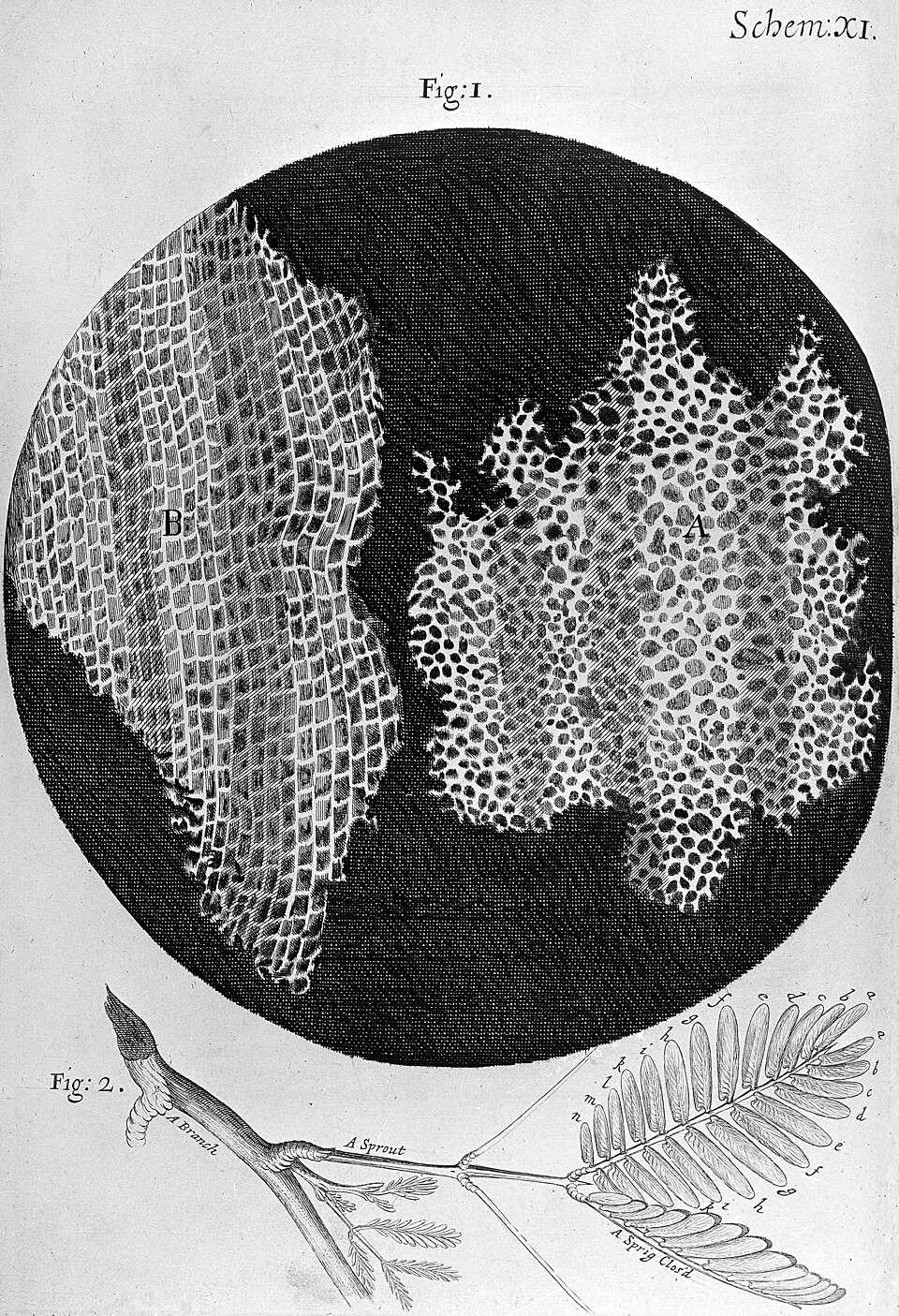
Correct: B, Robert Hooke. In 1665 Hooke cut a wafer-thin slice of cork, put it under a compound microscope of his own making, and saw that it was divided into row upon row of tiny empty boxes. The regular compartments reminded him of the small rooms in which monks lived, so he called them cells: the first use of the word in biology. He published the observation, with his drawing, in Micrographia. What Hooke actually saw were the dead cell walls left behind in cork, not living cells, but the discovery and the name are his.
Why the others are wrong
- (a)Robert Brown: Brown discovered the nucleus, in 1831, while examining orchid cells: an important later step, and he also gave his name to Brownian motion, but he came more than a century and a half after Hooke.
- (c)Leeuwenhoek: The sharpest distractor in the set. Antonie van Leeuwenhoek, working with his own single-lens microscopes in the 1670s, was the first to see LIVING cells and free-swimming single-celled organisms, which he called animalcules. First to see living cells, but not first to discover the cell: Hooke was there about a decade earlier.
- (d)Rudolf Virchow: Virchow supplied the third plank of cell theory in 1855, arguing that every cell arises from a pre-existing cell. That completed the theory built on the work of Schleiden and Schwann; it did not begin it.
Concept
Cell theory was assembled over nearly two centuries. Hooke saw and named cells in 1665; Leeuwenhoek saw living ones in the 1670s; Robert Brown identified the nucleus in 1831; Matthias Schleiden concluded in 1838 that plants are made of cells and Theodor Schwann extended the claim to animals in 1839; and Rudolf Virchow added in 1855 that cells come only from other cells. Stated as three propositions, cell theory holds that all living things are made of cells, that the cell is the basic unit of structure and function in life, and that all cells arise from pre-existing cells.
The examiner has assembled the options as a timeline, so the safest approach is to place each name on it rather than to reach for whichever is most familiar. Hooke 1665, Leeuwenhoek in the 1670s, Brown 1831, Virchow 1855: with those four dates the question answers itself, and so do most variants of it. Watch the wording closely, because a single adjective moves the answer: 'first discovered the cell' is Hooke, 'first saw living cells' is Leeuwenhoek, 'discovered the nucleus' is Brown, and 'all cells come from cells' is Virchow. Note also the instrument behind each name; Hooke used a compound microscope with more than one lens, while Leeuwenhoek's instruments were single tiny lenses of extraordinary quality that he ground himself.
Key facts
- Robert Hooke observed cells in a slice of cork in 1665 and published the finding in Micrographia.
- He coined the word 'cell' from the small rooms of a monastery, which the compartments resembled.
- What Hooke saw in cork were dead cell walls, not living cells.
- Antonie van Leeuwenhoek was the first to observe living cells and single-celled organisms, in the 1670s.
- Robert Brown found the nucleus in 1831; Rudolf Virchow proposed in 1855 that all cells arise from pre-existing cells.
Study next
Common traps
- Choosing Leeuwenhoek because he is remembered as the father of microbiology; he saw living cells, but Hooke came first.
- Attributing the discovery of the cell to Robert Brown, who discovered the nucleus.
- Missing the qualifying adjective in the stem: 'first', 'living' and 'nucleus' each point to a different name.
NDA asks who discovered the cell, the nucleus or cell theory's third proposition, and rotates the same four names between the stem and the options.
Related PYQs
No directly related past PYQ was found.
Practice
- practice, not a real PYQ
The nucleus of the cell was discovered by
- (a)Robert Hooke
- (b)Robert Brown
- (c)Theodor Schwann
- (d)Antonie van Leeuwenhoek
Answer(b) Robert Brown: in 1831, while examining cells of an orchid. - practice, not a real PYQ
The proposition that all cells arise from pre-existing cells was put forward by
- (a)Matthias Schleiden
- (b)Theodor Schwann
- (c)Rudolf Virchow
- (d)Robert Hooke
Answer(c) Rudolf Virchow: in 1855, completing the three propositions of cell theory.