
Which one of the following devices is non-ohmic ?
- (a)Conducting copper coil
- (b)Electric heating coil
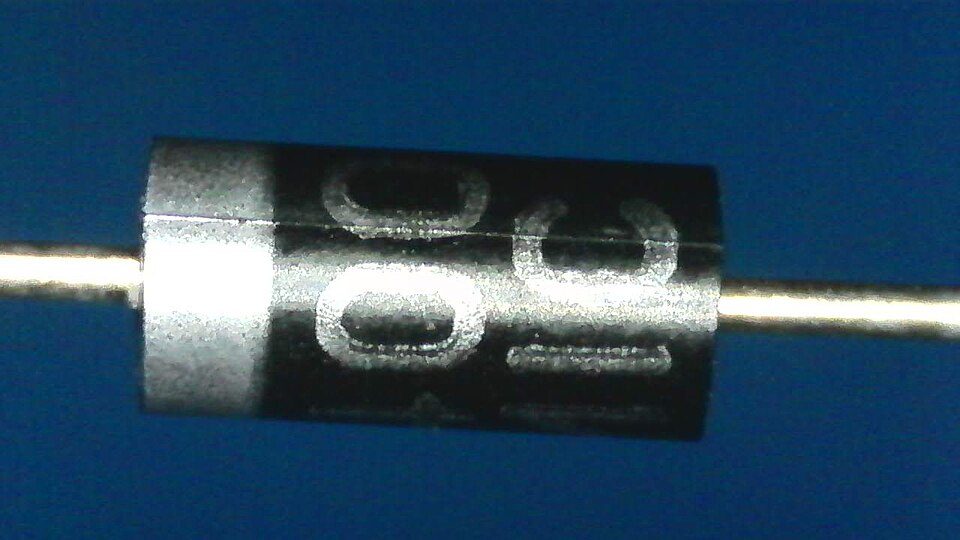
- (c)Semi conductor diode
- (d)Rheostat
Answer
Why
Correct: C, Semi conductor diode. A device is ohmic when the current through it is directly proportional to the potential difference across it, so that a plot of current against voltage is a straight line through the origin and the resistance is one fixed number. A diode does nothing of the sort. Forward biased, it passes almost no current until the voltage reaches about 0·7 volts for silicon, after which the current climbs very steeply; reverse biased, it blocks almost entirely. Its current-voltage curve is bent, and its resistance is different at every point on that curve, so the diode is the non-ohmic device here.
Why the others are wrong
- (a)Conducting copper coil: A metallic conductor at steady temperature is the textbook ohmic device: double the voltage across a copper coil and the current through it doubles.
- (b)Electric heating coil: A heating coil is a resistance wire such as nichrome and is treated as ohmic. Its resistance does creep up as it gets hot, but that is a temperature effect rather than a departure from proportionality at a fixed temperature, and it is nothing like the diode's one-way behaviour.
- (d)Rheostat: A rheostat is a variable resistor: a length of resistance wire with a sliding contact. Moving the slider changes the resistance, but at any one setting it obeys Ohm's law perfectly.
Concept
Ohm's law states that the current through a conductor is directly proportional to the potential difference across it, provided its physical conditions and especially its temperature stay constant. Devices for which this holds are called ohmic, and their current-voltage graph is a straight line through the origin whose slope is the reciprocal of the resistance. Devices for which it fails are non-ohmic: a semiconductor diode, a transistor, a filament lamp at working temperature, and an electrolyte in solution are the standard examples.
The useful thing to carry away is that Ohm's law is not a law of nature in the way Newton's laws are; it is a description that some materials happen to fit and others do not. What makes a diode different is that it is built out of two differently doped regions joined at a p-n junction, and that junction is not symmetric: it lets charge across in one direction far more readily than in the other. That asymmetry is the whole basis of rectification, of turning alternating current into direct current. One caution when a question mentions semiconductors: a plain rectangular slab of semiconductor with no junction in it does behave ohmically. It is the junction, not the material, that makes the diode non-ohmic.
Key facts
- An ohmic device gives a straight line through the origin on a current-voltage graph.
- A semiconductor diode conducts freely in forward bias beyond roughly 0·7 V for silicon and blocks in reverse bias.
- Filament lamps, diodes, transistors and electrolytes are the usual non-ohmic examples.
- Ohm's law holds only at constant temperature: the resistance of a metal rises as it heats up.
- A rheostat changes resistance mechanically by changing the length of wire in the circuit, and remains ohmic at each setting.
Study next
Common traps
- Assuming anything made of semiconductor material must be non-ohmic: it is the junction that matters.
- Treating a rheostat as non-ohmic because its resistance can be changed by hand.
- Forgetting the constant-temperature condition attached to Ohm's law.
NDA asks it by naming devices, as here, or by printing four current-voltage graphs and asking which one belongs to a diode or to a metallic conductor.
Related PYQs
Which one of the following statements regarding Ohm's law is not correct?
- (a) Ohm's law is an assumption that current through a conductor is always directly proportional to the potential difference applied to it.
- (b) A conducting device obeys Ohm's law when the resistance of a device is independent of magnitude and polarity of applied potential difference.
- (c) A conducting material obeys Ohm's law when the resistance of material is independent of the magnitude and direction of applied electric field.
- (d) All homogeneous materials obey Ohm's law irrespective of whether the field is within range or strong.
Answer(d) All homogeneous materials obey Ohm's law irrespective of whether the field is within range or strong.
The same point put as a statement test. Ohm's law is a description that some devices fit and others do not, which is exactly why a diode can be singled out as non-ohmic.
The potential difference between the two end terminals of an electric heater is 220 V and the current through it is 0·5 A. What would be the current through the heater if the potential difference across the terminals of the heater is reduced to 120 V ?
- (a) 1·0 A
- (b) 0·5 A
- (c) 0·27 A
- (d) 0·7 A
Answer(c) 0·27 A
The ohmic half of the same contrast, and it uses the very heating coil offered as a distractor here: the calculation only works because that device does obey Ohm's law.
Practice
- practice, not a real PYQ
The current-voltage graph of an ohmic conductor at constant temperature is
- (a)a straight line through the origin
- (b)a curve bending towards the voltage axis
- (c)a straight line with a non-zero intercept
- (d)a horizontal line
Answer(a) a straight line through the origin, that is what direct proportionality between current and voltage means. - practice, not a real PYQ
The main use of a semiconductor diode in a power supply is
- (a)amplification
- (b)rectification
- (c)oscillation
- (d)modulation
Answer(b) rectification: because it conducts in only one direction, it converts alternating current into direct current.