
Which one of the following has maximum inertia ?
- (a)An atom
- (b)A molecule
- (c)A one-rupee coin
- (d)A cricket ball
Answer
Why
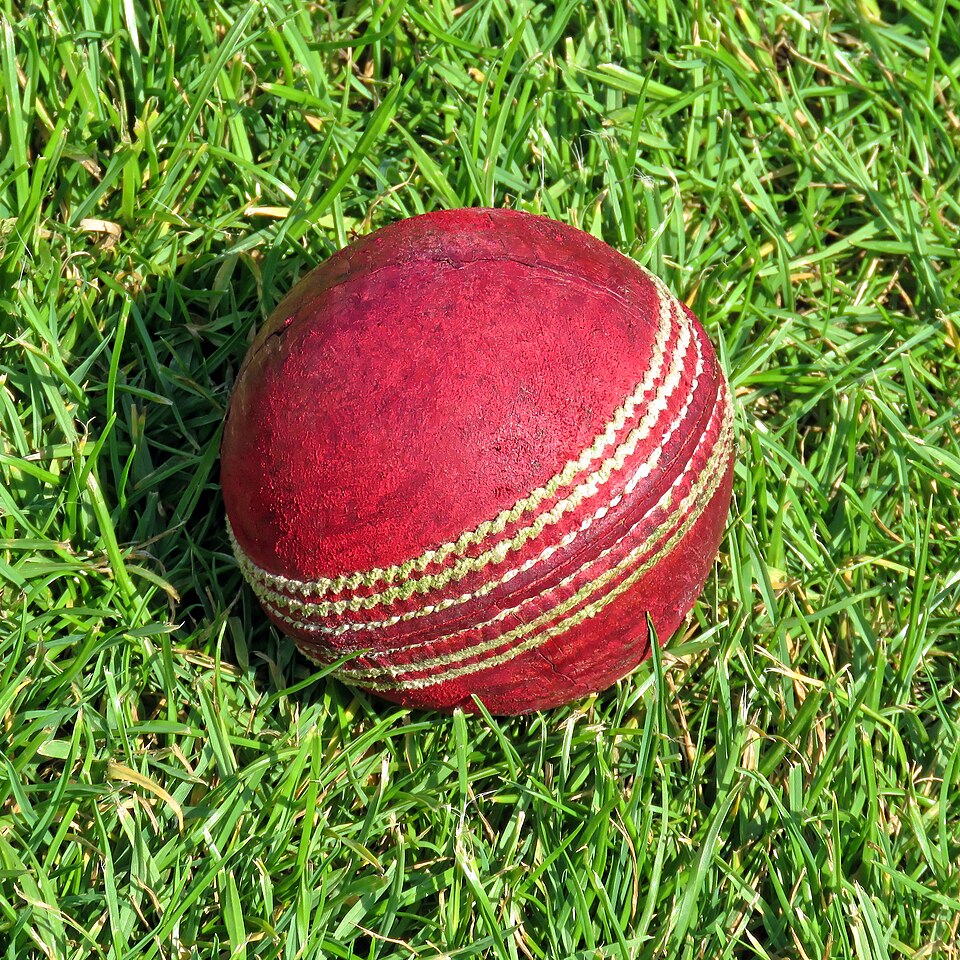
Correct: D, A cricket ball. Inertia is the reluctance of a body to change its state of rest or of uniform motion, and the quantity that measures it is mass. So the question is simply asking which of the four is heaviest. A cricket ball has a mass of roughly a sixth of a kilogram, a one-rupee coin only a few grams, and an atom or a molecule a mass so small it is written in units of ten to the power minus twenty-six kilograms. The cricket ball wins by a wide margin, so it has the greatest inertia.
Why the others are wrong
- (a)An atom: An atom's mass is of the order of ten to the power minus twenty-six kilograms: the smallest of the four by an enormous factor, so it has the least inertia, not the most.
- (b)A molecule: A molecule is built from atoms, so it is heavier than a single atom of the same element but still vanishingly light beside anything you can hold. It cannot be the maximum.
- (c)A one-rupee coin: A coin is the runner-up here, and that is what makes it the tempting choice, but it is a matter of a few grams against the cricket ball's roughly one hundred and sixty. The heavier body has the greater inertia.
Concept
Newton's first law says a body continues in its state of rest or of uniform motion in a straight line unless an external force acts on it. That built-in resistance to any change of state is inertia, and its measure is the mass of the body. Mass is therefore called inertial mass, and it is the same quantity that appears as the constant of proportionality in force equals mass times acceleration. Mass does not change with location; weight, which is the pull of gravity on that mass, does.
The whole item collapses to one substitution: read 'inertia' as 'mass' and then rank the four objects. It is worth naming the three faces of inertia that textbooks distinguish, because NDA asks about each of them. Inertia of rest is why a passenger jerks backwards when a bus starts. Inertia of motion is why he pitches forward when it brakes, and why dust flies off a beaten carpet. Inertia of direction is why mud from a spinning wheel leaves along a tangent. All three are the same property expressed in different circumstances, and in all three the heavier body is the harder one to disturb.
Key facts
- Inertia is measured by mass; the greater the mass, the greater the inertia.
- An official cricket ball has a mass between about 156 and 163 grams under the Laws of Cricket.
- Atomic and molecular masses are of the order of ten to the power minus twenty-six kilograms.
- Newton's first law is also called the law of inertia, and it defines what a force does rather than assuming it.
- Mass is the same everywhere, whereas weight changes with the local value of gravity.
Study next
Common traps
- Reading inertia as something to do with speed rather than with mass.
- Confusing inertia with weight and then worrying about where the object is.
- Assuming that a moving object has more inertia than a stationary one of the same mass.
NDA asks either for the object of maximum or minimum inertia, or for the everyday situation that illustrates one of the three kinds.
Related PYQs
Weight and mass of an object are defined with Newton's laws of motion. Which among the following is true?
- (a) Weight is a constant of proportionality.
- (b) Mass is a constant of proportionality.
- (c) Mass is not a constant of proportionality.
- (d) Weight is a universal constant.
Answer(b) Mass is a constant of proportionality.
The formal statement of what this item tests intuitively. Mass is the constant that ties force to acceleration, so the larger it is the harder the body is to disturb.
When a force of 1 newton acts on a mass of 1 kg which is able to move freely, the object moves in the direction of force with a/an
- (a) speed of 1 km/s
- (b) acceleration of 1 m/s²
- (c) speed of 1 m/s
- (d) acceleration of 1 km/s²
Answer(b) acceleration of 1 m/s²
The same relationship read the other way. Double the mass and the same force produces half the acceleration, which is inertia showing up as a number.
Practice
- practice, not a real PYQ
A passenger standing in a bus falls backwards when the bus suddenly starts moving. This is an example of
- (a)inertia of rest
- (b)inertia of motion
- (c)inertia of direction
- (d)centrifugal force
Answer(a) inertia of rest: the lower body moves with the bus while the upper body tends to stay at rest. - practice, not a real PYQ
Which of the following is the measure of the inertia of a body?
- (a)Its weight
- (b)Its volume
- (c)Its mass
- (d)Its speed
Answer(c) Its mass: mass is precisely the quantity that measures resistance to a change of state of motion.