
The Indian Railways have gone in for qualitative improvements since independence. Which of the following have taken place in recent years ? 1. Gauge conversion 2. Track electrification 3. Automatic signals Select the correct answer using the codes given below :
- (a)1 and 2 only
- (b)2 and 3 only
- (c)1 and 3 only
- (d)1, 2 and 3
Answer
Why
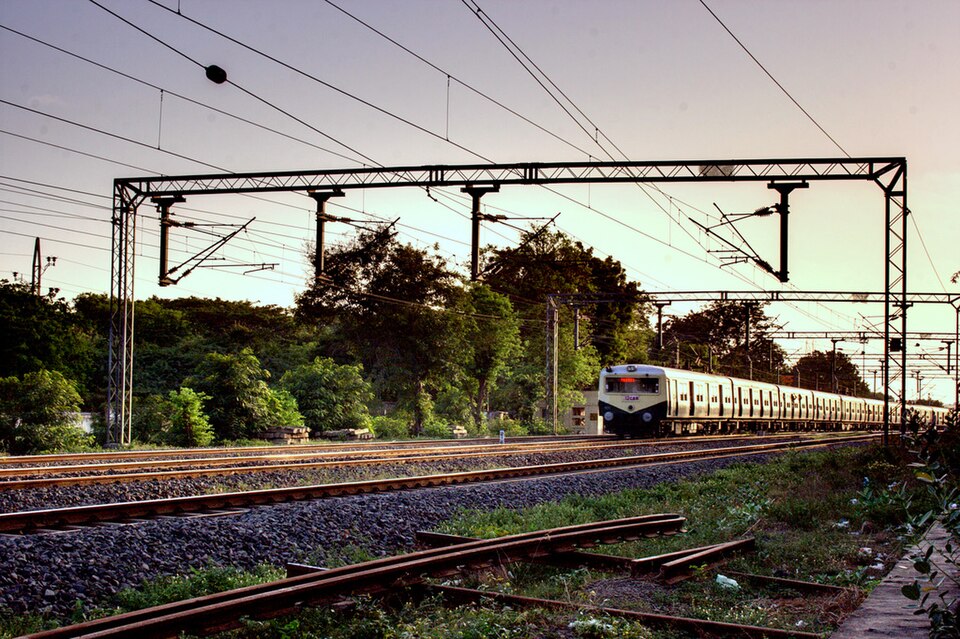
Correct: D, 1, 2 and 3. All three are genuine strands of the modernisation of Indian Railways. Gauge conversion has run under Project Unigauge since 1992, steadily replacing metre-gauge and narrow-gauge track with broad gauge so that rolling stock and traffic can move over one continuous network instead of being broken at every change of gauge. Track electrification has replaced steam and then diesel traction with overhead electric supply across the busiest routes, cutting fuel imports and raising haulage capacity. Automatic signalling has been extended over high-density sections, allowing several trains to occupy successive block sections behind one another rather than one train per long section, which raises the number of trains a line can carry. Since all three belong on the list, the answer is the option that includes every one.
Why the others are wrong
- (a)1 and 2 only: It correctly names gauge conversion and electrification but drops automatic signalling, which has been extended over the busy corridors and is one of the main ways of raising line capacity without laying new track.
- (b)2 and 3 only: It drops gauge conversion, which has been among the most visible of all the changes: Project Unigauge has been running since 1992 and has converted most of the metre-gauge network.
- (c)1 and 3 only: It drops electrification, which is if anything the most far-reaching of the three, since it changes the traction, the fuel bill and the emissions of the whole system.
Concept
Indian Railways inherited a network built by several companies to three different gauges, worked by steam and controlled by manual signalling. Modernisation since independence has run along three lines that this question names. Unigauge removes the transhipment penalty of a broken gauge. Electrification changes the source of motive power. Automatic signalling changes how closely trains may follow one another, which is a capacity question rather than a speed one.
Anchor the item to 2017 and note how far each strand has since gone. Electrification has advanced sharply, with the great majority of the broad-gauge route now under overhead wire, and an indigenous automatic train protection system called Kavach has been developed by the Research Designs and Standards Organisation for the same safety and capacity purpose that automatic signalling serves. A note on wording: a question that says 'in recent years' about a process running since 1992 is asking whether the strand is part of modernisation at all, not for a precise date, so treat each item on its substance.
Key facts
- Project Unigauge, begun in 1992, converts metre-gauge and narrow-gauge lines to broad gauge.
- Indian broad gauge is 1,676 millimetres wide.
- Automatic block signalling lets more than one train occupy successive block sections on the same line, raising capacity on busy routes.
- Electrification replaces diesel and steam traction with overhead electric supply, reducing fuel imports and emissions.
- Kavach, an indigenous automatic train protection system, was designed and developed by the Research Designs and Standards Organisation.
Study next
Common traps
- Excluding a true item because the phrase 'in recent years' makes you hunt for a date; the question is about what belongs to modernisation.
- Confusing automatic signalling, which is about capacity and safety, with automatic train operation.
- Assuming gauge conversion is complete; some heritage and hill lines remain on narrow gauge.
NDA sets railway questions both on geography, such as zones and headquarters, and on infrastructure and modernisation, as here.
Related PYQs
With reference to bio-toilets used by the Indian Railways, consider the following statements: 1. The decomposition of human waste in the bio-toilets is initiated by a fungal inoculum. 2. Ammonia and water vapour are the only end products in this decomposition which are released into the atmosphere. Which of the statements given above is/are correct?
- (a) 1 only
- (b) 2 only
- (c) Both 1 and 2
- (d) Neither 1 nor 2
Answer(d) Neither 1 nor 2
Another strand of the same modernisation programme, tested on its technical detail: the bio-toilet was the railways' answer to open discharge on the track, and its digestion is anaerobic and bacterial rather than fungal.
Consider the following statements about Kavach, the automatic train protection system : 1. It is designed and developed by Research Design and Standard Organisation (RDSO) in collaboration with Railway Technical Research Institute (RTRI), Japan 2. The trials of Kavach were facilitated by the Southern Railway 3. Kavach is a state-of-the-art electronic system with Safety Integrity Level-4 (SIL-4) Which of the statements given above is/are correct ?
- (a) 1 only
- (b) 3 only
- (c) 1 and 2 only
- (d) 1, 2 and 3
Answer(b) 3 only
Carries the signalling strand of this question forward six years: Kavach is the indigenous automatic train protection system built on the same aim of letting trains run closer together safely.
Practice
- practice, not a real PYQ
Project Unigauge of Indian Railways refers to
- (a)electrification of all broad-gauge routes
- (b)conversion of metre-gauge and narrow-gauge lines to broad gauge
- (c)introduction of a single ticketing system
- (d)standardisation of coach design
Answer(b) conversion of metre-gauge and narrow-gauge lines to broad gauge: begun in 1992. - practice, not a real PYQ
The main advantage of automatic block signalling on a busy railway route is that it
- (a)increases the maximum speed of every train
- (b)allows more trains to run on the same line
- (c)removes the need for locomotive drivers
- (d)reduces the cost of electrification
Answer(b) allows more trains to run on the same line: successive block sections can be occupied by trains following one another.