
Which one of the following is the scientific name of the causal organism of elephantiasis ?
- (a)Ascaris lumbricoides
- (b)Culex pipiens
- (c)Wuchereria bancrofti
- (d)Fasciola hepatica
Answer
Why
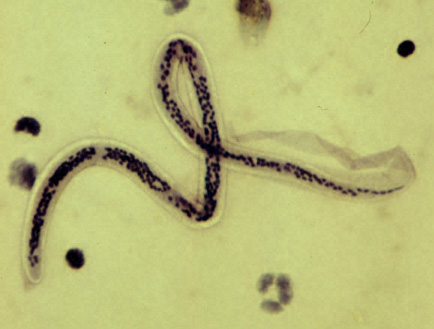
Correct: C, Wuchereria bancrofti. Elephantiasis is the visible late stage of lymphatic filariasis, and Wuchereria bancrofti is the filarial nematode responsible for about nine cases in ten worldwide; Brugia malayi and Brugia timori cause the rest. The adult worms live in the lymphatic vessels, where over years they obstruct and damage the flow of lymph. Fluid then accumulates in the tissues of the leg, arm, breast or scrotum, the skin thickens and hardens, and the limb takes on the coarse, swollen appearance that gives the disease its name. The immature forms, called microfilariae, circulate in the blood, most abundantly at night, which is when the mosquito that carries them feeds.
Why the others are wrong
- (a)Ascaris lumbricoides: This is the large intestinal roundworm, also a nematode, but it lives in the small intestine and is taken in with food or water contaminated by its eggs. It causes ascariasis, with abdominal pain and malnutrition, not lymphatic blockage.
- (b)Culex pipiens: This is the vector and not the parasite, which is the trap the item is built on. A Culex mosquito carries the microfilariae from one person to the next, but the organism that actually causes the disease is the worm it delivers.
- (d)Fasciola hepatica: Fasciola hepatica is the sheep liver fluke, a flatworm rather than a roundworm, and it lodges in the bile ducts of the liver. It reaches humans through aquatic plants such as watercress and has nothing to do with the lymphatic system.
Concept
A great many tropical diseases are transmitted by an insect but caused by something else, and examiners test the difference constantly. Malaria is caused by Plasmodium and carried by female Anopheles; dengue is caused by a virus and carried by Aedes aegypti; lymphatic filariasis is caused by Wuchereria bancrofti and carried mainly by Culex quinquefasciatus in India. In each pair the causal organism is the parasite or virus, and the mosquito is only the vehicle.
Read the stem for the words 'causal organism'. Once you have, Culex can be set aside at once, because a mosquito never causes a disease of this kind. Of the three worms left, connect each to its organ (Ascaris to the intestine, Fasciola to the liver, Wuchereria to the lymphatics) and only one of them can produce a swollen limb. As of the 2017 exam India was running mass drug administration against filariasis under the national programme; that effort has continued, with a triple-drug regimen introduced later, and India remains one of the countries carrying the largest share of the world's cases.
Key facts
- Lymphatic filariasis is caused by the nematodes Wuchereria bancrofti, Brugia malayi and Brugia timori.
- Wuchereria bancrofti accounts for roughly ninety per cent of cases worldwide.
- Adult worms live in the lymphatic vessels; the microfilariae circulate in the blood and are most numerous at night.
- Mosquitoes of the genera Culex, Anopheles, Aedes and Mansonia transmit the parasite; in India Culex quinquefasciatus is the main vector.
- Ascaris lumbricoides is the intestinal roundworm and Fasciola hepatica the liver fluke of sheep.
Study next
Common traps
- Naming the mosquito when the question asks for the causal organism.
- Confusing filarial worms with the intestinal roundworm Ascaris; both are nematodes but they live in different places.
- Assuming a fluke such as Fasciola is a roundworm; it is a flatworm.
NDA asks for the scientific name of the causal organism and always plants the vector among the options, so the reading of the stem decides the mark.
Related PYQs
Consider the following statements: I. Tapeworm is a hermaphrodite. II. Round-worm has separate sexes. III. Filaria is caused by a nematode. IV. Guinea worm is an annelid. Which of these are correct?
- (a) I and II
- (b) I, II and III
- (c) III and IV
- (d) II, III and IV
Answer(b) I, II and III: the guinea worm is a nematode, not an annelid, so statement IV fails.
Places filaria in its phylum explicitly: statement III says the disease is caused by a nematode, which is exactly why the answer here has to be the worm and not the mosquito.
Practice
- practice, not a real PYQ
The main mosquito vector of lymphatic filariasis in India belongs to the genus
- (a)Culex
- (b)Anopheles
- (c)Aedes
- (d)Sandfly
Answer(a) Culex: Culex quinquefasciatus is the principal Indian vector, while Anopheles carries malaria and Aedes carries dengue. - practice, not a real PYQ
Fasciola hepatica is a parasite of which organ?
- (a)The liver and its bile ducts
- (b)The lymphatic vessels
- (c)The small intestine
- (d)The lungs
Answer(a) The liver and its bile ducts: it is the sheep liver fluke, a flatworm, quite different from the filarial nematode of this question.